

The meaning of Buddhist bracelets extends far beyond mere decoration. These sacred accessories carry thousands of years of spiritual heritage and meditation wisdom. Serving as a physical bridge between the wearer and the teachings of the Buddha, these pieces help us maintain mindfulness in daily life, attract positive energy, and shield the mind from negative influences.
Whether you are a practicing Buddhist or simply someone seeking inner peace in a chaotic world, a Buddhist bracelet can become a faithful companion on your spiritual journey. This comprehensive guide explores the deep symbolism, material choices, color meanings, knotting techniques, and wearing practices of Buddhist bracelets, helping you choose the perfect piece for your personal path.
What Is a Buddhist Bracelet? – Definition, Origins, and Core Features
Definition and Primary Purpose
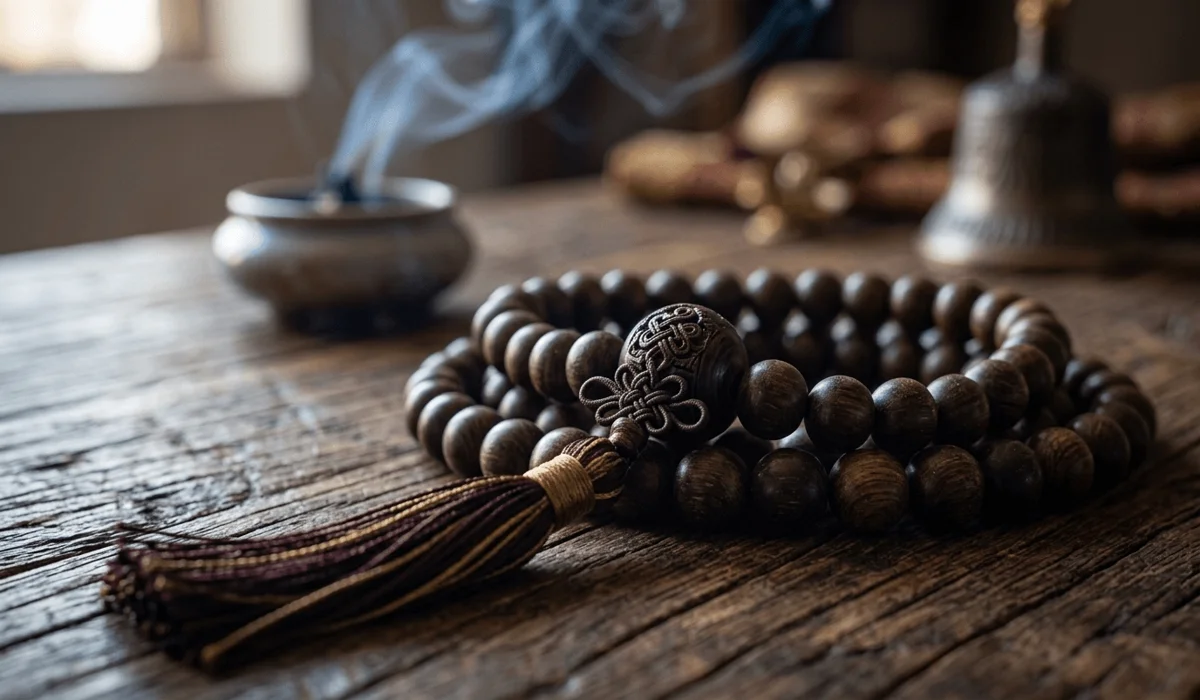
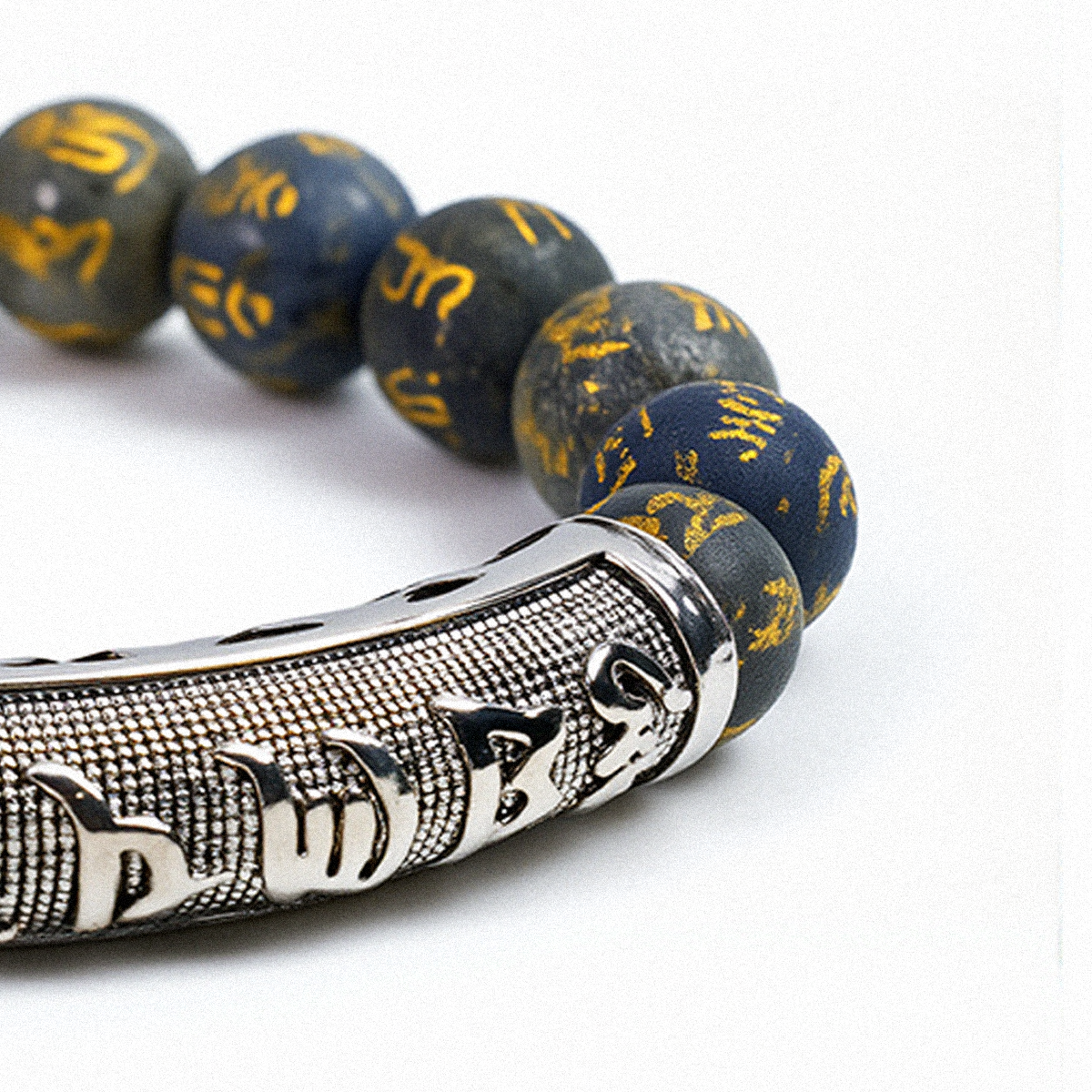
A Buddhist bracelet, known in Sanskrit as "Mala" (念珠), is a traditional spiritual tool used for meditation and mantra counting. Practitioners move their thumb over each bead while reciting a mantra, training their focus and anchoring themselves in the present moment.
In modern times, Buddhist bracelets have transcended religious boundaries to become mindfulness jewelry. They serve as a constant reminder to cultivate inner peace, compassion, and wisdom in everyday life.
Historical Origins
The origins of Buddhist prayer beads can be traced back over 3,000 years to ancient India and Tibet. Monks and practitioners initially used natural materials such as seeds, wood, or bone to create these sacred tools.
According to the Continued Biographies of Eminent Monks (续高僧传) from the Tang Dynasty, Buddhist malas have been used in China for over a millennium. One famous account tells of King Virudhaka, who suffered from anxiety due to the burdens of state affairs. Seeking a simple practice to calm his mind, he approached the Buddha, who taught him to string 108 seeds of the soapberry tree (Sapindus mukorossi) into a mala. The king was instructed to recite the Buddha's name while moving his thumb across each bead whenever anxiety arose. This became one of the earliest recorded origins of Buddhist prayer beads.
Basic Structure
A standard Buddhist bracelet typically includes the following core elements:
| Component | Description | Spiritual Meaning |
|---|---|---|
| Main Beads | Small beads forming the body of the mala | Represent each step of practice, aiding in mantra counting |
| Guru Bead (Mother Bead) | A larger bead, usually at the end of the mala | Symbolizes the teacher (Guru) or the Buddha himself, representing wisdom and guidance |
| Counting Knots | Small knots separating bead sections | Facilitate segment-by-segment counting during long meditation sessions |
| Tassel | Decorative silk or cord below the Guru Bead | Represents the continuation and perfection of wisdom |
The Spiritual Significance of Bead Counts
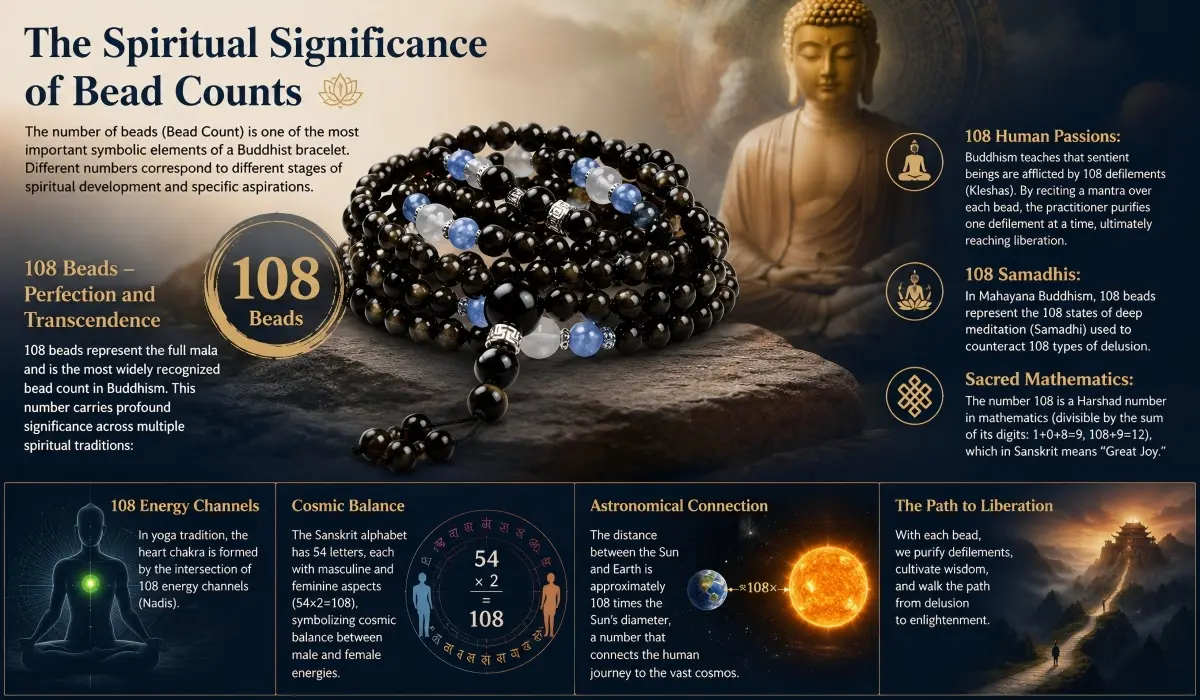
The number of beads (Bead Count) is one of the most important symbolic elements of a Buddhist bracelet. Different numbers correspond to different stages of spiritual development and specific aspirations.
108 Beads – Perfection and Transcendence
108 beads represent the full mala and is the most widely recognized bead count in Buddhism. This number carries profound significance across multiple spiritual traditions:
-
108 Human Passions: Buddhism teaches that sentient beings are afflicted by 108 defilements (Kleshas). By reciting a mantra over each bead, the practitioner purifies one defilement at a time, ultimately reaching liberation.
-
108 Samadhis: In Mahayana Buddhism, 108 beads represent the 108 states of deep meditation (Samadhi) used to counteract 108 types of delusion.
-
Sacred Mathematics:
-
The number 108 is a Harshad number in mathematics (divisible by the sum of its digits: 1+0+8=9, 108÷9=12), which in Sanskrit means "Great Joy."
-
In yoga tradition, the heart chakra is formed by the intersection of 108 energy channels (Nadis).
-
The Sanskrit alphabet has 54 letters, each with masculine and feminine aspects (54×2=108), symbolizing cosmic balance between male and female energies.
-
-
Astronomical Connection: The distance between the Sun and Earth is approximately 108 times the Sun's diameter, a number that connects the human journey to the vast cosmos.
Other Common Bead Counts and Their Meanings
| Bead Count | Symbolic Meaning | Best Use |
|---|---|---|
| 27 Beads | One-fourth of 108, representing the ten grounds, ten paramitas, and Buddhahood | Daily wear, short meditation sessions |
| 21 Beads | Ten grounds, ten paramitas, plus Buddhahood, or representing 21 forms of emptiness | Daily mantra recitation, travel |
| 18 Beads | The eighteen realms (six sense organs, six objects, and six consciousnesses), or the 18 Arhats | Wrist mala, convenient for daily wear |
| 54 Beads | The ten faiths, ten abodes, ten practices, ten dedications, ten grounds, and four good roots | Medium-length mala for longer meditation |
Regardless of bead count, the core purpose remains the same: helping the practitioner calm the mind and abide in the present moment.
Video source:YouTube
Author:Teresa @ Malaology
Original video link:https://www.youtube.com/watch?v=U2tYEBsofoU
Color Symbolism in Buddhist Bracelets – A Guide to Color Energy
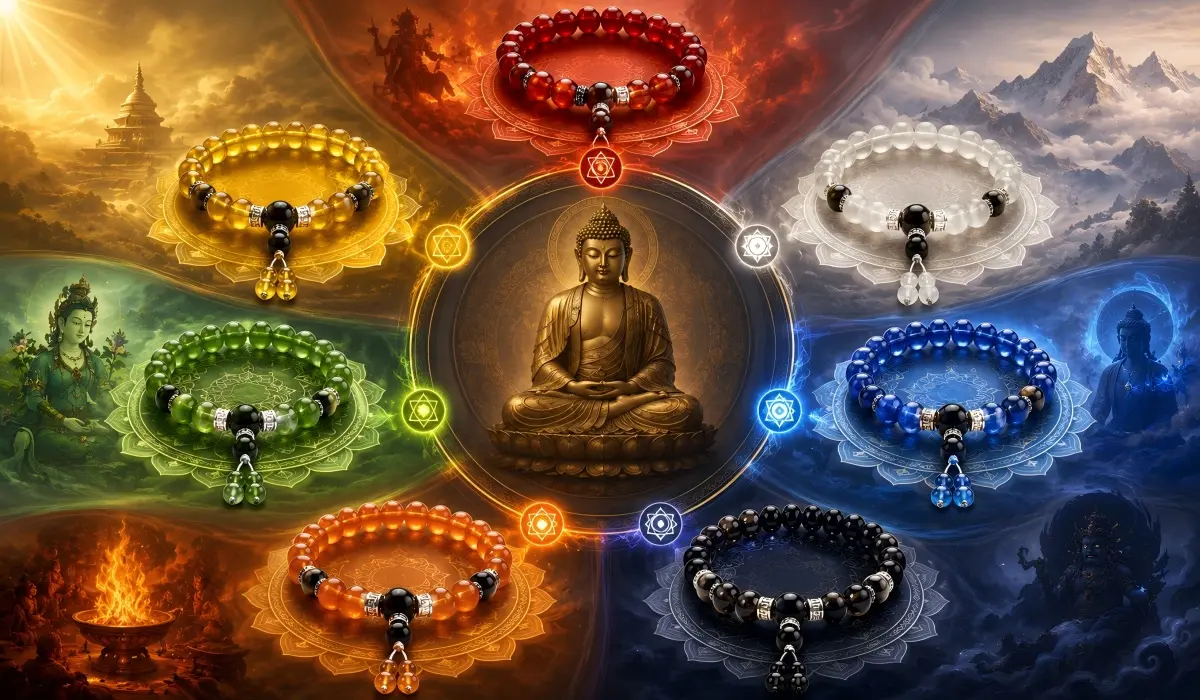
Colors in Buddhist bracelets carry specific energy frequencies and spiritual vibrations. In Tibetan Buddhism, each color corresponds to a particular chakra, emotional state, and practice objective.
The Five Colors – The Light of Buddha's Enlightenment
According to Tibetan Buddhist scriptures, the Buddha radiated five distinct colors (Pancha-varna) at the moment of enlightenment: Blue, Yellow, Red, White, and Orange.
| Color | Spiritual Meaning | Corresponding Chakra | Best For |
|---|---|---|---|
| Red | Life Force, Protection, Courage. Red is the most powerful protective color in Tibetan Buddhism, often used in blessed cords to guard the wearer | Root Chakra | Protection, enhancing vitality, attracting good fortune |
| Yellow/Gold | Wisdom, Humility, Renunciation. Yellow is the color of monastic robes, symbolizing the pursuit of Dharma and enlightenment | Solar Plexus Chakra | Cultivating wisdom, focusing on studies, developing humility |
| White | Purity, Spiritual Clarity, Liberation. Symbolizes the pure mind free from ignorance and defilement | Crown Chakra | Purifying karma, new beginnings, spiritual elevation |
| Blue | Healing, Wisdom, Infinite Space. Closely associated with the Medicine Buddha, representing boundless awareness | Throat/Third Eye Chakra | Physical and emotional healing, deep meditation, calming the mind |
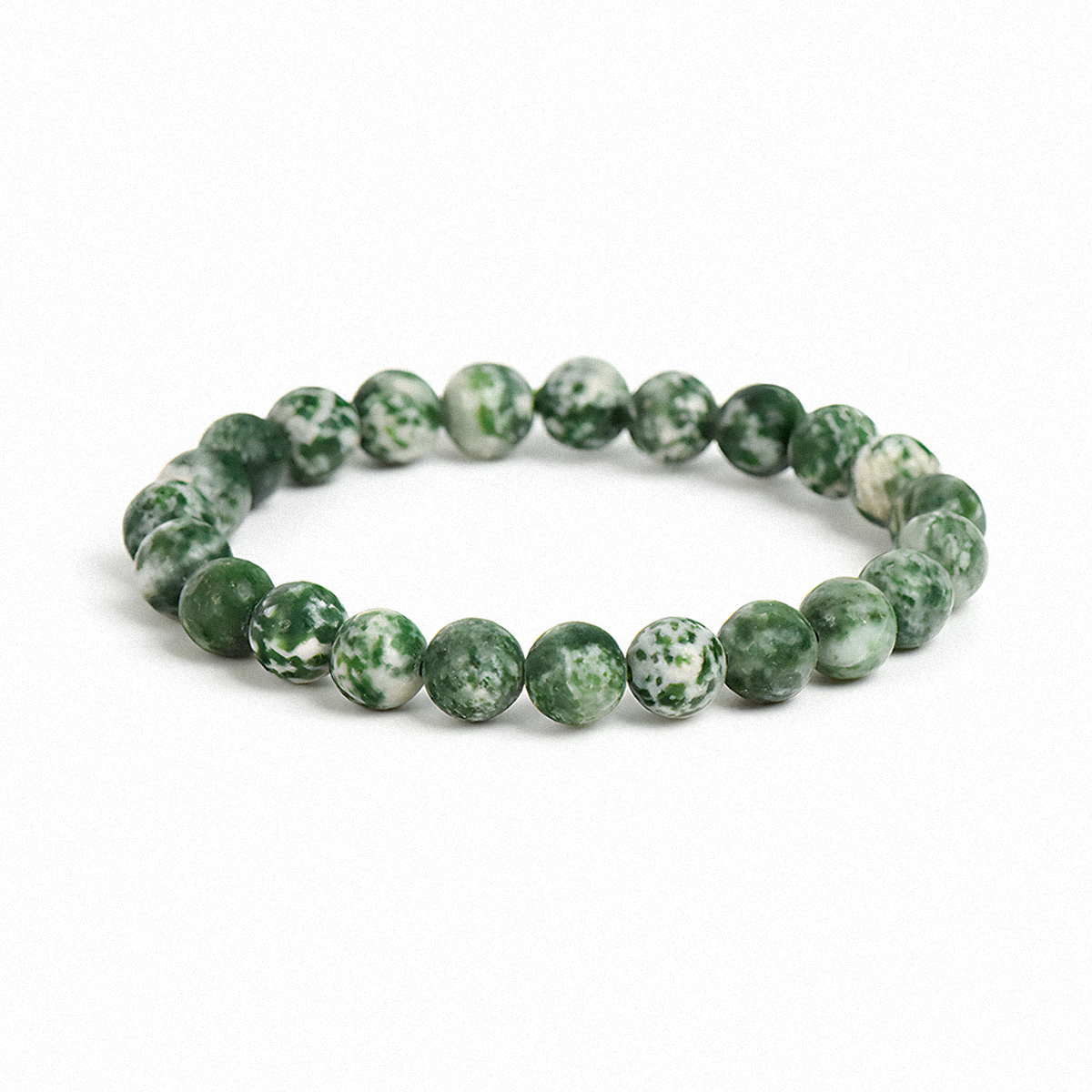
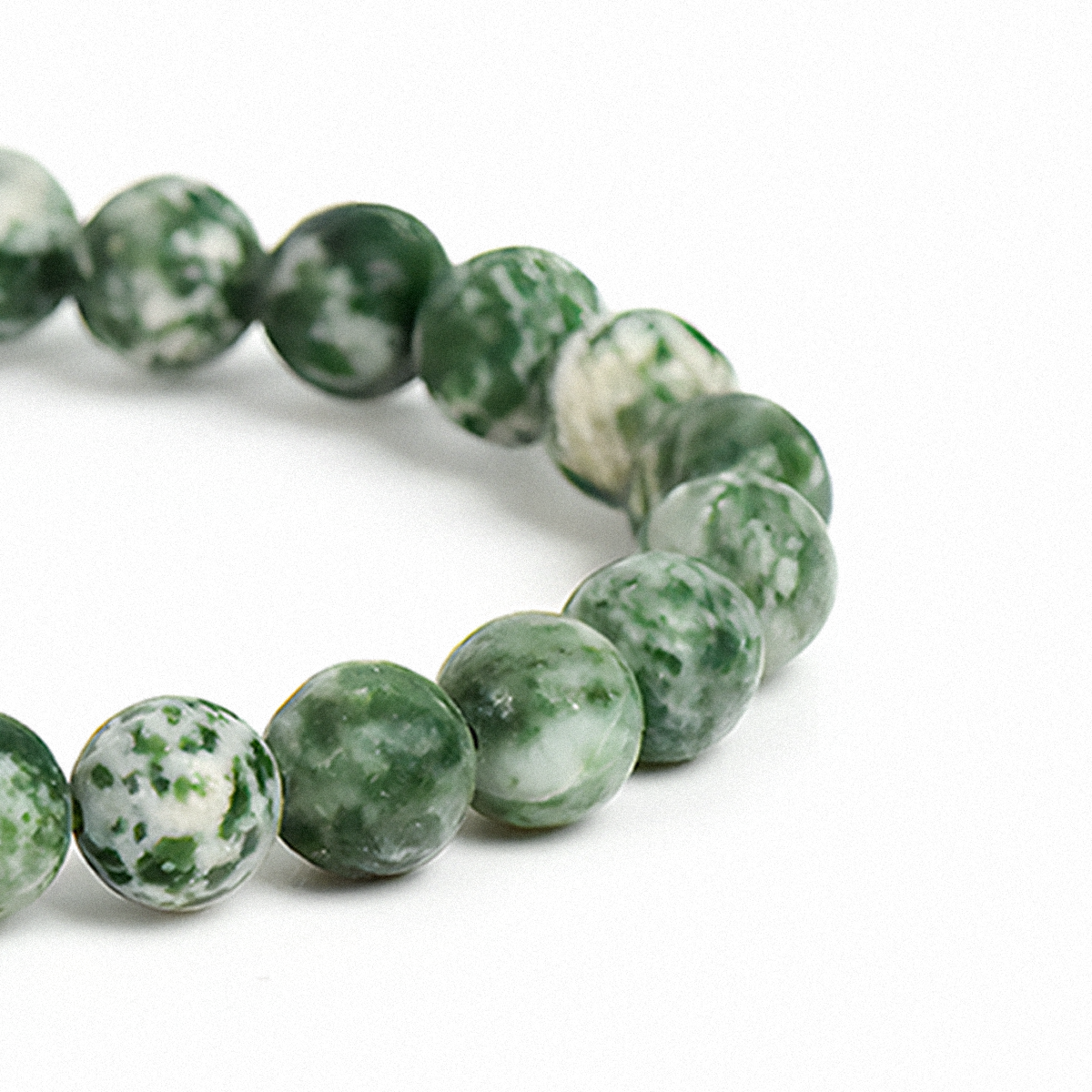
| Green | Balance, Harmony, Compassionate Action. Associated with Green Tara, symbolizing swift compassionate action to benefit all beings | Heart Chakra | Emotional balance, cultivating compassion, personal growth |
| Orange | Transformation, Vitality. Associated with fire rituals in Tibetan Buddhism, symbolizing the burning away of ignorance | Sacral Chakra | Transforming negative energy, stimulating creativity |
| Black/Dark Blue | Protection, Absorption of Negative Energy. Materials like obsidian are believed to have powerful spiritual shielding properties | Root Chakra | Clearing negative energy, deep purification, grounding |
The Five-Colored Cord and the Five Dhyani Buddhas
In some mala designs, a five-colored cord (green, yellow, red, white, black) is used. This represents the Five Dhyani Buddhas: Vairocana, Akshobhya, Ratnasambhava, Amitabha, and Amoghasiddhi. It also symbolizes the balance of the five elements (wood, fire, earth, metal, water).
Sacred Knots – The Spiritual Code of Hand-Knotted Designs
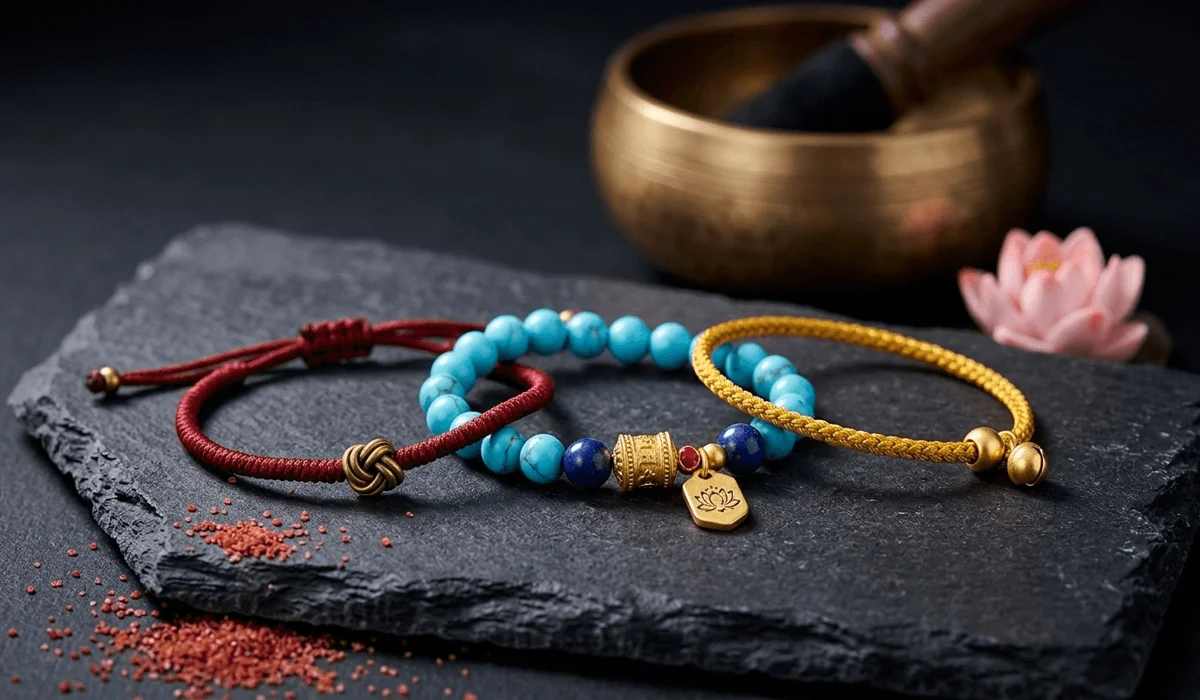
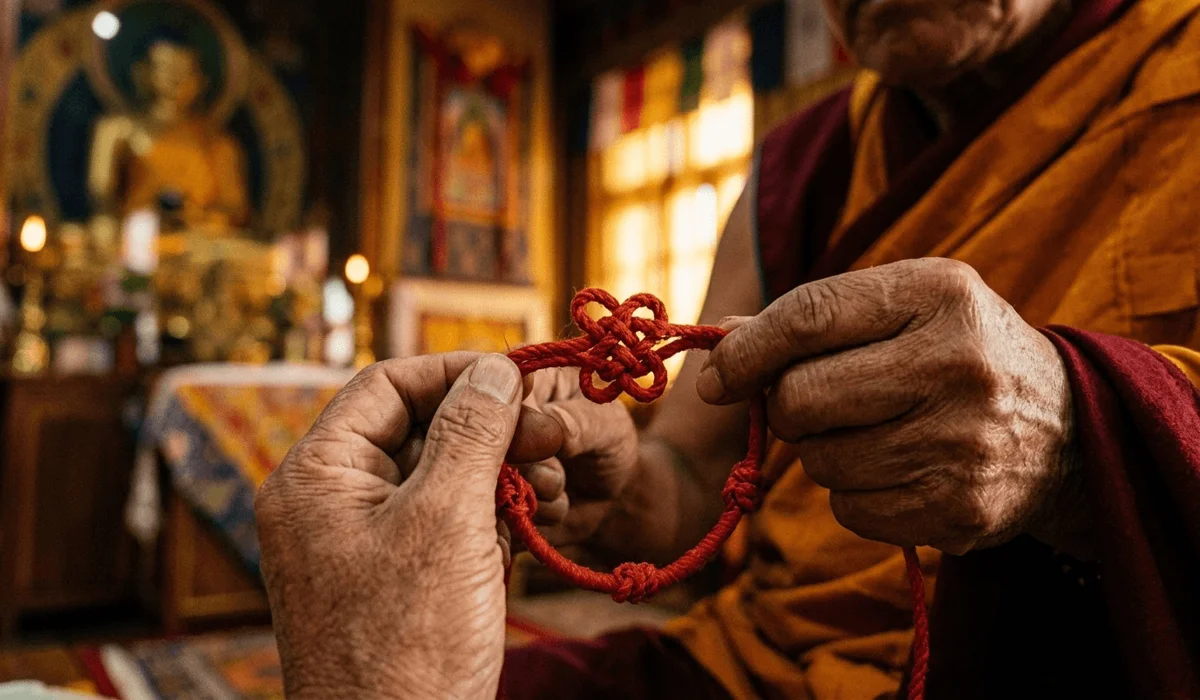
Knots are not merely decorative; they represent the binding and sealing of spiritual energy within the piece. Many Tibetan Buddhist bracelets are hand-knotted by monks or practitioners while reciting mantras. Each knot becomes a physical manifestation of a prayer.
The Meaning of 7-Knot Bracelets
The 7-knot bracelet is one of the most popular protective designs worldwide. Its spiritual significance includes:
-
The Seven Medicine Buddhas: Each knot corresponds to one of the Seven Medicine Buddhas, bestowing health and healing energy upon the wearer.
-
The Seven Factors of Enlightenment: Mindfulness, Investigation, Energy, Joy, Tranquility, Concentration, and Equanimity – the seven stages of spiritual cultivation.
-
Seven Layers of Protection: Each knot forms a spiritual shield that blocks obstacles and negative energy.
"Every knot is tied while chanting sacred mantras," says a Tibetan artisan. "They are like sealed blessings that accompany the wearer throughout their day."
The Eternal Knot – Infinite Wisdom and Compassion
The Eternal Knot is the most renowned auspicious symbol in Tibetan Buddhism. Its endless geometric pattern symbolizes:
-
The Buddha's infinite wisdom and compassion
-
Samsara – the cycle of birth, death, and rebirth
-
The interconnectedness of all phenomena (dependent origination)
-
The perfect union of wisdom and compassion
Materials and Their Spiritual Properties
The material of a Buddhist bracelet directly affects its energetic properties and spiritual effects. Different materials suit different practice goals and personal needs.
| Material | Spiritual Properties | Best For |
|---|---|---|
| Sandalwood | Calming, Clarity, Meditation Enhancement. The natural fragrance of sandalwood helps the nervous system enter a relaxed state | Meditation, stress relief, focus enhancement |
| Bodhi Seed | Awakening, Enlightenment. The Bodhi tree is where the Buddha attained enlightenment, making these seeds the most traditional choice for malas | Spiritual practice, deep meditation, making vows |
| Obsidian | Psychic Shielding, Emotional Clearing. Volcanic glass, considered one of the most powerful protective stones since ancient times | Protection, aura cleansing, dissolving negative energy |
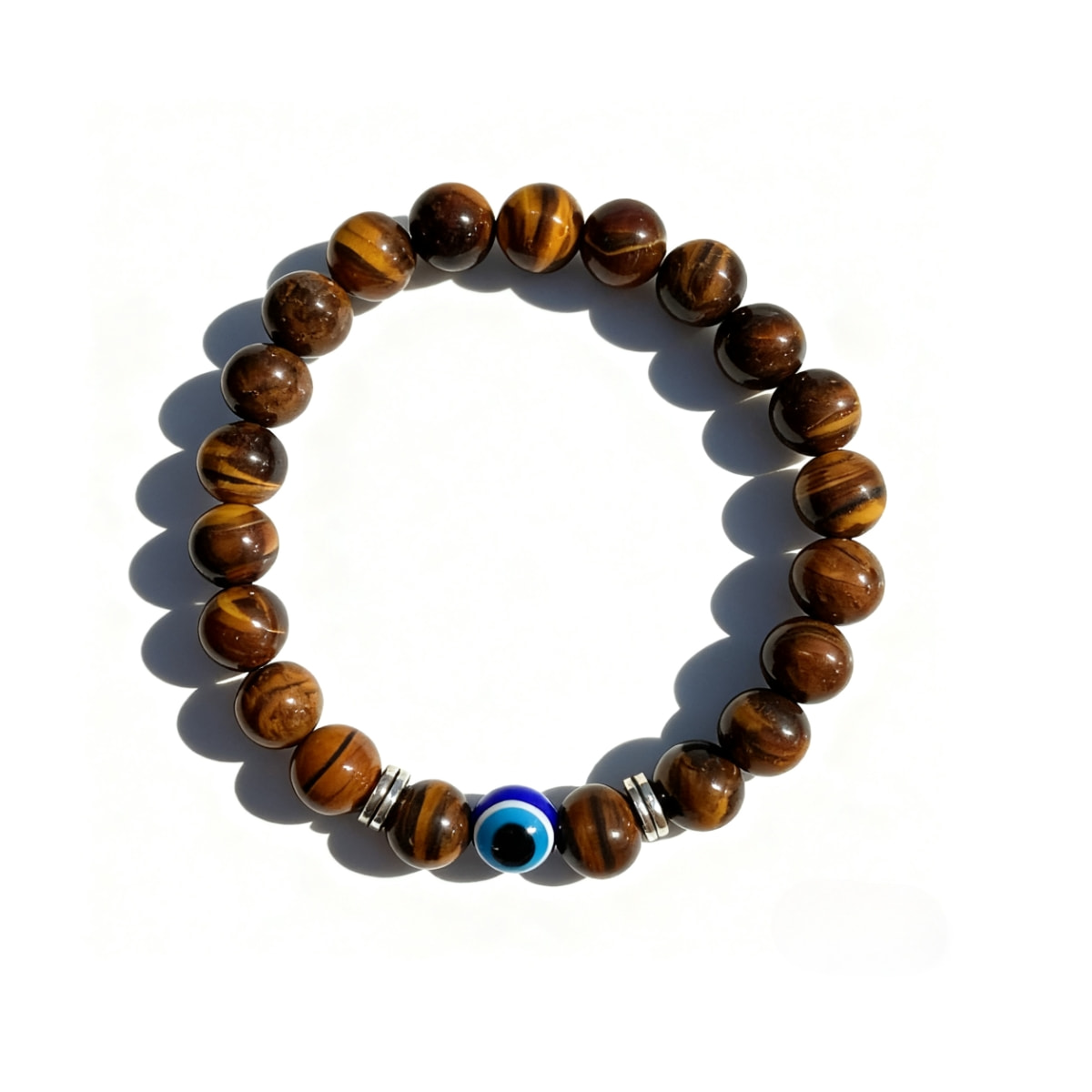
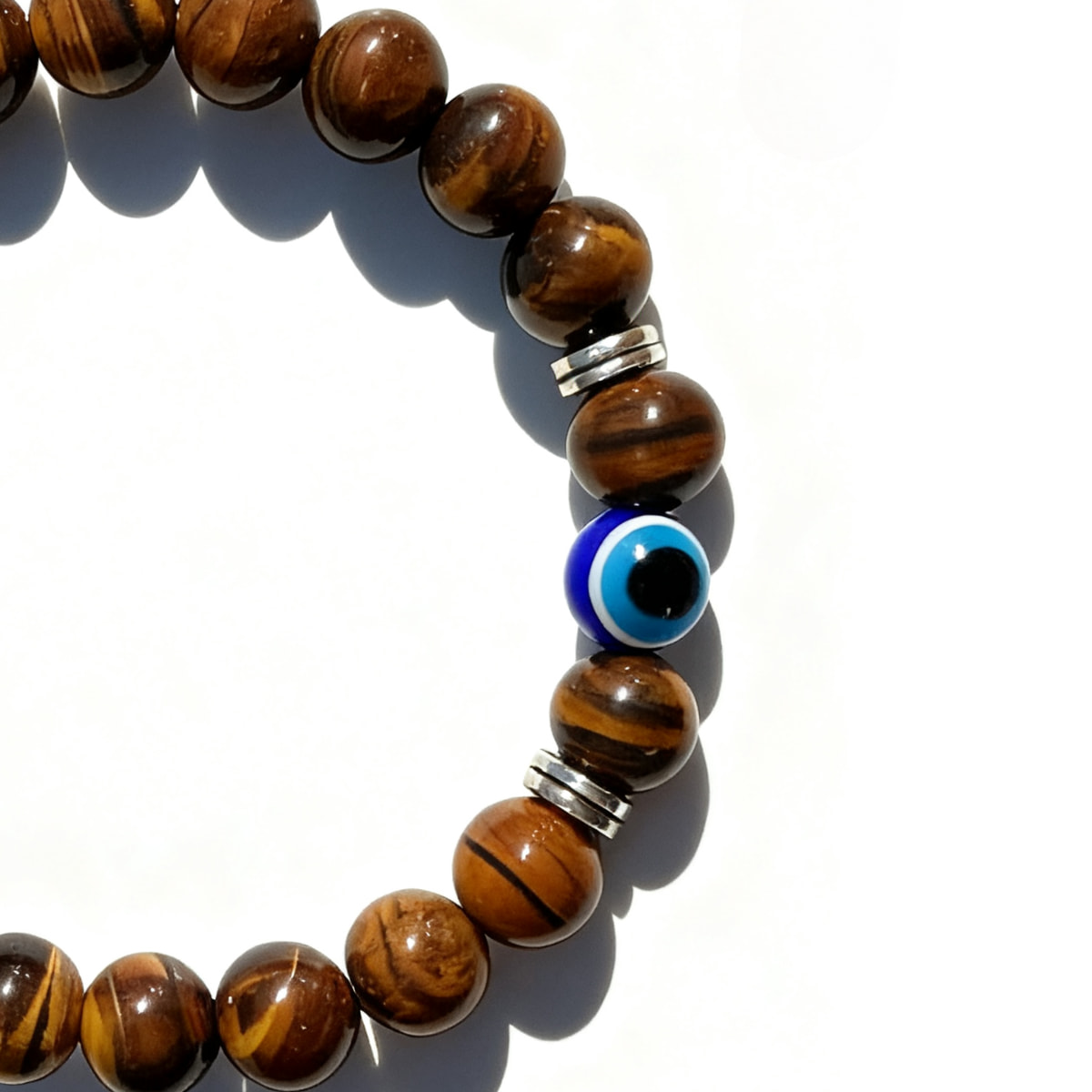
| Tiger's Eye | Courage, Focus, Protection. Combines solar energy with earth energy to stabilize confidence | Building self-confidence, daily protection, enhancing decisiveness |
| Copper | Energy Conduction, Healing, Fortune Attraction. In Tibetan tradition, copper is believed to conduct spiritual energy | Energy circulation, joint health, overall wellness |
| Hematite | Grounding, Stability, Mental Clarity. Helps calm the mind and alleviate anxiety | Anxiety relief, focus enhancement, centering |
| Bone Beads | Contemplation of Impermanence. Beads made from materials like yak bone remind practitioners of life's transient nature | Contemplating impermanence, deepening understanding of life's essence |
Buddhist Bracelets and the Seven Chakras
The seven chakras are the primary energy centers of the human body. Buddhist bracelets are often designed in conjunction with chakra theory to help wearers achieve energetic balance.
| Chakra | Location | Significance | Corresponding Color |
|---|---|---|---|
| Root Chakra (Muladhara) | Base of spine | Survival needs, security, stability | Red |
| Sacral Chakra (Svadisthana) | Lower abdomen | Emotional balance, creativity, sexuality | Orange |
| Solar Plexus (Manipura) | Above navel | Willpower, determination, self-worth | Yellow |
| Heart Chakra (Anahata) | Center of chest | Unconditional love, compassion, acceptance | Green |
| Throat Chakra (Vishudha) | Throat | Communication, creativity, truth | Blue |
| Third Eye (Ajna) | Between eyebrows | Wisdom, intuition, insight | Indigo |
| Crown Chakra (Sahasrara) | Top of head | Spiritual awakening, connection to the universe | Purple/White |
A 7 Chakra Bracelet combines natural crystals with skin contact to help harmonize the seven energy centers, thereby reducing stress, enhancing well-being, and improving relationships.
How to Wear – The Energy Logic of Left vs. Right Hand
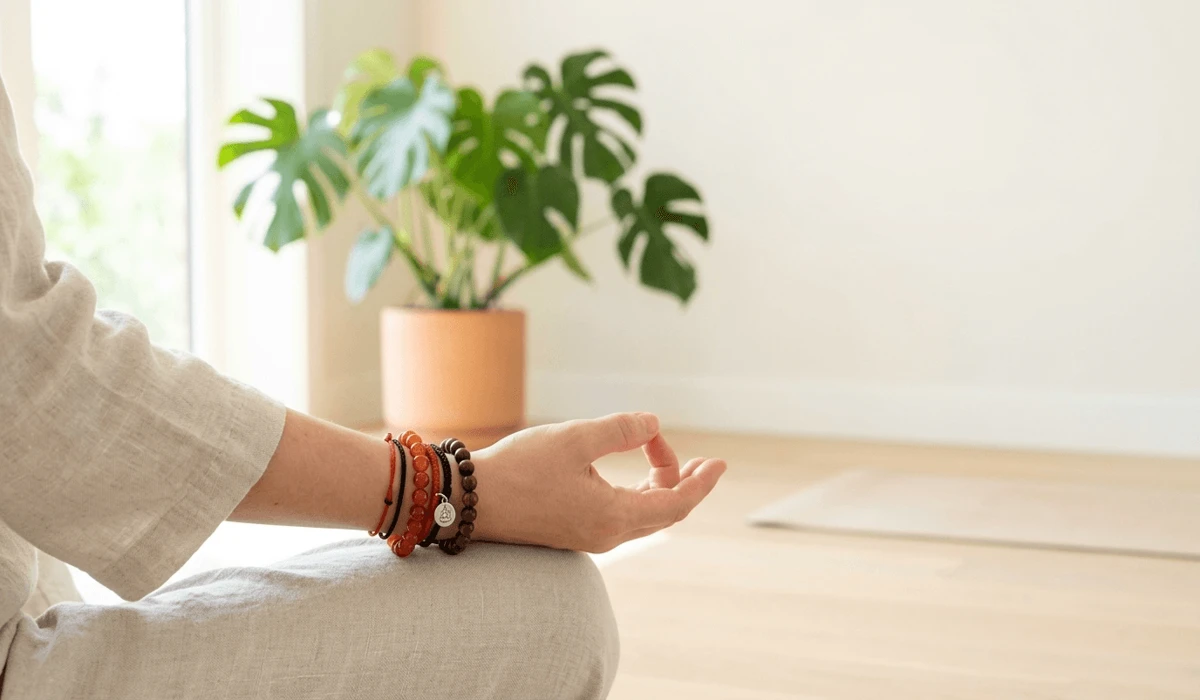
The choice of which wrist to wear a Buddhist bracelet on carries specific meaning in spiritual traditions. This logic is based on how energy flows through the human body.
Left Hand – Receiving Energy
The left hand is considered the receiving side of the body in spiritual practices. In yoga and energy healing traditions, it is associated with feminine Yin energy.
-
Wearing a bracelet on the left wrist helps you absorb the positive energy, blessings, and spiritual guidance of the mala.
-
This wearing style is ideal for those seeking healing, calmness, and focused meditation.
Right Hand – Projecting Energy
The right hand is considered the projecting side, associated with masculine Yang energy.
-
Wearing a bracelet on the right wrist helps you project outward your energy for manifestation, protection, and influencing the external environment.
-
This style suits goal setting, career advancement, and projecting compassionate intentions toward others.
Practical Tip: Many practitioners switch wrists according to their daily needs. Wearing it on the left during morning meditation and on the right during work hours is a flexible and effective approach.
Video source:YouTube
Author:Spiritual Universe Unlocked
Original video link:https://www.youtube.com/watch?v=v50vXsYMaow
Buddhist Bracelet vs Similar Spiritual Jewelry
Buddhist Bracelets vs Feng Shui Bracelets
While they may look similar, their goals and symbol systems are fundamentally different.
| Feature | Buddhist Bracelet | Feng Shui Bracelet |
|---|---|---|
| Primary Goal | Inner peace, spiritual growth, liberation from defilements | External wealth attraction, environmental harmony, luck enhancement |
| Common Symbols | Eternal Knot, Lotus, Buddha, Six-Syllable Mantra | PiXiu, Coins, Bagua |
| Primary Materials | Sandalwood, Bodhi seeds, natural crystals, copper | Citrine, Jade, obsidian |
| Blessing Method | Monk blessing through mantra recitation | Arranged according to Feng Shui theory, focusing on directions and element balance |
Buddhist Malas vs. Hindu Malas
Both traditions use the 108-bead count, but the mantras, deities, and philosophical frameworks differ.
| Feature | Buddhist Mala | Hindu Mala |
|---|---|---|
| Common Materials | Sandalwood, Bodhi seeds, bone beads, crystals | Rudraksha seeds, Tulsi wood |
| Guru Bead Symbolism | The Guru or the Buddha | Supreme Consciousness or Shiva |
| Common Mantras | Om Mani Padme Hum, Buddha's name | Om, Gayatri Mantra |
Who Is a Buddhist Bracelet Suitable For?
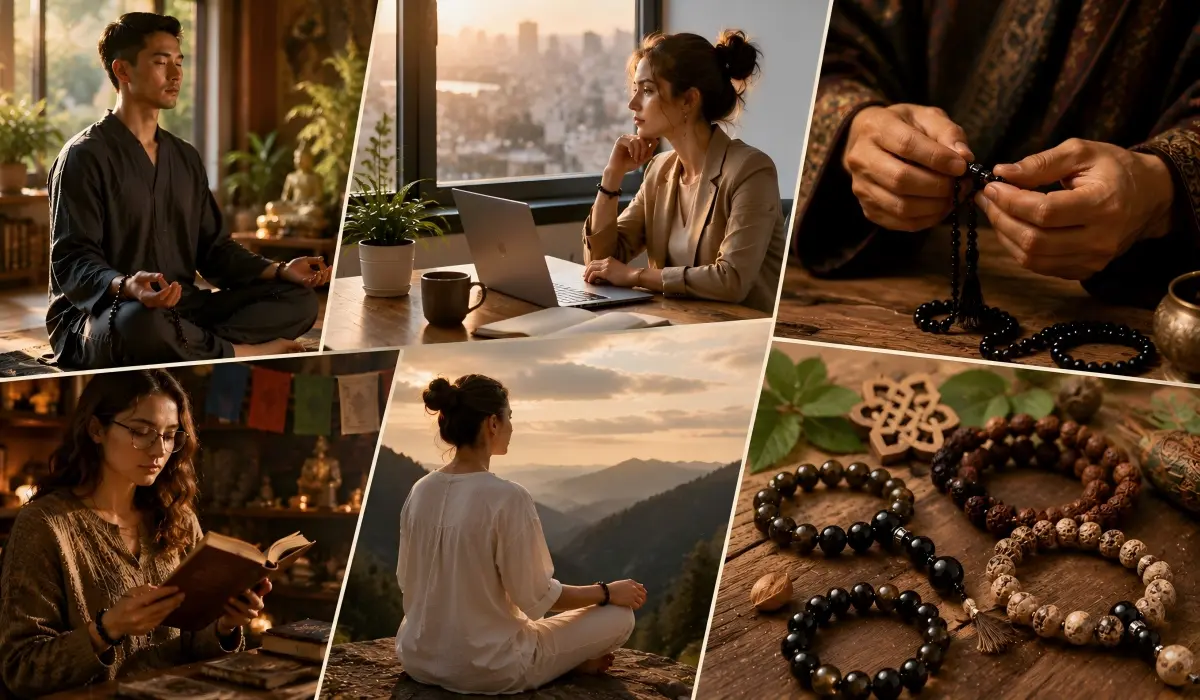
A Buddhist bracelet is a universal spiritual accessory. It does not require the wearer to be a Buddhist, but it does require respect and mindfulness.
Ideal for:
-
Meditators: Those who need a tool for mantra counting and focused meditation.
-
Mindfulness Seekers: Individuals in fast-paced lives who desire a tangible reminder to return to the present.
-
Cultural Enthusiasts: Those who appreciate Tibetan craftsmanship (e.g., hand-knotting, the Eternal Knot) and Eastern cultural heritage.
-
Personal Growth Seekers: Anyone wishing to cultivate patience, compassion, and wisdom in daily life.
-
Natural Material Lovers: People who prefer natural materials (wood, seeds, crystals) over synthetics.
On Reddit, user u/No_Spell_3561 shared how wearing a mala changed their energy:
"Something I didn't expect—my mantra practice felt different. More grounded. Like the beads were absorbing the intention."
*sources:[Does wearing a mala actually change something?](https://reddit.com/r/shaivism/comments/1thegch/does_wearing_a_mala_actually_change_something/)*
This experience shows that the bracelet becomes a partner in your spiritual work. It is an inclusive tool that welcomes anyone seeking clarity.
How to Cleanse, Charge, and Care for Your Buddhist Bracelet
Buddhist bracelets absorb the energy of the wearer and their environment. Regular cleansing and charging are essential to maintain their spiritual vibration.
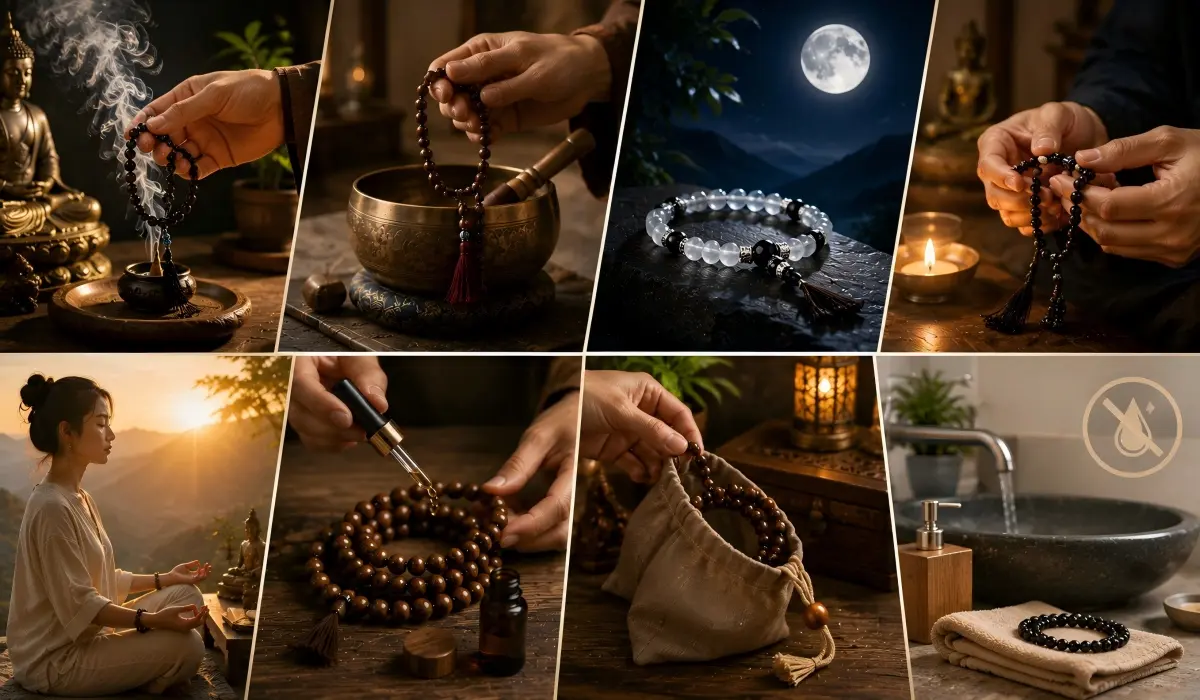
Cleansing Methods
-
Smoke Cleansing: Gently pass the bracelet through the smoke of sandalwood incense or sage to clear stagnant energy.
-
Sound Cleansing: Place the bracelet near a singing bowl; the sound vibrations wash over and harmonize the beads.
-
Moonlight Cleansing: Leave the bracelet under a full moon overnight, especially beneficial for crystal malas.
-
Mantra Cleansing: Hold the bracelet in both hands and recite a mantra (such as Om Mani Padme Hum) to infuse it with pure energy.
Charging Methods
-
Moonlight Charging: Expose the bracelet to the light of a full moon.
-
Morning Meditation Charging: During morning meditation, hold the bracelet in your palms and imbue it with your daily intention.
Daily Care
-
Avoid Water: Cotton or silk cord can weaken when wet. Remove the bracelet before swimming or showering.
-
Wooden Bead Care: Apply a tiny drop of sandalwood oil to prevent cracking and maintain the natural fragrance.
-
Proper Storage: When not in use, store the bracelet in a clean pouch or on a dedicated altar as a sign of respect.
Frequently Asked Questions
Q: What does a Buddhist 7-knot bracelet symbolize?
A: A 7-knot bracelet represents the Seven Medicine Buddhas or the Seven Factors of Enlightenment. Each knot is considered a spiritual shield that locks in protective energy for the wearer.
Q: Which wrist should I wear a Buddhist bracelet on?
A: Traditionally, the left wrist is worn to receive energy and blessings. The right wrist is used to project energy, suitable for those wishing to share compassion or strengthen their aura.
Q: Can I wear a Buddhist bracelet if I am not Buddhist?
A: Absolutely. Buddhist bracelets are universal symbols of peace, mindfulness, and compassion. As long as the wearer approaches them with respect and uses them as a reminder of good intention, they are welcome to wear one.
Q: How do I choose the right Buddhist bracelet color?
A: Choose a color based on your current needs, such as red for protection and energy, blue for healing, or yellow for wisdom and humility.
Q: What do different bead counts mean?
A: 108 beads address the 108 defilements (Kleshas). 27 beads is one-fourth of 108, convenient for daily chanting. 21 beads represent the ten grounds, ten paramitas, and Buddhahood. Each count corresponds to a different spiritual milestone.
Conclusion
A Buddhist bracelet is more than just a piece of jewelry—it is a sacred companion on your spiritual journey. It carries thousands of years of wisdom and compassion, reminding us to stay present, cultivate good intentions, and protect our inner peace and awakening amidst a busy world.
Aura & Luck invites you to find a piece that resonates with your soul, allowing these sacred blessings to accompany you on every step of your journey.

Longyi Luck
Longyi Luck is a Feng Shui practitioner and spiritual researcher who blends traditional year-based wisdom with modern lifestyle insights, specializing in Feng Shui, spirituality, meditation, and mindfulness. With years of dedicated study and practice, Longyi explores cultural symbolism and the practical application of ancient wisdom to help individuals cultivate balance, clarity, and harmony in everyday life. Since 2020, Longyi has been committed to translating timeless traditions into accessible guidance for the modern world.
longyi@auraandluck.com

.webp?w=800&h=800)
.webp?w=800&h=800)