
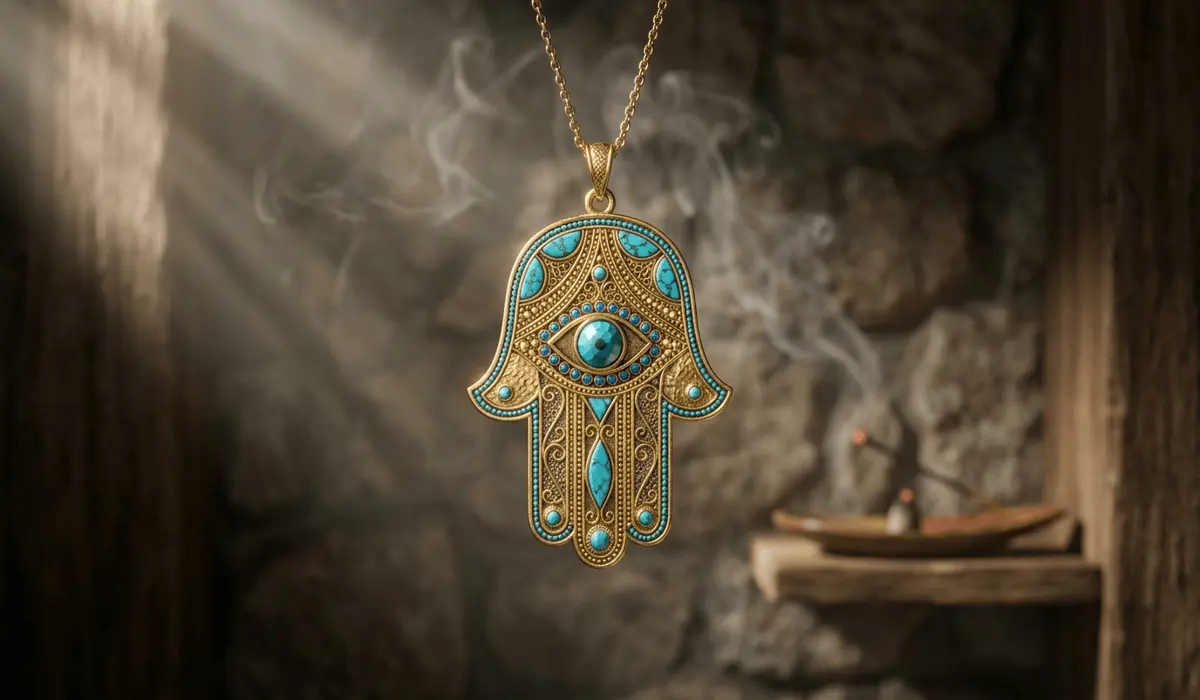
Have you ever noticed a hand-shaped symbol with an eye in its center—on someone's jewelry, in home decor, or hanging from a rearview mirror? This mysterious emblem is the Hamsa Hand—an ancient amulet that spans thousands of years and bridges multiple cultural traditions. It is far more than a decorative motif; it is a genuine spiritual anchor that helps us find security and inner peace amid the chaos of modern life.
This open palm is a cross-cultural symbol of protection and blessing, believed to ward off negative energy. In 2026, as we grapple with digital burnout and relentless social pressure, the Hamsa Hand offers us a moment to pause, breathe, and feel divine support. Understanding how this simple gesture connects our body to the universe is the first step toward lasting inner calm.
Ancient Origins and Sacred Legends
Where Does the Name "Hamsa" Come From?
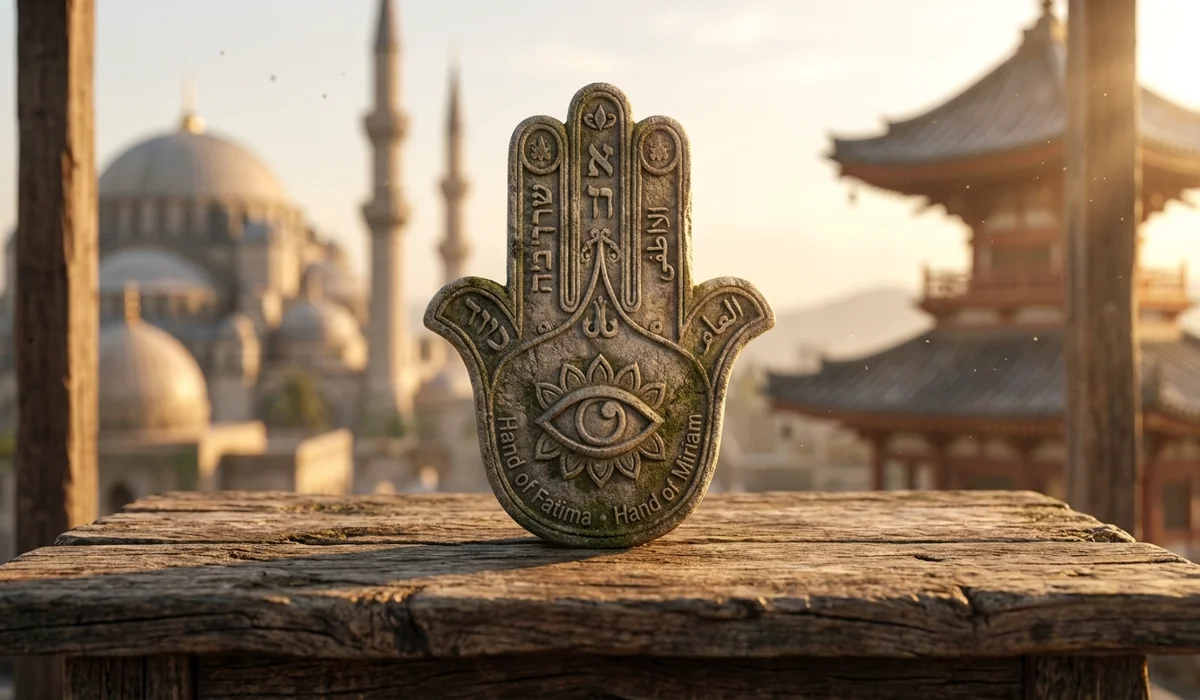
The word "Hamsa" derives from the Arabic and Hebrew terms for "five" (Khamsa / Hamesh), directly referencing the five fingers of the hand. The symbol's history stretches back to ancient Mesopotamia over three thousand years ago, where it first served as a talisman against the "evil eye"—protecting homes and souls from misfortune caused by malicious gazes.
What exactly is the Evil Eye? Across many cultures, it is believed that when someone looks at you with envy or ill intent, that negative focus shoots an "energy arrow" into your energy field. The Hamsa Hand's original purpose was to function as an energy deflector—a spiritual shield that bounces these harmful glances back to their source.
The Hamsa is known by different names across traditions, each carrying unique cultural resonance. In Islam, it is called the Hand of Fatima, honoring the daughter of the Prophet Muhammad, symbolizing purity, faith, and patience. In Judaism, it is the Hand of Miriam, named after Moses' sister, representing divine protection and prophetic wisdom. In Christian contexts, it is sometimes associated with the protective embrace of the Virgin Mary. Meanwhile, in Buddhism and Hinduism, it corresponds to the Abhaya Mudra—the gesture of fearlessness, protection, and energy flow.
Shared Wisdom Beyond Religion
The Hamsa Hand transcends religious boundaries because it addresses humanity's most fundamental need: a sense of safety. Dr. Rivka Ulmer, a scholar of religious symbolism, observes: "The Hamsa is a cross-cultural symbol embraced by different religious traditions—an object that can be worn or displayed in the home to attract good fortune and protection."
This cross-cultural sharing predates Islam. Archaeologists have discovered the Hand of Tanit at ancient Phoenician sites and the Hand of Ishtar in Mesopotamia—both are precursors to the Hamsa. This evidence proves that the human desire for spiritual protection is universal, transcending any single religion or ethnicity.
Why is the hand shape so significant? As a symbol, the open hand carries a dual meaning: an open palm represents opening the heart to divine power and receiving blessings, while also symbolizing the act of giving shelter and compassion. More importantly, the hand is a body part that everyone understands instantly—no words required. This universality makes the Hamsa one of the most intuitive spiritual symbols in existence.
Today, regardless of your faith, you can connect through the Hamsa Hand to this millennia-old legacy of protective wisdom.
Video source:YouTube
Author:Enlightened Scroll
Original video link:https://www.youtube.com/watch?v=RARZtK5NaOM
The Hidden Philosophy: Decoding the Symbolism
The Eye in the Palm: The All-Seeing Eye and Spiritual Awakening
The most striking feature of the Hamsa Hand is often the eye at the center of the palm. There is a common misconception to clear up here: this gazing eye is not the evil eye itself—it is a defensive weapon against it.
This eye represents the Third Eye (Ajna Chakra)—the seat of spiritual wisdom and intuition. In Yogic philosophy, the third eye is an energy center located between the eyebrows. When activated, it allows you to see beyond physical reality, perceiving essential truth beyond illusion; to sense others' true intentions and energy states; and to develop inner insight that guides wiser decisions.
Think of it as a spiritual monitoring system: it sees what you cannot see—envy, hatred, and malicious intent. When these harmful energies approach, this eye identifies and deflects them, preventing harm.
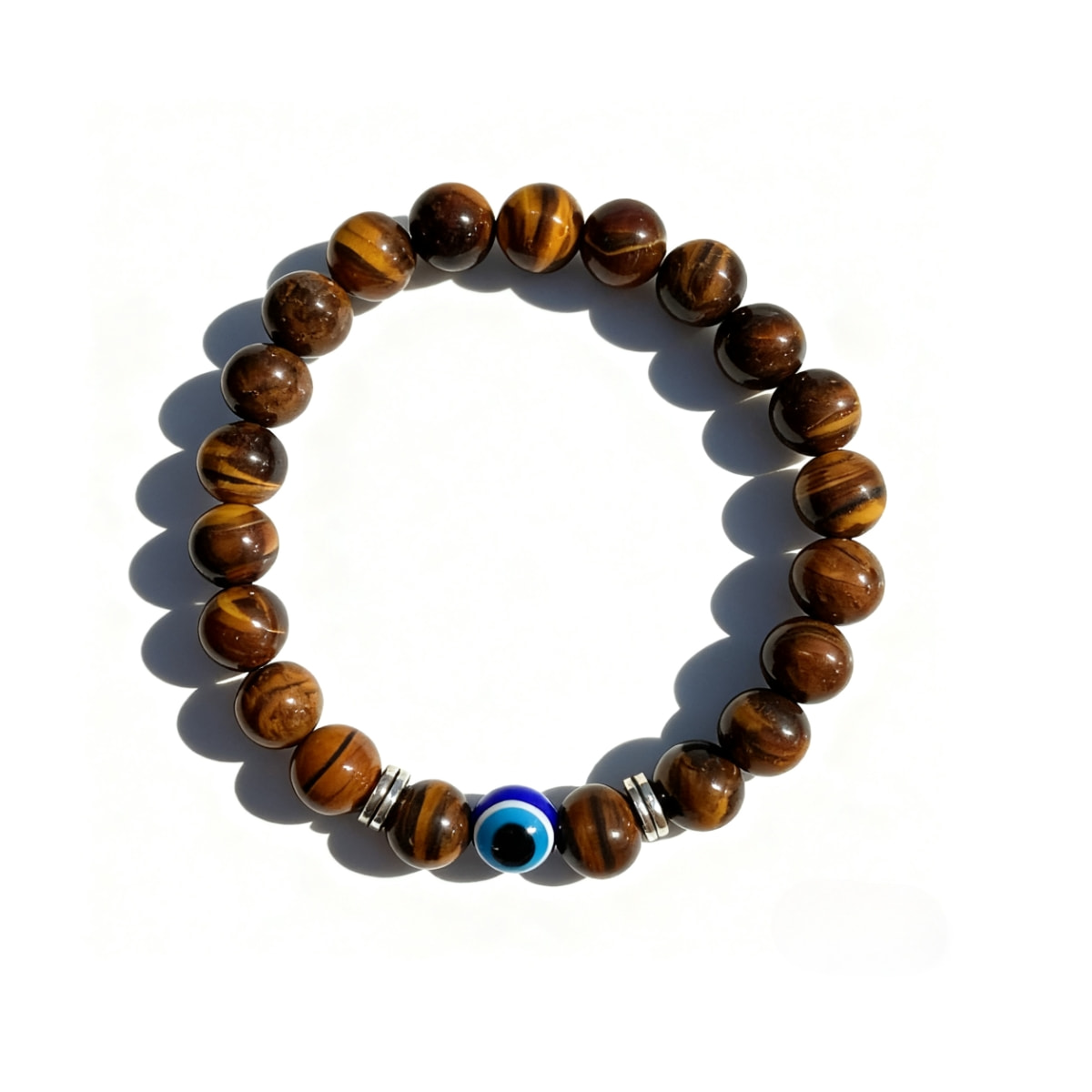
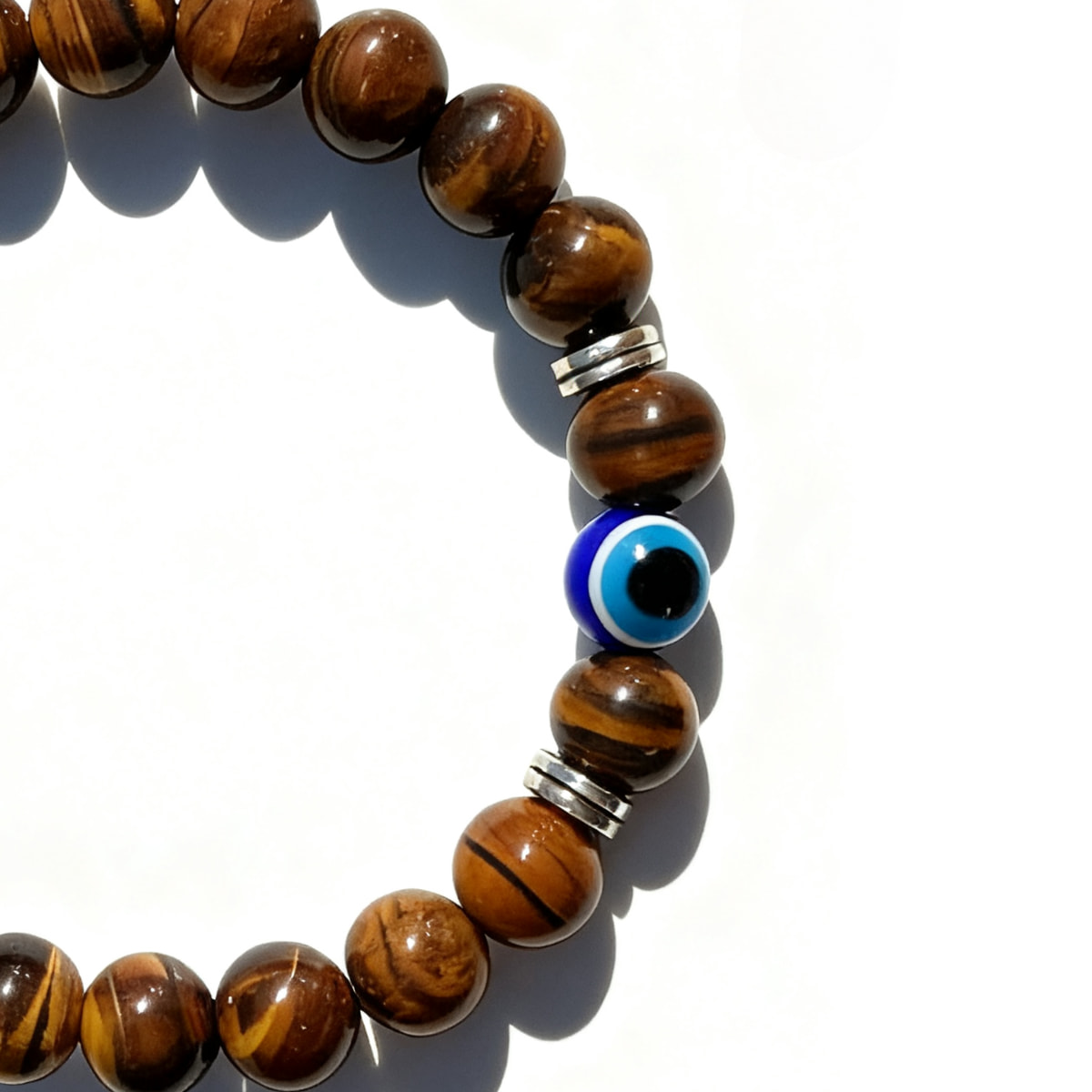
The significance of the color blue: Many Hamsa amulets use blue pigment for the eye—and this is no accident. In Middle Eastern culture, blue is considered the most effective color for neutralizing the evil eye, much like modern use of blue light filters to protect our eyes from digital screen damage.
The Five-Finger Path: The Five Elements and Chakra System
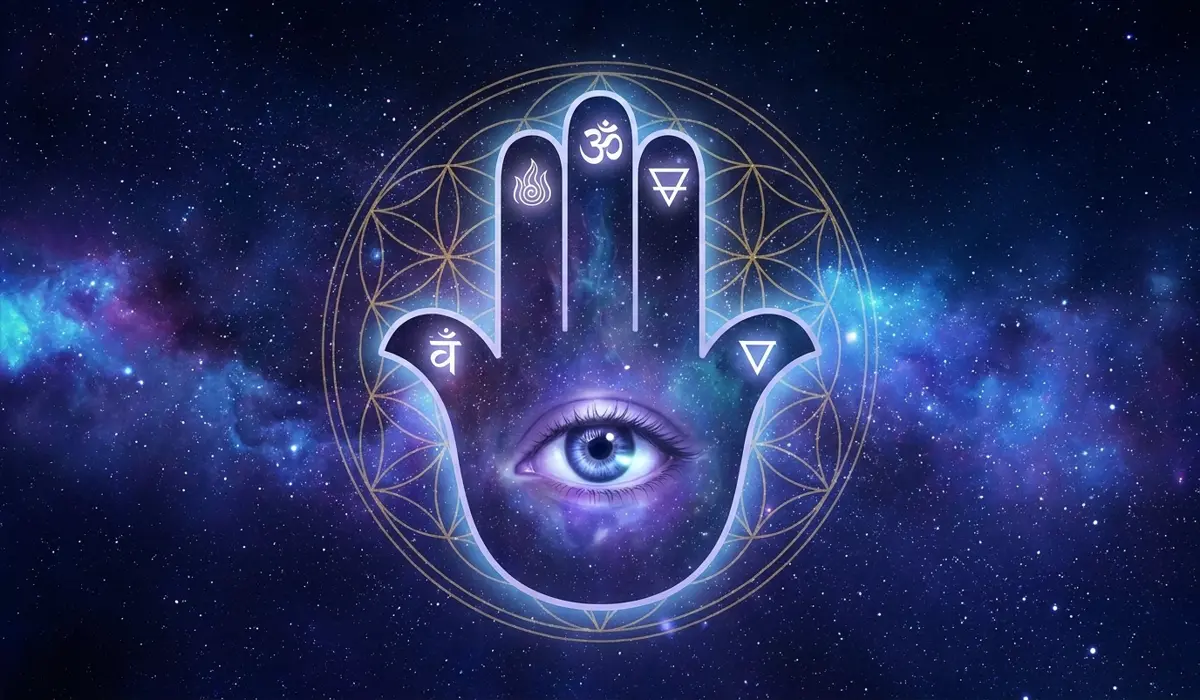
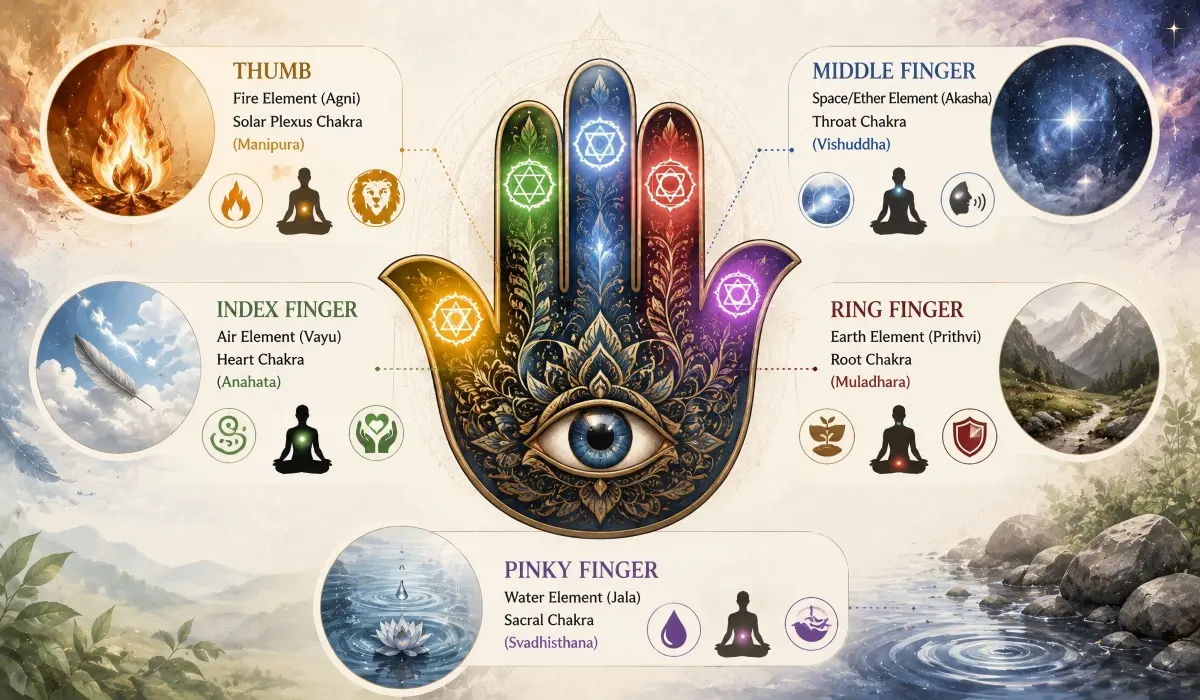
In Vedic and Ayurvedic traditions, the five fingers of the Hamsa Hand correspond to the five great elements (Pancha Mahabhutas) that constitute the cosmos and the human body, as well as the chakras (energy centers).
The thumb corresponds to the fire element (Agni) and the Solar Plexus Chakra (Manipura), governing willpower, self-confidence, and personal power. It symbolizes action and determination. When fire is balanced, you feel energetic and focused; when imbalanced, you may become irritable or lack motivation.
The index finger corresponds to the air element (Vayu) and the Heart Chakra (Anahata), governing emotional flow, love, and empathy. It symbolizes adaptability and communication. Balanced air allows you to express emotions and connect with others; imbalance may bring loneliness or emotional withdrawal.
The middle finger corresponds to the space/ether element (Akasha) and the Throat Chakra (Vishuddha), governing expression, creativity, and truth. It symbolizes expansiveness and openness. Balanced ether enables clear authentic expression; imbalance can cause difficulty speaking or mental confusion.
The ring finger corresponds to the earth element (Prithvi) and the Root Chakra (Muladhara), governing survival, security, and grounding. It symbolizes stability and endurance. Balanced earth makes you feel rooted and secure; imbalance brings anxiety or a sense of floating.
The pinky finger corresponds to the water element (Jala) and the Sacral Chakra (Svadhisthana), governing emotional intelligence, creativity, and pleasure. It symbolizes fluidity and nourishment. Balanced water allows smooth emotions and creativity; imbalance may cause emotional flooding or creative block.
| Finger | Element | Associated Chakra | Balanced State | Imbalanced State |
|---|---|---|---|---|
| Thumb | Fire (Agni) | Solar Plexus | Energetic, focused | Irritable, unmotivated |
| Index | Air (Vayu) | Heart | Emotionally expressive, connective | Lonely, emotionally closed |
| Middle | Space (Akasha) | Throat | Clear authentic expression | Difficulty expressing, confusion |
| Ring | Earth (Prithvi) | Root | Rooted, secure | Anxious, ungrounded |
| Pinky | Water (Jala) | Sacral | Emotionally fluid, creative | Emotionally flooded, blocked |
When these five elements become imbalanced within us, various physical and psychological issues arise. By focusing on or combining the energy of specific fingers, we can perform elemental purification (Tatva Shuddhi)—balancing body and mind. This is the core value of the Hamsa mudra in energy healing.
In Reddit's r/cdramasfans community, user u/BarberProfessional28 explains the power of these gestures:
"Have you ever noticed how cultivators... weave their fingers into intricate patterns...? It’s a direct stylistic inheritance from mudras... a system of symbolic hand gestures... Think of it as a physical 'stamp' that confirms a spiritual reality."
*sources:[The Hidden Language of Mudras in Xianxia](https://reddit.com/r/cdramasfans/comments/1tlll6h/the_hidden_language_of_mudras_in_xianxia_feat/)*
This insight shows that hand positions are like codes for our energy. Each finger on the Hamsa Hand represents one of the Mahabhutas, or great elements. When we hold our hands this way, we are cleaning our energy and balancing our life. It is not just about blocking "evil." It is about making our own Aura so strong that negative vibes cannot stay. This process of Tatva Shuddhi, or elemental purification, is the secret to staying grounded.
User u/MiaEnko shared a similar realization on Reddit about how hand positions change the body:
"What really surprised me was that different hand positions genuinely felt different in my body... One day I caught myself doing it and suddenly thought: ‘Wait… Naruto’😄 Maybe that’s why this anime fascinates so many of us. It feels real."

*sources:[I had the weirdest Naruto realization at 30](https://reddit.com/r/Naruto/comments/1tlry1h/i_had_the_weirdest_naruto_realization_at_30/)*
This shows that even without being religious, we can feel the physical shift that mudras cause. For more formal studies on this, you can check Feng Shui Society to see how space and body energy work together. It is all about finding what makes you feel the most alive and protected.
Facing Up vs. Facing Down: Two Energy Directions
The Hamsa Hand can be oriented in two primary directions, each conveying a distinct intention and application.
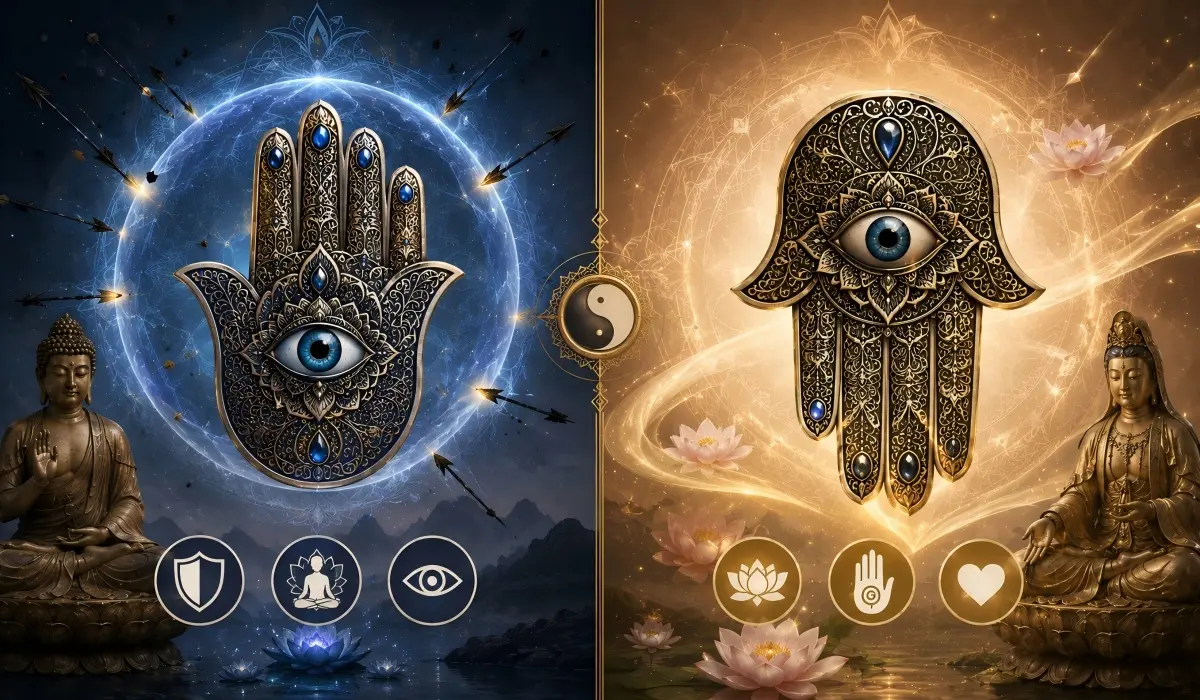
Facing Up (Abhaya Hamsa / Fearless Hamsa): The palm faces outward, fingers spread, revealing the complete hand. Its core function is defense and protection, with energy directed outward to repel negativity. In Sanskrit, this corresponds to the Abhaya Mudra, meaning "fearlessness." This orientation is most suitable when you feel threatened or need to establish energy boundaries. It acts like a shield, saying "no" to negative forces. In Buddhist iconography, Shakyamuni Buddha often used this mudra after his enlightenment.
Facing Down (Varada Hamsa / Generous Hamsa): The palm faces downward, fingers together or slightly drooping. Its core function is reception and blessing, with energy directed inward to attract positive forces. In Sanskrit, this corresponds to the Varada Mudra, meaning "generosity." This orientation is suitable when you need abundance, want to open your heart, or are ready to receive help. It acts like a generous hand, saying "yes" to prosperity. Avalokiteshvara (the Bodhisattva of Compassion) is often depicted with this mudra.
| Feature | Facing Up (Abhaya Hamsa) | Facing Down (Varada Hamsa) |
|---|---|---|
| Sanskrit Name | Abhaya Mudra | Varada Mudra |
| Hand Direction | Palm outward (facing viewer) | Palm downward (facing ground) |
| Core Function | Defense & Protection | Reception & Blessing |
| Energy Flow | Pushes negative energy outward | Draws positive energy inward |
| Best For | Feeling threatened, needing boundaries | Seeking abundance, opening heart |
| Symbolic Action | "Stop" gesture—saying "no" to negativity | "Giving" gesture—saying "yes" to abundance |
| Suggested Placement | Worn on right hand (active defense) | Worn on left hand (passive reception) |
Practical Tip: If you are heading into a difficult meeting or high-pressure environment today, wear your Hamsa facing upward. If you are waiting for an opportunity or praying for good fortune, wear it facing downward. Some people opt for double-sided Hamsa jewelry, allowing them to switch orientations based on daily needs.
Hamsa Mudra in Meditation Practice
Step-by-Step Hamsa Mudra Practice Guide
Using the Hamsa Hand in meditation is a powerful way to enhance your spiritual practice.
Preparation:
Begin by finding a quiet, undisturbed space to create a sacred space. Wear loose, comfortable clothing to avoid physical restriction of energy flow. Adopt a seated posture such as Padmasana (Lotus Pose) or Sukhasana (Easy Pose) with a straight spine, allowing Kundalini energy to rise freely along the spinal column. You may hold a Hamsa amulet or wear Hamsa jewelry as a tactile anchor to deepen focus. Optionally, light sage or incense to purify the space.
Phase One: Energy Activation (about 3 minutes)
Place your hands on your knees, palms facing up. Close your eyes and perform diaphragmatic breathing for 5 rounds. With each inhalation, imagine a stream of golden divine light pouring in through your Crown Chakra, flowing through every cell of your body. With each exhalation, feel your body progressively relaxing and your mind becoming more focused.
Phase Two: Forming the Mudra (1 minute)
Choose Abhaya (facing up) or Varada (facing down) according to today's intention setting. Bring your hands to chest level and form the mudra. Then, feel the energy points at each fingertip and imagine them connecting to their corresponding cosmic elements. This is a process of "translating intention into hand language"—your body is "speaking" your spiritual intent.
Phase Three: Energy Circulation Meditation (10-20 minutes)
This is the heart of the Hamsa meditation. Begin with grounding: inhale for 4 seconds, visualizing energy rising from the Root Chakra as a pillar of red light ascending from deep within the earth, establishing your grounding. Hold the breath for 2 seconds as the energy flows through the Sacral and Solar Plexus chakras, turning orange and gold—activating your creativity and willpower. Exhale slowly for 6 seconds as energy reaches the Heart Chakra, turning emerald green and filling your chest—activating unconditional love.
Continue by inhaling for 4 seconds, letting energy rise to the Throat Chakra as sky-blue light, releasing authentic expression. Hold for 2 seconds as energy reaches the Third Eye and Crown Chakra, turning indigo and violet—accessing spiritual insight. Finally, exhale slowly for 6 seconds as energy descends from the crown, down through your arms, and flows into your palms and fingertips—completing one full cycle.
Throughout this process, keep your attention on the "eye" at the center of your palm. This is the focal point of energy—simultaneously a center of protection and a center of reception. The key insight is that the Hamsa Mudra forms a closed energy loop: the life energy (Prana) that would normally escape through your fingertips is reflected back into your body, reinforcing your aura and preventing the fatigue that sometimes follows meditation.
| Meditation Phase | Breath Rhythm | Visualization | Energetic Effect |
|---|---|---|---|
| Grounding | Inhale 4 sec | Red pillar from Root Chakra | Establish grounding |
| Flowing | Hold 2 sec | Energy turns orange-gold through Sacral & Solar Plexus | Activate creativity & willpower |
| Expanding | Exhale 6 sec | Emerald green fills Heart Chakra | Activate unconditional love |
| Expressing | Inhale 4 sec | Sky-blue illuminates Throat Chakra | Release authentic expression |
| Transcending | Hold 2 sec | Indigo-violet reaches Third Eye & Crown | Access spiritual insight |
| Cycling | Exhale 6 sec | Energy flows through arms to palms | Complete energy loop |
Hamsa Mantra Meditation
In the Yogic tradition, "Hamsa" itself is a mantra—one of the most powerful sound vibrations in Ayurveda and spiritual healing.
"Hamsa" means "swan" in Sanskrit. In Indian culture, the swan symbolizes the soul because of its legendary ability to separate milk from water—symbolizing the faculty of discrimination between truth and illusion. At the breath level, the natural sound of inhalation is "Ham" and the natural sound of exhalation is "Sa"—together they form "Hamsa." This reveals that the breath itself is a living mantra. At the philosophical level, "Hamsa" is connected to "So Hum," meaning "I Am That"—affirming your unity with cosmic consciousness.

Detailed Practice Method:
Begin by assuming the Hamsa Mudra, eyes gently closed. Breathe naturally without control—simply observe the natural rhythm of your breath. Internally chant the mantra: mentally recite "Ham" (pronounced "hum") on the inhalation, and "Sa" (pronounced "sah") on the exhalation. Gradually expand your awareness—you begin to realize that it is not "I am breathing" but rather "breathing is happening." Eventually, the vibration of "Ham-Sa" merges completely with your breath, and you experience yourself as the mantra itself.
Start with 5 minutes of practice and gradually extend to 15-20 minutes. For advanced practice, use a mala (prayer beads) for counting: with 108 beads, move one bead per breath cycle (one inhalation and one exhalation). Completing 108 cycles takes about 20-30 minutes.
The Hamsa Amulet in Modern Life
Why Do We Still Need the Hamsa Today?
In 2026, we face unprecedented environmental stress. From the perspectives of psychology and energy medicine, the Hamsa's modern relevance manifests across multiple dimensions.
In the face of information overload, our Crown Chakra becomes overstimulated, leading to overthinking and sleeplessness. The Hamsa draws energy back to the heart and palms, helping us establish cognitive boundaries. With social anxiety, our heart chakra contracts and defensive mechanisms overreact. The Hamsa, as a tactile anchor, can quickly activate the parasympathetic nervous system to calm anxiety responses.
With digital blue light fatigue, our third eye energy becomes imbalanced and intuition is clouded. The eye symbol on the Hamsa reminds us to "reopen" our inner vision. With urban energy pollution, our aura develops leaks and we feel "drained." The Hamsa acts as an energy shield, helping maintain the integrity of our aura.
Neuroscientific research shows that tactile stimulation can directly activate calming responses in the amygdala—the brain's fear-processing center. When you touch your Hamsa jewelry, it is not merely psychological comfort but a physiological-level neural reset. This is why a small amulet can bring such genuine feelings of safety.
How to Choose and Wear Hamsa Jewelry
When selecting Hamsa jewelry, material is an important consideration. Different materials carry distinct energetic properties.
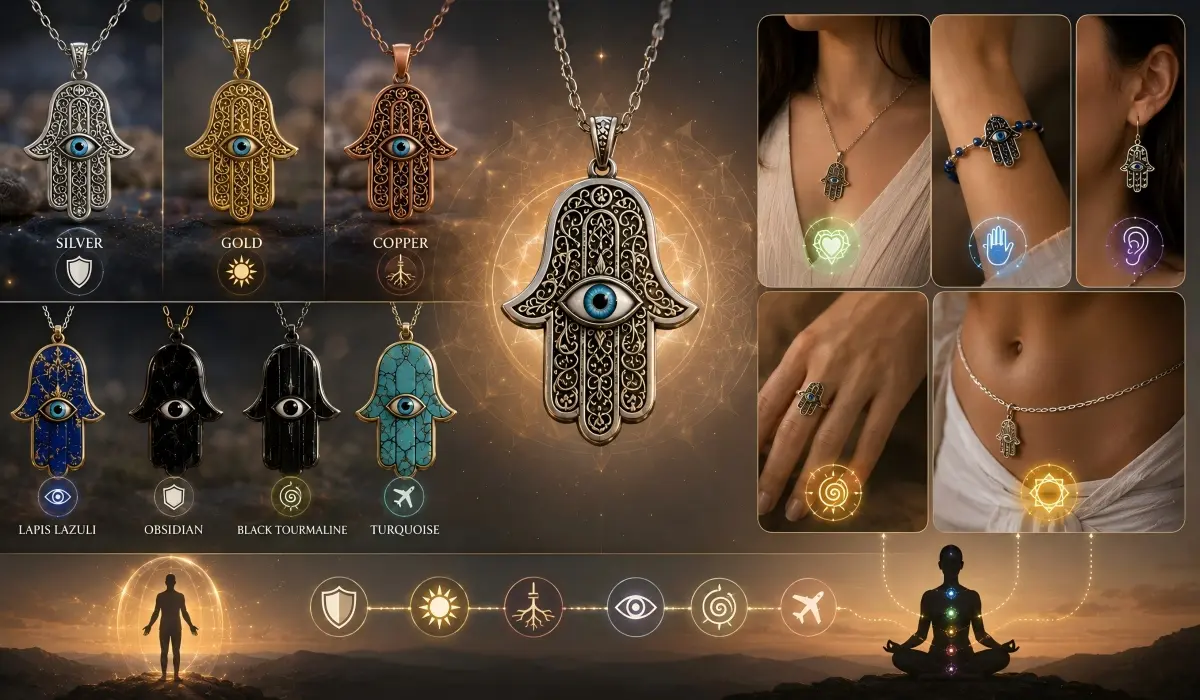
Silver is considered pure and reflective, ideal for all-around protection and daily wear—the traditional material of choice in Middle Eastern culture. Gold carries solar energy and authority, suitable for building confidence and personal power, historically associated with royalty and nobility. Copper offers excellent conductivity and grounding effects, beneficial for enhancing energy circulation and connecting with earth energy.
For those seeking to deepen spiritual practice, Lapis Lazuli is the top choice—connected to wisdom and the third eye, enhancing intuition, and revered in ancient Egyptian and Sumerian traditions. Obsidian provides powerful grounding and protection against intense negative energy. Black Tourmaline absorbs and transforms negative energy, the premier protective stone in modern crystal healing. Turquoise is a traditional protective stone, especially effective for travel safety, beloved in Middle Eastern and Native American cultures.
Placement also affects energetic function. When worn as a necklace, it sits close to the Heart Chakra, offering continuous energetic protection—ideal for all-day wear, functioning as an "energy passport." As a bracelet, it serves as a tactile reminder, particularly valuable during high-pressure meetings or social situations. Earrings are believed to block negative information at the "hearing" level, protecting in noisy or negative environments. Rings continuously activate hand energy points and function effectively as a personal talisman. For those seeking to protect the Solar Plexus, a belly chain can enhance confidence and personal boundaries.
Placing the Hamsa in Your Home
Following principles from Feng Shui and Western space clearing, where you place the Hamsa in your home directly affects its energetic impact.
The main entrance is the most critical placement—position it facing outward to block negative energy from entering, functioning as your home's "energy guard." The baby's room should have it facing upward to protect the most vulnerable family members—infants have not yet fully formed their energy fields and need the most protection. On a desk or workspace, orientation can be adjusted based on needs, creating a peaceful oasis in the digital environment—ideally paired with Selenite or Black Tourmaline.
Above the bed in the bedroom, a downward-facing Hamsa is recommended to receive blessings and protection during sleep, supporting healing sleep. In the kitchen, an upward-facing Hamsa can help prevent arguments and family conflict, as the kitchen is the energetic heart of the home where tension can accumulate. In the car, hanging from the rearview mirror facing outward ensures driving safety and protection from road rage and accidents—a practice very popular in the Middle East.
It is recommended to cleanse Hamsa items in the home quarterly (at the spring equinox, summer solstice, autumn equinox, and winter solstice) and reaffirm your spatial intentions.
Activation and Cleansing Rituals for the Hamsa
Want your Hamsa amulet to work at its full potential? Here is a complete activation and maintenance ritual.
First-Time Activation Ritual (about 30 minutes)
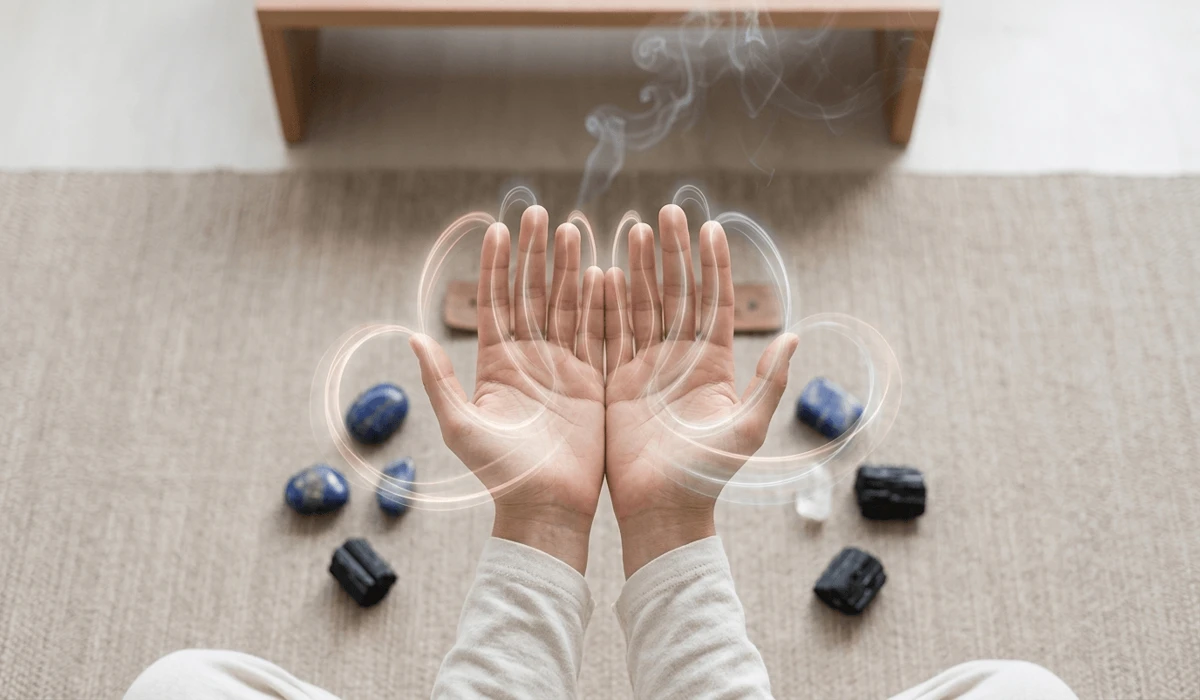
Gather the following items: your Hamsa object as the core tool; a white candle symbolizing purity and the sacred; sage or palo santo for smoke cleansing; sea salt for energy absorption and purification; and spring or purified water for water-element cleansing.
The ritual unfolds in seven stages, each carrying its own energetic significance.
| Step | Name | Action | Duration/Count | Spiritual Purpose |
|---|---|---|---|---|
| 1 | Cleanse (净化) | Pass the Hamsa through sage or palo santo smoke | 7 times | Clears away unfamiliar energy accumulated during shipping and storage; 7 represents a complete spiritual cycle |
| 2 | Ground (接地) | Bury the Hamsa in sea salt | 2 hours | Salt absorbs residual old energy, returning the item to a "zero state" of purity |
| 3 | Rinse (冲洗) | Gently rinse under running water, then air-dry naturally | Until dry | The water element carries away final impurities, completing purification on both physical and energetic levels |
| 4 | Connect (连接) | Close eyes, breathe deeply, become fully present | 1-2 minutes | Establishes resonance between your personal energy field and the item, allowing it to "know" you |
| 5 | Charge (加持) | Hold the Hamsa and visualize golden light pouring into it from the cosmic source | 2-3 minutes | Activates the item's spiritual potential—the "charging" process |
| 6 | Intention (定意) | Speak your intention clearly aloud (e.g., "I activate this Hamsa Hand as my sacred protective barrier") | 1 minute | The vibration of sound "fixes" the intention into the item's physical structure |
| 7 | Seal (封存) | Touch the Hamsa to your heart center and third eye | 7 times each | Completes the energetic connection and permanently activates the amulet; the item now carries your personal energy signature |
Daily Maintenance and Cleansing
A Hamsa worn daily should be cleansed weekly, either by moonlight or smoke cleansing. Avoid wearing it while bathing or swimming, as water can absorb some of its energy and weaken its protective effect. For occasional use, monthly cleansing is sufficient—store it wrapped in silk or natural fabric.
Special attention is needed if you wear your Hamsa through high-risk environments (hospitals, funerals, conflict zones)—it should be urgently cleansed immediately afterward: first buried in sea salt for 2 hours, then smoke-cleansed. These places have complex energy that the Hamsa may absorb, requiring prompt "release."
Quick Daily Cleansing (just 5 minutes) : Light a white candle, hold the Hamsa in both hands, mentally recite "Clear all today's residue" 3 times, then let it rest beside the candlelight for 5 minutes. Before wearing, gently kiss the Hamsa—this gesture symbolizes your intimate connection and gratitude.
Video source:YouTube
Author:Kathleen Karlsen
Original video link:https://www.youtube.com/watch?v=x-G9Y5gbAvU
Frequently Asked Questions
Q: How does the Hamsa Mudra redirect energy during deep meditation?
A: The Hamsa Mudra creates a closed loop for your life force or Prana. When you hold your hands in this specific way, the energy that normally escapes through your fingertips is reflected back into your body. This helps keep your aura strong and prevents you from feeling tired after a long day.
Q: What is the difference between Hamsa Hand facing up vs. facing down in yoga?
A: When the Hamsa faces up, it is the Abhaya position used for shielding and protection. It acts as a stop sign for negative energy. When the Hamsa faces down, it is the Varada position, which is used for receiving blessings and manifesting wealth. It signals to the universe that you are ready to accept good things.
Q: Can the Hamsa Hand help alleviate modern digital burnout and social anxiety?
A: Yes, it works as a physical anchor for your nervous system. In high-stress digital environments, the Hamsa symbol serves as a visual and tactile cue to stay grounded in the present moment. This helps reduce the feeling of being overwhelmed by screens and social pressure.
Q: What stones amplify the Hamsa's protective frequency?
A: Lapis Lazuli is excellent for the Third Eye and intuition. Black Tourmaline is the best for grounding and physical protection. Turquoise is the traditional stone used in the Middle East to boost the Hamsa's power against the Evil Eye.
Conclusion: Integrating the Hamsa Wisdom
The Hamsa Hand is far more than an ancient symbol—it is a spiritual map to a better life. By understanding and applying this symbol, we learn to walk through the world with an open heart and a protected soul. It reminds us that we are never alone and that divine strength is always within reach.
Whether you use it as a mudra in meditation, wear it as a beautiful talisman, or display a Hamsa artwork in your home—let it become a daily energy anchor in your life. Just 2-3 minutes each day of touching it, gazing at it, and breathing consciously can reconnect you to that ancient and eternal protective power.
Action Steps for Today:
-
Choose a Hamsa item you already own or intend to acquire
-
Spend 2 minutes writing down your intention for protection or abundance
-
Begin a 5-minute Hamsa Mudra meditation today
-
Share what you have learned with a friend
Let the Hamsa Hand become your faithful companion on the path toward fearlessness, peace, and spiritual growth. Begin your journey today, and let this sacred hand be the guardian of your energy, guiding you toward light and joy.

Longyi Luck
Longyi Luck is a Feng Shui practitioner and spiritual researcher who blends traditional year-based wisdom with modern lifestyle insights, specializing in Feng Shui, spirituality, meditation, and mindfulness. With years of dedicated study and practice, Longyi explores cultural symbolism and the practical application of ancient wisdom to help individuals cultivate balance, clarity, and harmony in everyday life. Since 2020, Longyi has been committed to translating timeless traditions into accessible guidance for the modern world.
longyi@auraandluck.com


.webp?w=1280&h=1280)
.webp?w=800&h=800)