

Wooden mala beads are powerful spiritual tools that help focus the mind during Japa Meditation by providing a tactile anchor for mantra recitation. We find that many practitioners prefer wood over gemstones because it is lightweight, warm to the touch, and carries deeply grounding energy. In this guide, we will show you how to choose, use, and care for these sacred tools to deepen your spiritual practice and find inner peace.
Whether you are a complete beginner or an experienced practitioner looking to deepen your existing practice, this article will serve as your reliable companion. We begin with the ancient traditions of Japa meditation, exploring the cosmic symbolism behind 108 beads and their connection to the chakras. We then guide you in selecting the right material—whether Sandalwood, Rosewood, or Bodhi Seed—based on your personal needs. You will learn the correct wearing and bead-flicking techniques, with the core principle being the coordination of thumb and middle finger while avoiding the index finger to transcend the "ego." More importantly, we will teach you how to cleanse and charge your mala using sage smoke, singing bowl vibrations, or full moon light, along with daily maintenance tips. The article concludes with the most frequently asked questions from beginners, enriched with real-life practitioner insights. Combining theoretical depth with actionable steps, this guide ensures you can start practicing immediately and experience tangible benefits.
What Is Using Wood Mala Beads for Japa Meditation?
Definition of the Practice
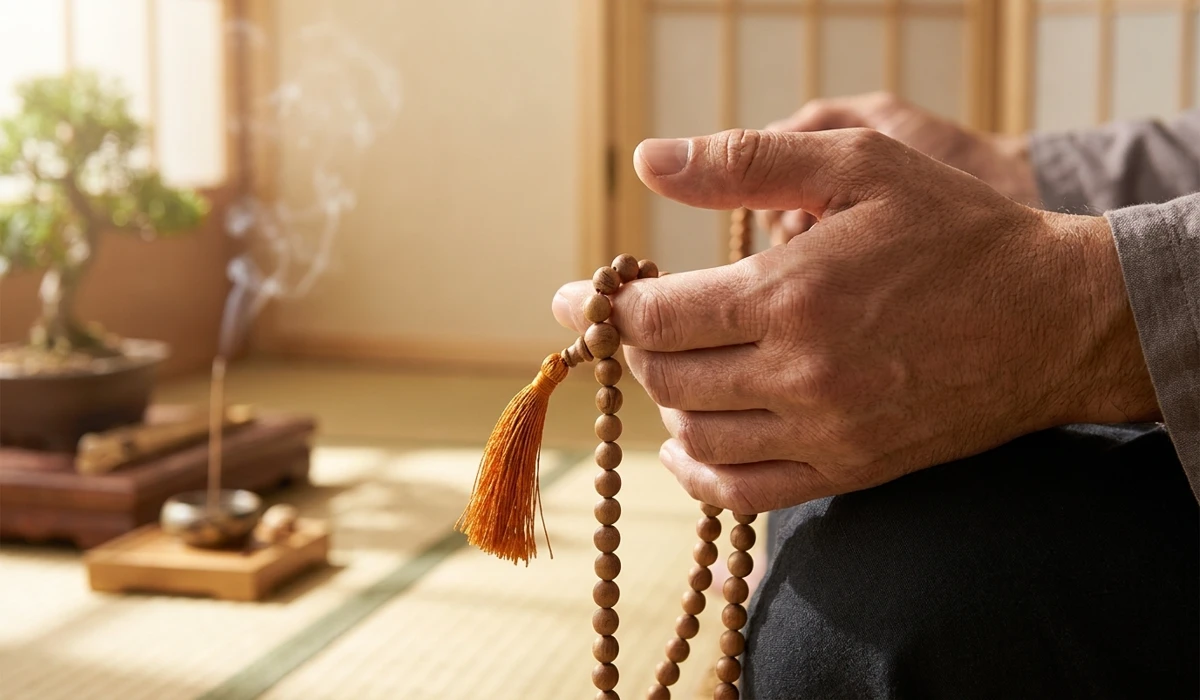
Japa meditation is a mindful practice where you repeat a specific mantra or divine name in a rhythmic way. We use a wooden mala as a tactile counting tool to keep track of these repetitions without having to count in our heads. The word Japa comes from Sanskrit and means to whisper or mutter, which describes the quiet nature of this spiritual work.
When we rely on mental counting during meditation, the brain's language centers remain active, which ironically generates more distracting thoughts. By flicking mala beads, we delegate the task of "counting" to the body, allowing our awareness to rest more purely on the mantra sound. This is one of the irreplaceable advantages of wooden malas as meditation tools.
Origin and Natural Materials
This tradition is rooted in ancient Vedic and Buddhist history, dating back thousands of years as a way to connect with the divine. These beads are crafted from organic textures such as aromatic Sandalwood, dense Rosewood, or sacred Bodhi seeds. Unlike stone, wood absorbs the natural oils from your skin over time, making the mala feel more personal and spiritually "alive" as you use it.
Basic Characteristics of a Mala
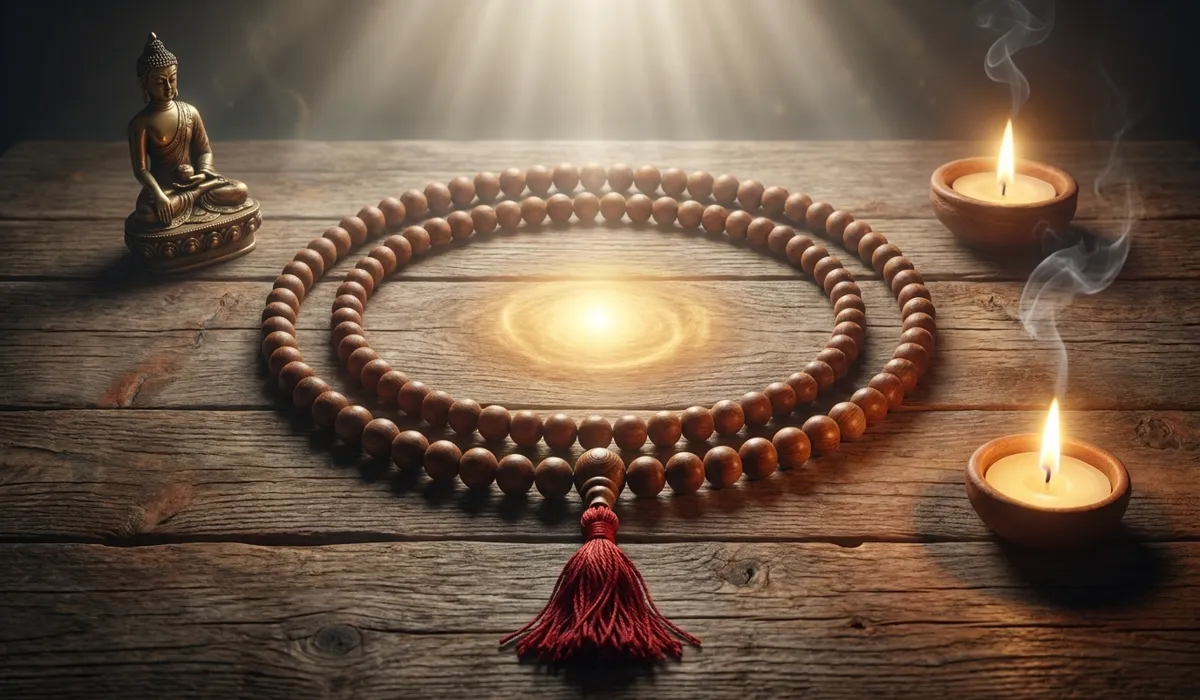
A traditional mala always contains exactly 108 beads plus one larger bead known as the Guru bead. It often features a tassel that represents the "thousand-petal lotus" of enlightenment and spiritual energy. Most of our high-quality wooden malas are hand-knotted between each bead to make them easier to move during your meditation practice.
Spiritual Meaning and Symbolism
Traditional Symbolism of 108
The number 108 is a sacred geometry constant that represents the spiritual completion of the universe. In many cultures, it is believed there are 108 energy lines connecting to the heart chakra. By moving through 108 beads, we are symbolically traveling through the cosmos to reach our inner center.
Interestingly, 108 also appears in astronomy—the Sun's diameter is approximately 108 times that of Earth, and the distance from the Earth to the Sun is about 108 times the Sun's diameter. This cosmic-scale repetition gives the 108-bead counting system not only spiritual depth but also an implicit resonance with the ancient wisdom that humans and the universe are structurally interconnected.
Beyond symbolism, 108 repetitions hold unique physiological and psychological value. With each mantra recitation taking about 3-5 seconds, one full round takes approximately 6-9 minutes—which is precisely the minimum time required for the nervous system to shift from the "fight-or-flight" sympathetic mode to the "rest-and-digest" parasympathetic mode. In other words, 108 beads are not just a spiritual number; they are a time-tested "meditation timer" that ensures sufficient depth without overwhelming beginners with excessive duration.
The Role of the Guru Bead
The 109th bead is called the Guru bead and it honors the relationship between the teacher and the student. It serves as a starting point and a stopping point for your meditation session. According to tradition, you should never cross over the Guru bead; instead, you turn the mala around if you wish to do another round.
In more traditional contexts, the Guru bead is regarded as the "soul" of the entire mala, representing the highest spiritual guidance or your inner "Higher Self." Many practitioners intentionally slow down when approaching the last bead before the Guru bead, concluding each round with a sense of gratitude. Not crossing the Guru bead is not merely a physical taboo but a psychological ritual—it reminds us that every ending is also a new beginning, circulating endlessly like the rhythm of life itself.

Chakra Associations and Grounding
Wooden beads have a strong connection to the Root Chakra (Muladhara), which helps you feel safe and stable. Aromatic woods like Sandalwood are also great for the Third Eye (Ajna) because their scent helps clear the mind. We suggest using wood when you feel "spacey" and need to bring your energy back down to earth.
Not all wooden malas affect the chakras in the same way. Sandalwood, with its cooling properties, is particularly beneficial when the Third Eye chakra is overactive (i.e., when you are overthinking)—its fragrance acts like a "mental cooling patch" that soothes brainwaves. Rosewood, with its warm and dense energy, works more directly on the Root Chakra, making it especially suitable for those who are chronically sleep-deprived, have irregular routines, or feel "top-heavy" and ungrounded. Bodhi seeds are believed to simultaneously activate the Crown Chakra and the Root Chakra, creating an "ascending-descending" energy channel—a classic choice for those seeking holistic balance.
Benefits and Intentions Associated with Wooden Mala Beads
Using wooden beads helps anchor your focus so your mind doesn't wander like a "monkey mind" during silence. The natural warmth of the wood provides a calming sensory experience that helps regulate your nervous system. Many practitioners find that the act of moving the beads builds great patience and discipline in their daily lives.
We recommend setting a specific intention before you start your practice to give your meditation a clear goal. Here are a few common intentions people use with wooden malas:
-
Spiritual Grounding: Staying centered during emotional or stressful times.
-
Deep Concentration: Using the physical beads as a reminder of present-moment awareness.
-
Nervous System Regulation: Pairing bead movement with slow, deep breaths.
-
Patience Cultivation: Learning to move slowly and deliberately through life.
Setting an intention is not about casually thinking "I want to be better." An effective intention needs three qualities: positive framing (say "I embrace calm" rather than "I don't want anxiety"), sensory accessibility (ideally, you can find a corresponding physical sensation), and present-moment connection (rather than a distant future goal). For example, you might frame it this way: "In this round of 108 mantra repetitions, I let each flick of a bead feel like gently placing a pebble into a still lake, with the ripples carrying my mantra throughout my entire body." Such an intention will quickly pull you back whenever your mind drifts.
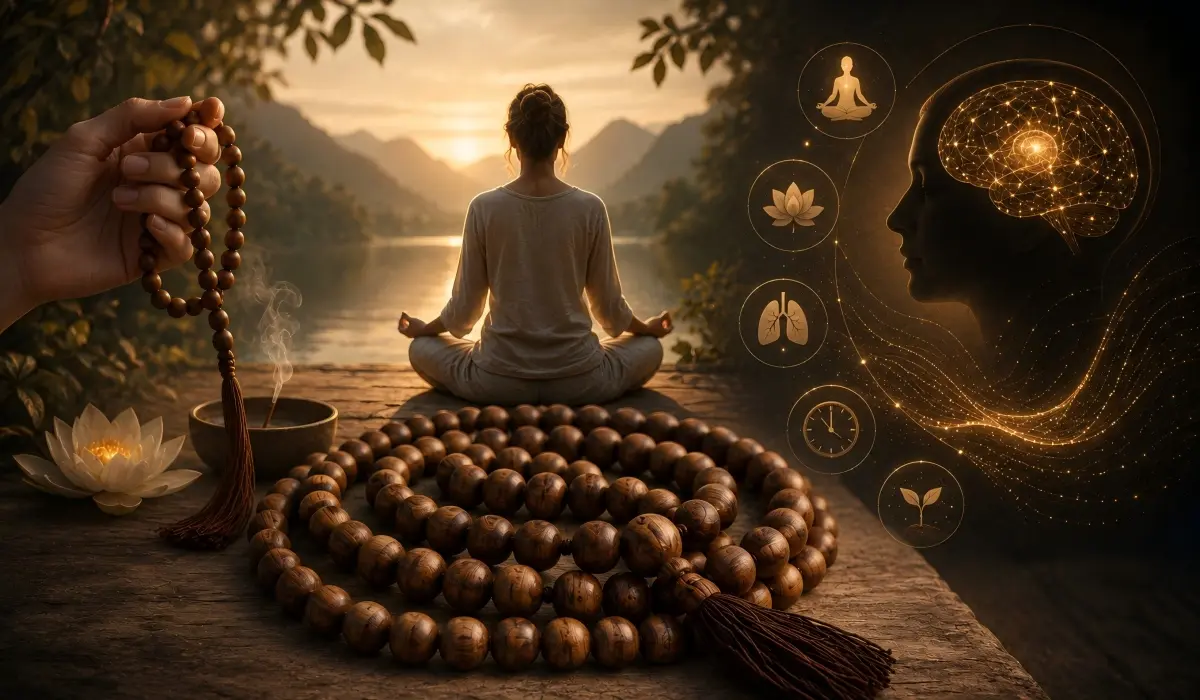
By using these tools, you create a psychological trigger that tells your brain it is time to relax and look inward. Over time, the mere touch of your mala beads can help you enter a meditative state faster. This is one of the many reasons why malas are so popular for beginners and experts alike.
From a neuroscientific perspective, this is essentially building a conditioned reflex—when you repeatedly touch your mala in a calm state, your brain's prefrontal cortex gradually associates the "woody texture" with a "relaxation command." This is why many long-term practitioners can regain inner order within seconds just by gripping their wooden mala on a busy street. This is not mysticism but a trainable mental pattern.
How to Wear Wooden Mala Beads
Left Hand vs Right Hand Logic
In Feng Shui and many eastern traditions, the right hand is used for the actual Japa meditation because it is the hand of giving and action. However, when you wear your beads as a necklace or bracelet, the left hand is often preferred. We believe the left side is the "receiving" side, allowing you to absorb the protective and grounding energy of the wood throughout the day.
The seemingly contradictory advice of "right hand for flicking, left hand for wearing" actually reflects the Eastern philosophical unity of movement and stillness. When you actively flick the beads with your right hand during meditation, you are "sending out" the vibrations of your mantra into the world. When you wear the mala on your left wrist in daily life, you are "receiving" the stable frequency of the wood. If you are left-handed, you can naturally mirror this—the key is consistency, allowing your body to internalize this ritualized left-right division.
Beyond wrist and neck, you can also attach smaller wooden bracelets to your backpack or keep them in your shirt pocket as a portable amulet. The key is to maintain a sense of reverence—avoid taking them into restrooms or unclean places. This not only honors tradition but also helps preserve the energetic purity of your mala.
Video source:YouTube
Author:Soul Yoga Therapy
Original video link:https://www.youtube.com/watch?v=flpIAS7r3FE
When and Where to Wear Them
You can wear your mala during yoga to stay connected to your intentions or keep it in your pocket during travel for quick centering. Some people prefer to keep their meditation mala private and only wear it at home in their sacred space. If you are interested in other ways to use spiritual tools, you can also explore Crystal Healing to complement your wood mala practice.
Wearing Suggestions for Different Scenarios
| Scenario | Recommended Wearing Method | Primary Benefit |
|---|---|---|
| Daily Commute | Wear on left wrist or keep in pocket | Instant grounding, anxiety relief |
| Yoga/Meditation Class | Hang around neck or wrap around right hand | Strengthen focus and intention alignment |
| Travel/Business Trips | Carry in a Gaumukh bag | Energy protection from external interference |
| Pre-Sleep Sitting | Hold in hand or place beside pillow | Promote nervous system relaxation, improve sleep |
In modern life, many people wear malas as fashion accessories. Our suggestion is: if your purpose is spiritual practice, consider setting a "boundary line"—for example, dedicate one mala for daily wear and decoration, and another (preferably higher-quality Sandalwood or Bodhi seed) exclusively for meditation, not to be shown casually to others. This not only protects the energetic purity of your private practice but also ensures that whenever you pick up your "dedicated mala," your brain instantly transitions into a deeper meditative state.

Wood Mala Beads vs Similar Meditation Tools
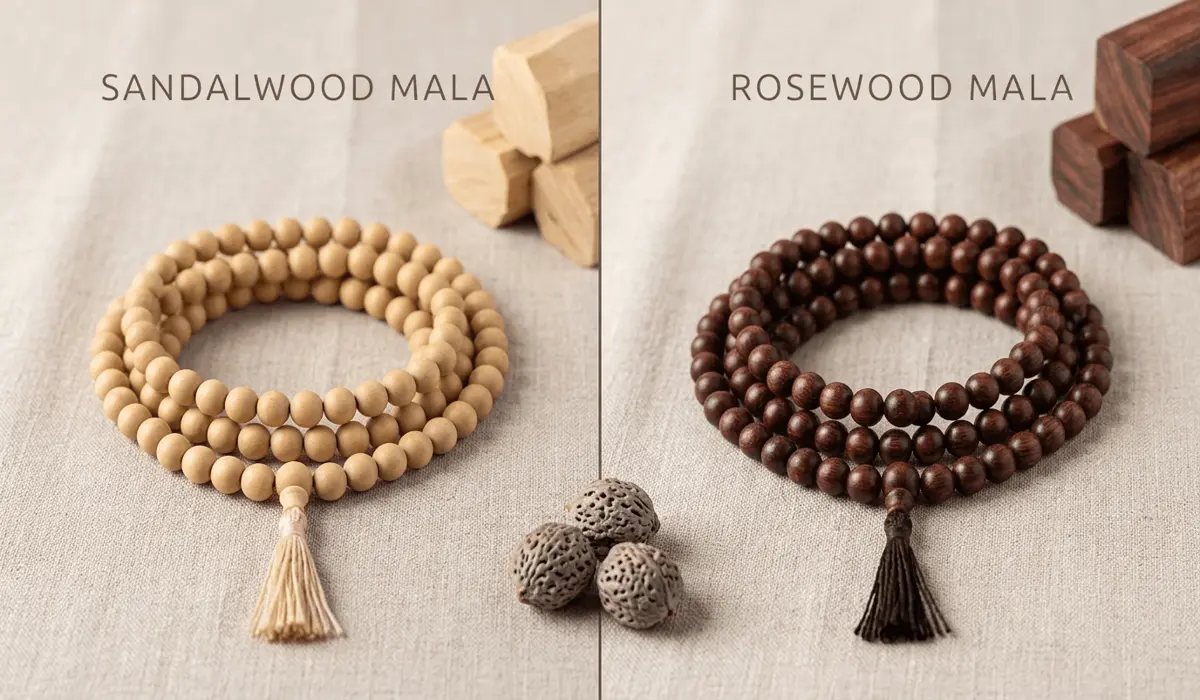
Choosing the right material is important because every wood has a different vibration and physical feel. For example, Sandalwood is very cooling and has a famous scent that helps soothe anxiety. On the other hand, Rosewood is denser and is often used for protection and clearing away negative energy.
| Material | Primary Benefit | Energy Type | Texture | Best For |
|---|---|---|---|---|
| Sandalwood | Mental clarity, nerve-soothing, natural fragrance | Cooling / Calming | Smooth, warm | Anxiety-prone individuals, beginners |
| Rosewood | Energy protection, grounding, dispelling distractions | Warming / Strengthening | Slightly rough, heavy | Those with frequent mood swings |
| Bodhi Seed | Spiritual awakening, lineage blessings, profound merit | Traditional / Potent | Naturally textured surface | Advanced practitioners |
| Crystal/Gemstone Mala | Specific chakra healing (e.g., amethyst, clear quartz) | Focusing / Amplifying | Cool, smooth | Energy healing enthusiasts |
While wood offers a smooth and uniform feel, seeds like Bodhi have a more textured and irregular surface. Both are organic and will darken over time as they interact with your skin's natural oils. To see more options for your journey, you can explore our Spiritual Crystal collections for different energy types.
Compared to the "coldness" of gemstones and the "hardness" of metal, wood is a "semi-active" material—it breathes (expanding and contracting slightly with humidity), ages (darkening in color), and remembers (absorbing oils). These characteristics make each mantra repetition feel like interacting with a "living companion" rather than operating a cold tool. Especially after prolonged use of the same wooden mala, you will find that each bead becomes "familiar" and "warm" to the touch. This emotional bond between person and object is itself a powerful psychological anchor that deepens your focus more steadily.
Beginners often hesitate between buying an expensive or inexpensive mala. Our recommendation: start with an entry-level but natural-wood mala (such as regular Sandalwood), typically priced affordably. After 3-6 months of consistent practice—once you have genuinely experienced and committed to Japa meditation—then consider upgrading to higher-quality aged Sandalwood or rare Rosewood. This approach is not only economically rational but also aligns with the natural progression of practice—after all, precious malas should be matched with precious meditation habits, not merely serve as decorative objects.
Who Is Wood Mala Meditation Suitable For?
Energy Alignment and Zodiacs
Wood is perfect for anyone who feels disconnected from their physical body or overwhelmed by fast-moving thoughts. Earth signs like Taurus, Virgo, and Capricorn often love the tangible and natural feel of wooden beads. Air signs like Gemini also benefit because the rhythmic counting helps anchor their busy minds into a steady flow.
Practitioner Experience Levels
We often recommend wood malas to beginners because they are durable, lightweight, and very affordable compared to rare gemstones. They are also a great choice for eco-conscious practitioners who want to use biodegradable and sustainably sourced materials. Even advanced meditators appreciate the subtle aromatherapy provided by high-quality Sandalwood.
"I've been doing bhairav sadhana and it's nice to have a gaumukh... it is a bag in which you can put your mala there and no one would be able to see it other than you."
*sources:[Gaumukh related query...](https://reddit.com/r/Tantrasadhaks/comments/1tek4ms/gaumukh_related_query/)*
In the Reddit community r/Tantrasadhaks, user u/ketefsod explains that using a Gaumukh bag allows practitioners to keep their mala hidden from public view during meditation. In traditional spiritual practices, malas are often treated as sacred objects that carry personal energy and intention. Keeping them private is believed to preserve their spiritual purity and strengthen the practitioner's connection with the mantra.
How to Cleanse, Charge, and Care for Wooden Mala Beads
Cleansing Methods for Wood
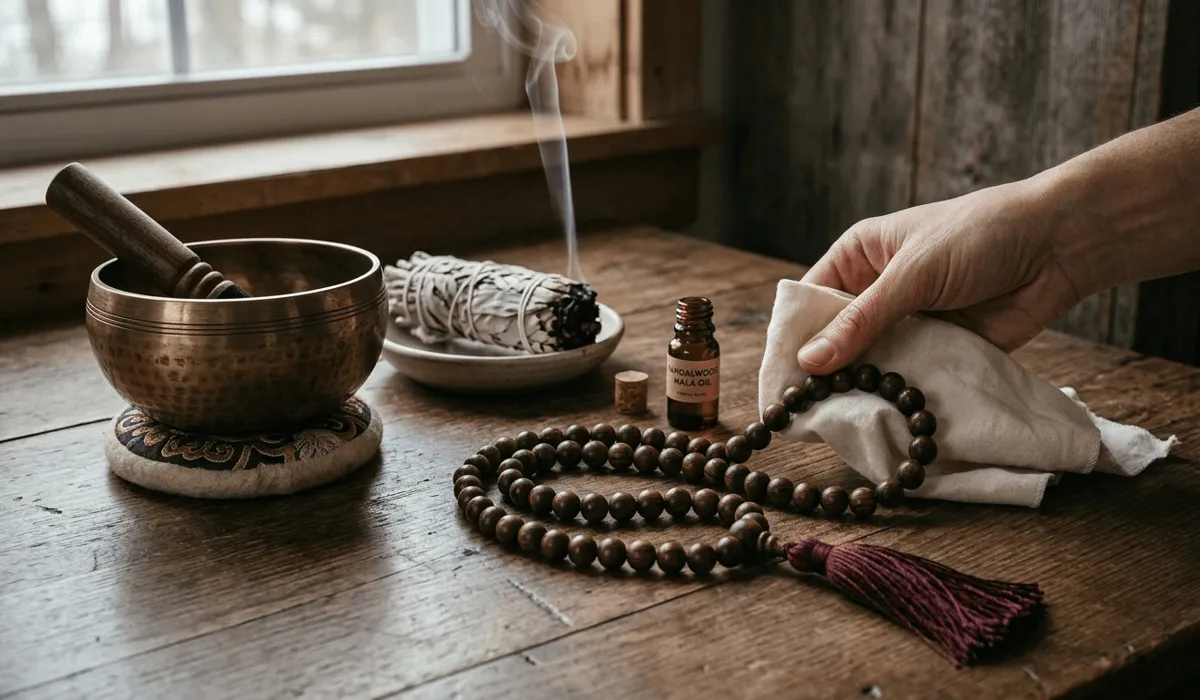
Because wood is porous, you should not soak your mala in water as it might warp or crack. Instead, we suggest using smoke from sage or Palo Santo to clear away any old energy. You can also use sound by placing your beads next to a singing bowl to let the vibrations refresh the material.

If burning incense or using a singing bowl is not feasible, you can place your mala on a bed of natural sea salt overnight (with a cloth barrier to prevent direct contact). Sea salt is widely regarded across cultures as having negative-energy-absorbing properties. Alternatively, a brief morning sunlight exposure (no more than 15 minutes) can similarly refresh the beads, but be cautious not to overdo it to prevent the wood from drying and cracking.
Charging and Daily Storage
To charge your beads with fresh energy, leave them on a windowsill during a full moon, allowing the moonlight to gently bathe each bead—this is a very gentle yet effective method for energy cleansing and charging. Avoid leaving them in direct sunlight for too long, as this can dry out the natural oils in the wood. When you aren't using them, store your beads in a soft silk or cotton pouch to keep them clean and respected.
| Charging Method | Key Steps | Best For | Precautions |
|---|---|---|---|
| Full Moon Light | Place on windowsill for 4-6 hours on full moon night | Regular monthly maintenance | Avoid rain exposure |
| Singing Bowl Vibrations | Place near bowl, strike for 3-5 minutes | Quick cleansing | Moderate volume is sufficient |
| Smoke Purification | Circle beads through sage/Palo Santo smoke 3 times | Pre/post daily practice | Fire safety awareness |
| Visualization | Close eyes, visualize white light enveloping mala | Anywhere, anytime | Requires some concentration |
Long-Term Maintenance
To keep the wood from becoming brittle, you can apply a tiny drop of natural sandalwood oil or coconut oil once or twice a year. Always treat your mala with respect and try to keep it off the floor. Following these simple steps ensures that your tool will last for many years of practice.
Step-by-Step Guide: How to Use Wooden Mala Beads for Japa Meditation
To help you visualize the process, we have broken down the traditional method into the following steps:
-
Preparation Posture — Sit comfortably and drape the mala over your middle finger.
-
Starting Position — Begin with the first bead next to the Guru bead.
-
Flick and Chant — Use your thumb to pull each bead toward you while silently or softly whispering your mantra once.
-
Continue Counting — Flick the next bead in the same manner and repeat the chant.
-
Complete One Round — When you reach the 108th bead (the one just before the Guru bead), you have finished one round.
-
Reverse Direction — If you wish to continue, do not cross the Guru bead. Instead, turn the mala around and go back in the reverse direction starting from the bead you just finished.
The core of this process lies in the coordination of the thumb and middle finger—the thumb symbolizes the transformation of the "ego," the middle finger represents "awakening," and avoiding the index finger serves to minimize the interference of the "little self."
Video source:YouTube
Author:Himalayan Institute
Original video link:https://www.youtube.com/watch?v=IuPmTCbZwSQ
Frequently Asked Questions
Q: What are the spiritual benefits of wooden mala beads?
A: Wooden mala beads help anchor the mind during meditation which reduces anxiety and creates a state of flow. Wood is a natural conductor that is believed to store the spiritual energy of the mantras you chant over time.
Q: How do I use wood malas for chanting and japa?
A: Drape the mala over your middle finger and use your thumb to pull each bead toward you after every mantra repetition. It is traditional to avoid using the index finger because it represents the ego which can interrupt the spiritual energy.
Q: Why are there exactly 108 beads in a wood mala?
A: The number 108 is sacred in many traditions and represents the connection between the individual and the universe. It also corresponds to the 108 energy lines in the body and provides a set timeframe for a deep meditation session.
Q: How do I prepare my wooden mala beads for the first time?
A: You should first cleanse the beads using smoke or sound to remove any energy from the shipping process. Then spend about ten minutes holding the beads in silence to harmonize their vibration with your own personal energy before your first meditation.
Q: How do I properly care for and store my sandalwood beads?
A: You should keep your sandalwood beads away from water to prevent warping and loss of scent. Store them in a cool and dark place in a dedicated cloth pouch to preserve the aromatic oils and keep them safe from dust.
Conclusion and Gentle Next Step
Wooden mala beads are more than just jewelry; they are companions on your journey toward mental clarity and inner peace. By using these tools in your daily routine, you create a dedicated space for mindfulness and grounding. If you want to learn more about the science of beads, you can visit the Gemological Institute of America (GIA) for general information. For those interested in the history of prayer tools, the Online Encyclopedia and Gemmological Association of Great Britain (Gem-A) offer great resources on organic materials. Respecting your mala ensures it grows with you as your practice matures.
The content provided in this article is for informational and cultural exchange purposes only. It does not constitute medical, legal, financial, or other professional advice. Readers should consult with qualified professionals regarding any specific concerns or health issues.

Longyi Luck
Longyi Luck is a Feng Shui practitioner and spiritual researcher who blends traditional year-based wisdom with modern lifestyle insights, specializing in Feng Shui, spirituality, meditation, and mindfulness. With years of dedicated study and practice, Longyi explores cultural symbolism and the practical application of ancient wisdom to help individuals cultivate balance, clarity, and harmony in everyday life. Since 2020, Longyi has been committed to translating timeless traditions into accessible guidance for the modern world.
longyi@auraandluck.com



.webp?w=800&h=800)
.webp?w=800&h=800)