

Bodhi seed malas are traditional prayer beads used for spiritual counting and mindfulness practice in Buddhist and Vedic traditions. We believe these bodhi seeds are the ultimate tools for anyone seeking a deeper connection to their inner self and the path of enlightenment. By understanding the history of bodhi seeds and their spiritual energy, you can transform your daily meditation into a powerful spiritual growth ritual.
In Tibetan Buddhism, Chinese Buddhism, and Hinduism, the bodhi seed mala is regarded as one of the most sacred mala materials, carrying over 2,500 years of spiritual lineage. Each complete bodhi seed mala typically consists of 108 main beads, one guru bead, and a tassel, used for Japa meditation—the practice of mantra repetition.
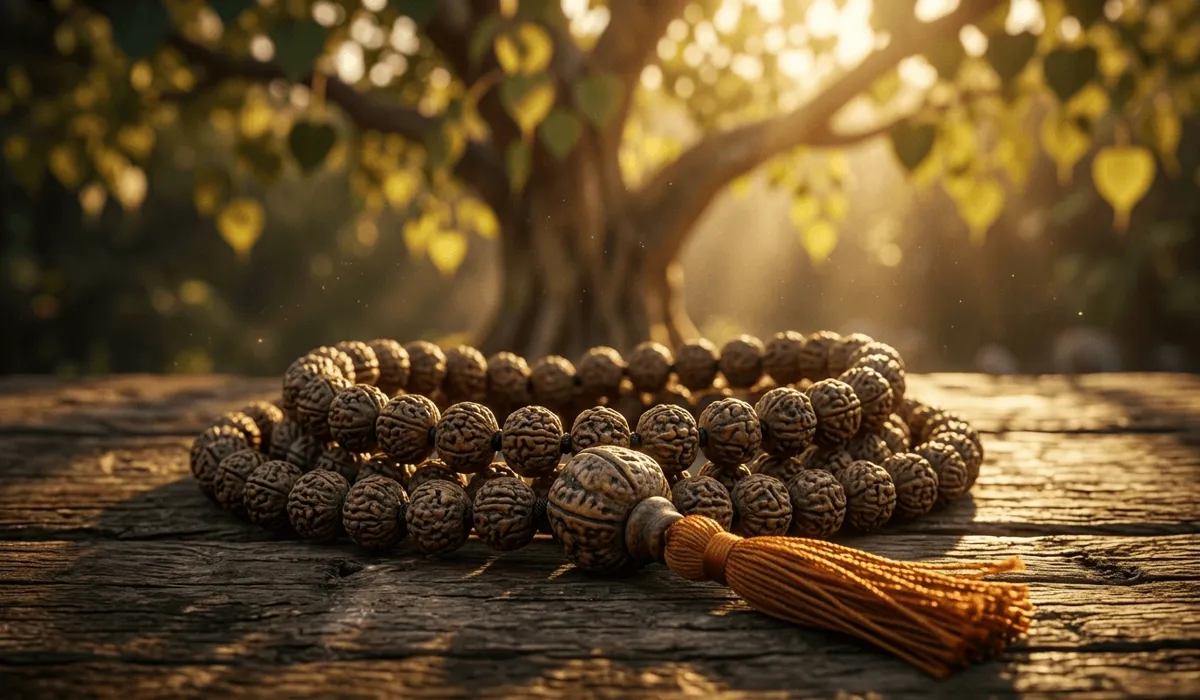
The Core Meaning of Bodhi Seed Malas
Definition
The word Bodhi comes from Sanskrit and translates to "enlightenment" or "awakening." A bodhi seed mala represents the potential for every person to wake up from ignorance and realize their true nature. We see these malas as a map for the spiritual journey, helping practitioners stay focused on their higher purpose.
Origin & Materials
These sacred malas are harvested from the Bodhi tree (Ficus religiosa) , the very species of tree under which Shakyamuni Buddha attained awakening. Regarding the origin of bodhi seeds, an important clarification is needed: according to search results, what is commonly called "bodhi seeds" in the market are not actually the fruits of the Bodhi tree—because the true Bodhi tree fruits are too small to be made into malas. The bodhi seed malas spoken of in Tibetan Buddhist tradition typically come from the "Buddha Chitta tree" in Nepal and the Himalayan region. Nevertheless, these malas are considered sacred because of their symbolic connection to the place of the Buddha's enlightenment. While many seeds are sold under this name, an Online Encyclopedia Information search will show that Tibetan bodhi seeds are the most prized for their dense quality.
According to the Buddha Speaks the Sutra of Measuring the Merits of Malas, Manjushri Bodhisattva taught about various materials for malas—iron, copper, pearl, coral, wood, lotus seed, crystal, and bodhi seeds—and that reciting mantras or Buddha names while holding malas of different materials yields different corresponding merits. The sutra particularly emphasizes that the bodhi seed mala possesses the most supreme merit among all materials.
Video source:YouTube
Author:DharmaShop
Original video link:https://www.youtube.com/watch?v=NLppDEWSfVo
Basic Characteristics
Authentic bodhi seed malas are naturally textured and very dense, making them perfect for long-term use. Most traditional malas feature 108 beads, which is a sacred number in Eastern philosophy. As you use them, the bodhi seeds absorb natural oils from your skin, causing them to darken and develop a rich, polished patina. Every natural bodhi seed has a unique grain pattern—no two are exactly alike, symbolizing that every practitioner has their own unique path to enlightenment.
Among the many bodhi seed varieties, the Phoenix Eye Bodhi is the most precious. It features a unique natural "eye" marking on each bead, symbolizing spiritual insight, clear vision, and wisdom. In Tibetan Buddhism, the Phoenix Eye Bodhi mala is regarded as the most sacred and powerful type of bodhi seed. Other varieties include Dragon Eye Bodhi (triangular "eye" marking, symbolizing the overcoming of afflictions), Kylin Eye Bodhi (square "eye" marking, symbolizing auspiciousness), and Star and Moon Bodhi (tiny dots and holes, symbolizing the radiance of stars and moon).
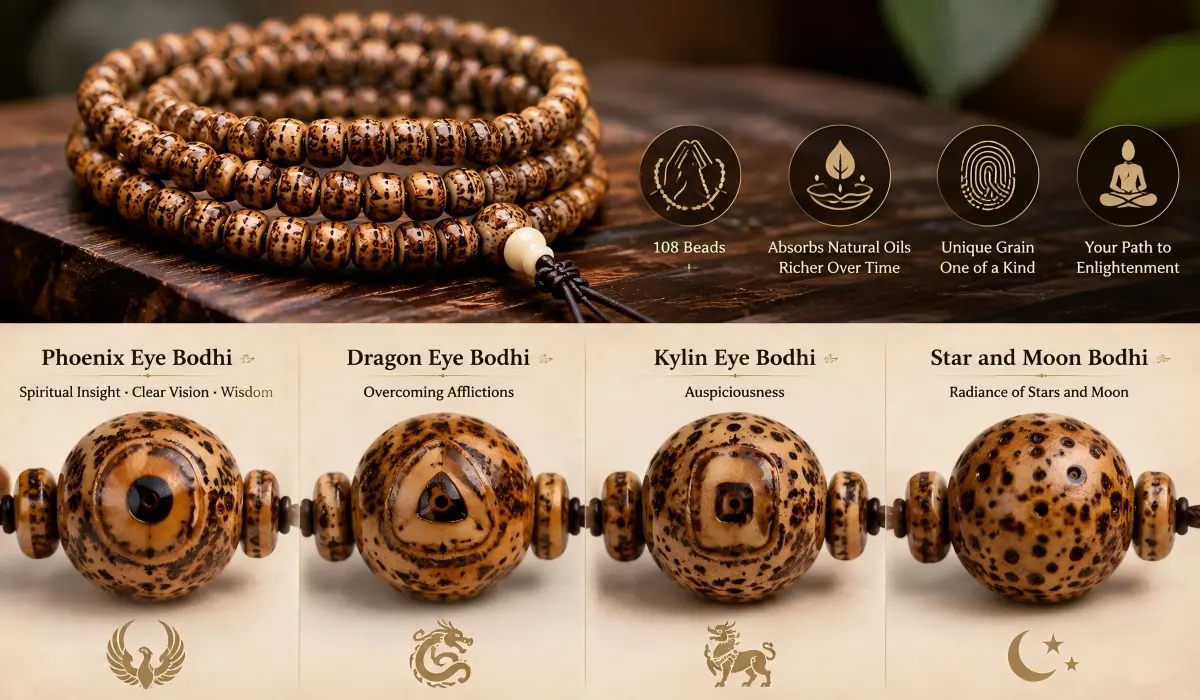
Comparison of Major Bodhi Seed Varieties
| Variety | Appearance | Symbolic Meaning | Rarity |
|---|---|---|---|
| Phoenix Eye Bodhi | Clear "eye" marking on bead surface | Compassion and Wisdom | Most rare |
| Dragon Eye Bodhi | Triangular "eye" marking | Overcoming afflictions | Rare |
| Kylin Eye Bodhi | Square "eye" marking | Auspiciousness | Rare |
| Star and Moon Bodhi | Tiny dots and holes, like stars and moon | Purity and Perfection | Common |
Spiritual Meaning & Symbolism
The spiritual meaning of bodhi seed malas is deeply tied to the "Tree of Wisdom" and the triumph over human suffering. They symbolize the internal strength needed to break through the "hard shell of ego" to find inner peace. When we hold these malas, they remind us that wisdom is grown through patience and consistent practice.
In the chakra system, bodhi seed malas provide multiple energy-balancing functions. They offer powerful grounding energy, making them excellent for the Root Chakra, helping practitioners establish a sense of security and stability. They also help clear the Third Eye and Crown Chakras, which are essential for inner awakening and clear vision. By balancing these energy centers, the bodhi seed mala helps you stay steady while reaching for higher spiritual goals.
Chakra Associations of Bodhi Seed Malas
| Chakra | Location | Role of Bodhi Seeds | Effect |
|---|---|---|---|
| Root Chakra | Base of spine | Strong grounding | Enhances security and stability |
| Third Eye Chakra | Between eyebrows | Opens intuition | Enhances inner vision and insight |
| Crown Chakra | Top of head | Spiritual connection | Experience of oneness with the universe |

Cultural and Historical Context
In many Eastern traditions, bodhi seed malas are considered the most auspicious mantra tools for any type of practice. Ancient texts suggest that using bodhi seed malas for mantra recitation increases the merit of your practice more than other materials. They connect modern seekers to a lineage that is over 2,500 years old, linking us to the sacred energy of the Buddha's enlightenment in Bodh Gaya.
Benefits & Intentions Associated with Bodhi Seed Malas
Many practitioners use these bodhi seed malas to find focus during big life changes or difficult study periods. The bodhi seed is a symbol of resilience, showing us that beauty comes from time and effort. We often suggest bodhi seed malas for those who want to build a lasting spiritual foundation.
Using these meditation tools provides a physical anchor that keeps your mind from wandering during mantra recitation. They are perfect for Japa meditation, as their earthy texture is easy to feel between the fingers. Over time, the mala carries the peaceful energy of your practice, forming a layer of energetic protection. Regular use of a bodhi seed mala also enhances awareness of the present moment, helping practitioners quickly return to calm during times of anxiety or stress.
Common mantras used with bodhi seed malas include: the Avalokiteshvara mantra "Om Mani Padme Hum" —for compassion and wisdom; "Om Ah Hum" —for purification of body, speech, and mind; the Heart Sutra mantra "Gate Gate Paragate Parasamgate Bodhi Svaha" —for prajna wisdom. Practitioners may also choose their own mantra according to their personal spiritual goals.
On Reddit, user No_Spell_3561 shared their experience in the r/shaivism community:
"Something I didn't expect... my mantra practice felt different. More grounded."
*sources:[Does wearing a mala actually change something energetically or are we just romanticizing tradition?](https://reddit.com/r/shaivism/comments/1thegch/does_wearing_a_mala_actually_change_something/)*
This personal account highlights how the physical presence of a bodhi seed mala can shift the energy state and focus of a meditation session.
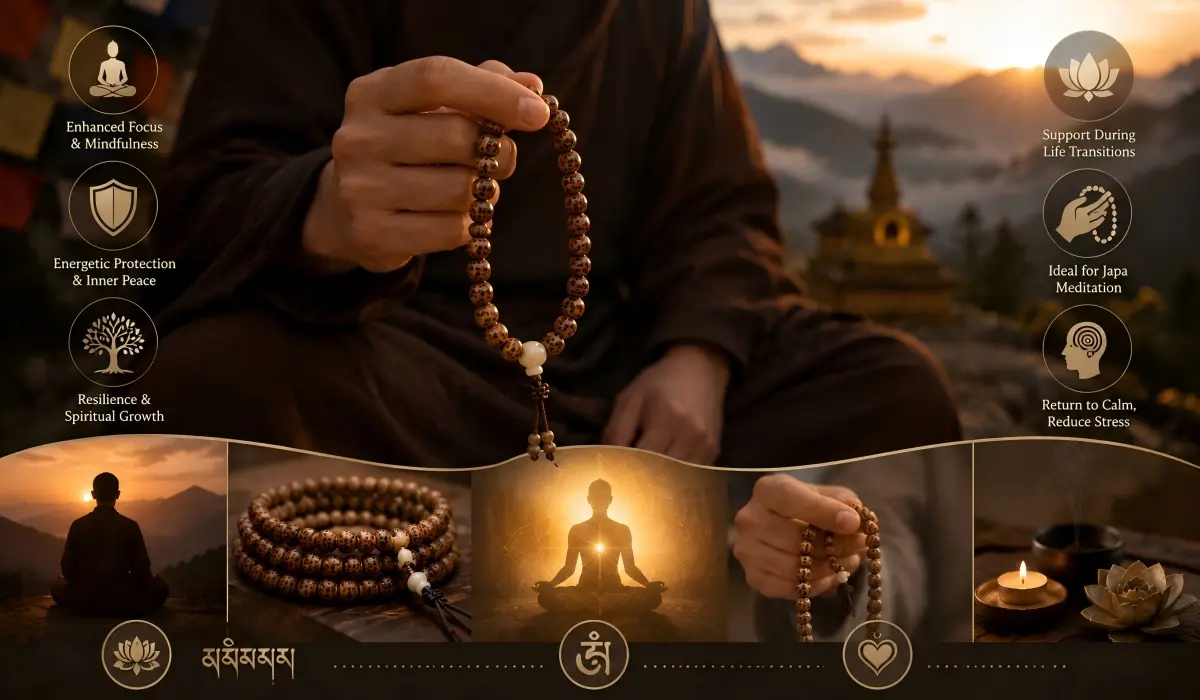
How to Wear Bodhi Seed Malas
In Feng Shui logic, wearing a mala has clear directional significance: wearing the mala on the left wrist helps you "receive"—absorbing spiritual blessings and calming energy; the right wrist is for "sending"—directing your intentions and prayers into the universe. You can also wear the mala as a necklace to keep the awakening beads close to your heart chakra throughout the day.
We recommend wearing your bodhi seed mala during times of high stress, important meetings, exams, interpersonal interactions, and daily commutes to help you stay grounded and calm, transforming waiting time into meditation moments. It serves as a constant reminder of your commitment to mindfulness and personal growth.
To energetically activate a new bodhi seed mala, follow this simple ritual: hold the mala in both hands and close your eyes; visualize a soft golden light filling each bead; whisper a personal mantra or intention into the guru bead; wear the mala with respect to keep that energy close to you.
How to Use a Bodhi Seed Mala
A standard bodhi seed mala consists of 108 main beads, one guru bead (also called the Buddha head or three-way connector), and disciple beads (counter beads). According to the Vajra Peak Yoga Mala Sutra, each bead represents the sacred fruit of a bodhisattva, while the guru bead represents Infinite Life or the perfect fruition of Buddhist practice. Therefore, when reciting, one should not cross over the guru bead while counting; instead, turn the mala around and go back in the opposite direction, showing respect for the Buddha's wisdom.
In Tibetan Buddhist traditions, the string of the mala typically uses white, yellow, red, and green threads, representing the simultaneous blessings of the four activities: pacifying, increasing, magnetizing, and subjugating. Three knots are tied above the guru bead, symbolizing the three bodies of Buddhahood—Dharmakaya, Sambhogakaya, and Nirmanakaya. The tightness between beads should be moderate—too tight may bring obstacles to longevity or practice, while too loose makes it difficult to attain the siddhi (accomplishment) of the deity.
A newly strung bodhi seed mala needs to be blessed to become a truly powerful practice tool. According to Tibetan Buddhist transmission, during the blessing ceremony, one recites the Mala Blessing Mantra 21 times, then the Dependent Arising Mantra 3 times, visualizing the blessings of the guru and the Three Jewels, purifying the mala and the practitioner, dispelling all obstacles, and visualizing the Buddhas and Bodhisattvas descending into the mala, making it inseparable from the Buddhas and Bodhisattvas.
During recitation, visualize the string of the mala as the deity and each bead as the deity's retinue. Hold the mala in your left hand, and with each mantra recitation, move one bead forward. Maintain focus and quality throughout the recitation, chanting, moving beads, and visualizing at a moderate pace. If you cough, speak, become distracted, or your mind wanders, you should compensate with additional recitations. After completing one full round, typically count only 100 recitations—the extra 8 beads serve as a buffer to compensate for lapses in attention during the session. With long-term proper use, the mala will become increasingly empowered, and practitioners should not change their mala lightly nor let others touch it casually.
Video source:YouTube
Author:Great Compassion Bodhi Prajna Temple
Original video link:https://www.youtube.com/watch?v=op68neAjiZg
How to Identify and Choose Authentic Bodhi Seed Malas
With the growing popularity of bodhi seed malas, the market for bodhi seed malas has expanded significantly in quantity, variety, and price range, with quality varying greatly. To select an authentic bodhi seed mala, consider the following aspects.
First, observe color and texture. Every natural bodhi seed has its own unique grain pattern—no two seeds in the world are exactly alike. Authentic bodhi seeds have clear, consistent grain patterns and natural coloration—natural bodhi seeds cannot display perfect uniformity and translucency. Those that appear overly uniform and unnaturally shiny should raise suspicion. When selecting, carefully inspect each bead for regularity, ensuring there are no missing, cracked, withered, or damaged beads.
Second, feel the texture. Authentic bodhi seeds have a certain roughness and friction on the surface. Even after high polishing, they do not display a paint-like shine but rather a waxed feel, without an oily reflective effect. If possible, gently heat the mala over a flame—authentic bodhi seeds will only emit the normal scent of burning plant material; if a chemical, pungent odor is produced, it is most likely a plastic or resin imitation.
Third, be aware of common counterfeiting methods. Bodhi seed counterfeiting primarily targets high-end varieties and aged bodhi seeds—substituting inferior materials (such as using jujube pits to imitate Phoenix Eye), passing off fakes as genuine (molding resin or plastic into shape and then processing or aging them), and artificially aging (using chemical soaks, oil boiling, or lacquering to make new bodhi seeds appear old). When selecting, also note that sizing is measured in millimeters, and the beads in a mala should be as consistent in size as possible, arranged neatly and evenly. Natural coloration will always vary, so choose malas with minimal color variation to maintain overall aesthetic appeal. For varieties with "eyes" such as Phoenix Eye and Star and Moon, seeds with eye markings positioned between the two holes, straight and complete, and aligned in a single line when strung, have higher value.
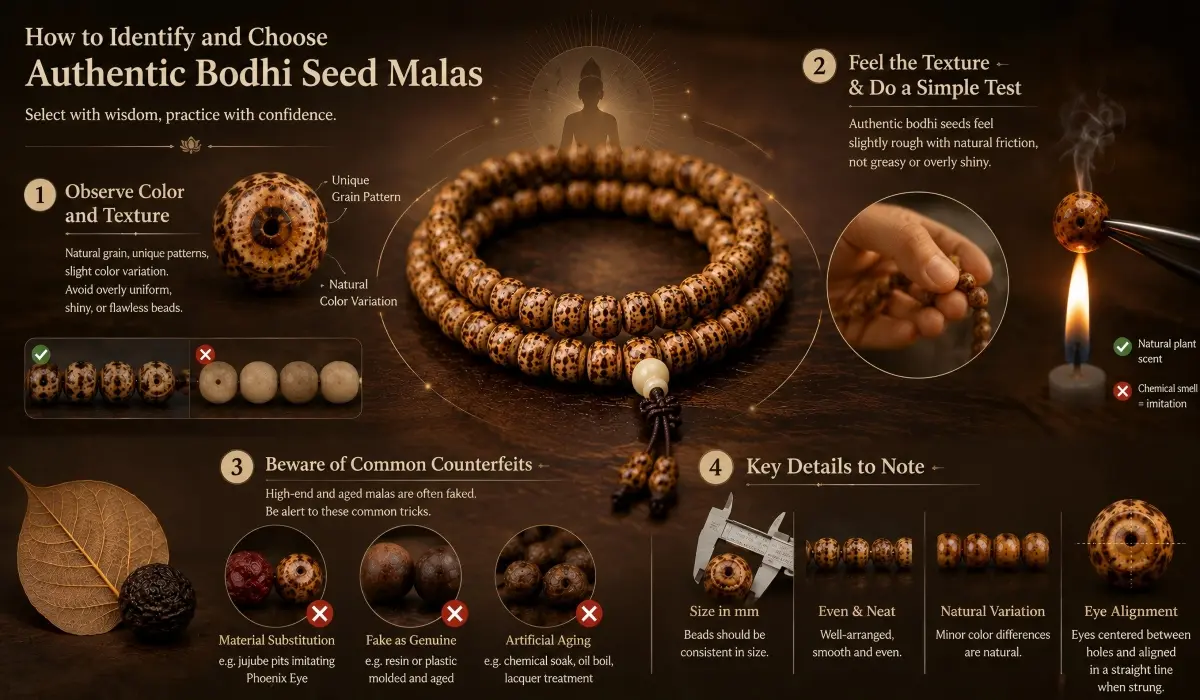
Bodhi Seed Mala Selection Quick Reference
| Inspection Item | Quality Standard | Red Flags |
|---|---|---|
| Color | Naturally uneven, with variations in shade | Overly uniform or translucent (may be plastic/resin) |
| Grain Pattern | Clear, consistent, naturally unique | Muddy, chaotic, or perfectly identical (may be mold-pressed) |
| Bead Body | Regular shape, no defects, consistent size | Missing, cracked, withered, or damaged beads |
| Texture | Slightly rough, no oily shine | Overly smooth, paint-like gloss (may be counterfeit) |
| Burning Test | Normal scent of burning plant material | Chemical, pungent odor (plastic/resin imitation) |
Bodhi Seed vs Similar Stones or Beads
| Feature | Bodhi Seed | Rudraksha | Sandalwood |
|---|---|---|---|
| Primary Use | Enlightenment & Wisdom | Protection & Power | Calming & Relaxation |
| Texture | Dense with natural grain | Rough and faceted | Smooth and light |
| Element | Earth/Spirit | Fire | Air/Wood |
| Best For | Those seeking enlightenment | Those seeking protection | Those with anxiety/insomnia |
Rudraksha is excellent for protection practices, while the bodhi seed mala emphasizes the "Middle Way"—peace and steady growth. Sandalwood is wonderful for its scent, but it does not have the same durability as natural seeds. For those interested in other materials, you can explore Gemstone Meditation Tools to see how they compare to organic seeds.
Who Is a Bodhi Seed Mala Suitable For?
Chakra and Energy Alignment
If you feel "spacey" or disconnected from your spiritual path, a bodhi seed mala can bring you back to earth. They are ideal for students of philosophy, energy healing practitioners, meditation beginners, and long-term practitioners seeking to deepen their existing practice. The steady energy of the seeds helps bridge the gap between physical life and spiritual goals.
Zodiac and Astrological Associations
In Vedic astrology, bodhi seed malas are often linked to the expansive and wise energy of Jupiter. They are especially helpful for earth signs like Taurus (who value natural materials and stability) and Virgo (who appreciate detail and practicality), as well as those born in the Year of the Tiger or Rabbit (enhancing helpful connections) and Year of the Dragon or Snake (stabilizing emotions). However, anyone can wear a bodhi seed mala, as the search for truth is a universal human desire.

How to Cleanse, Charge, and Care for Bodhi Seed Malas
To keep your bodhi seed mala in its best condition, daily maintenance is essential. Gently wipe it with a soft cloth to remove dust. Avoid getting the mala wet, as natural seeds might crack if they absorb too much water. Also avoid prolonged exposure to high heat and direct sunlight, which may cause cracking or fading. Washing your hands before handling the mala prevents stains from penetrating the seeds, and regularly check the string to prevent breakage and loss of beads. Maintaining your bodhi seed mala is itself a form of spiritual discipline—each wipe is an opportunity to cultivate patience and focus.
Energy cleansing and charging are equally important. Common cleansing methods include: smoke cleansing with sandalwood or sage incense (recommended weekly); moonlight charging by placing the mala under a full moon overnight (recommended monthly); using a singing bowl to clear old energy with sound vibrations; or charging through mantra recitation by chanting 108 mantras with the mala. When not being worn, store your bodhi seed mala in a silk pouch to avoid surface damage from friction with hard objects.
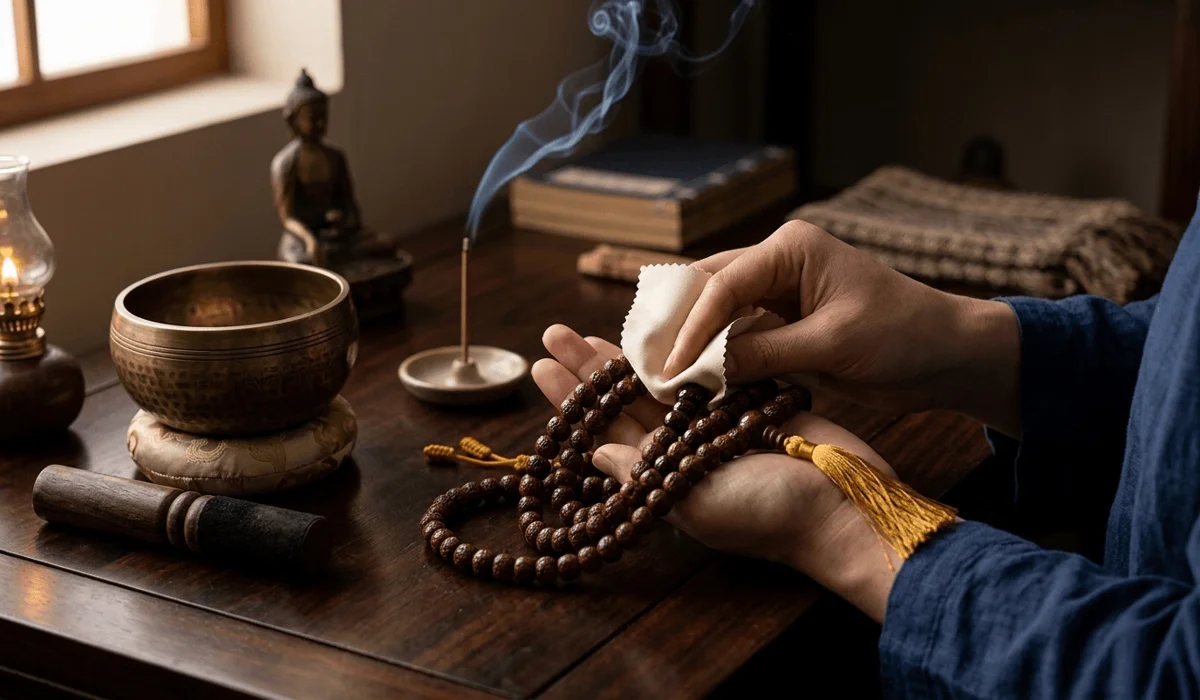
Bodhi Seed Mala Cleansing Methods Comparison
| Cleansing Method | How to Do It | Recommended Frequency | Best For |
|---|---|---|---|
| Smoke Cleansing | Sandalwood or sage smoke | Weekly | Daily maintenance |
| Moonlight Charging | Overnight under full moon | Monthly | Deep charging |
| Singing Bowl Sound Healing | Sound vibration cleansing | As needed | When energy feels blocked |
| Mantra Charging | Chant 108 mantras | After each use | Daily practice |
Frequently Asked Questions
Q: What is the spiritual meaning of Bodhi seed beads?
A: They symbolize the enlightenment achieved by the Buddha and the potential for every human to wake up to their peaceful nature. They act as a physical reminder of the path toward wisdom and the end of suffering.
Q: Why are Bodhi seed malas traditionally composed of 108 beads?
A: The number 108 is sacred and represents the 108 earthly temptations or defilements that one must overcome. It also aligns with the energy lines that converge at the heart chakra in ancient Vedic science.
Q: How do Bodhi seeds change as you use them for meditation?
A: The seeds naturally absorb oils from your skin, turning from a light tan to a deep, dark reddish-brown. This physical change is seen as a sign of the practitioner's inner progress and dedication to their practice.
Q: What is the significance of the guru bead in a Bodhi mala?
A: The guru bead represents the teacher or the Buddha and marks the start and end of a mantra circuit. It is never crossed during prayer; instead, you turn the mala around to show respect for the teacher's wisdom.
Q: What is the difference between various types of Bodhi seeds?
A: Phoenix eye seeds have an eye-like marking symbolizing compassion, while Star and Moon seeds have tiny dots and holes. While they look different, they all share the same foundation of enlightenment and spiritual awakening.

Conclusion & Gentle Next Step
A bodhi seed mala is more than just an accessory; it is a faithful companion on your spiritual path. As your mala changes color and texture over time, it reflects the growth of your own heart and mind. We invite you to treat your mala with care, and it will surely support your journey toward peace.
To ensure you are getting the most out of your practice, we recommend learning more from experts like Global Gemstone Authority regarding natural materials. Let these ancient seeds be a constant source of inspiration and grounding in your busy life.
We suggest starting your bodhi seed mala practice journey with the following steps: first, choose the right bodhi seed mala variety based on your personal needs and budget; then, perform the energy activation ritual for your mala as described above; next, establish a daily practice habit, starting with just 5 minutes of mantra meditation each day; observe the color changes in your mala monthly and reflect on your personal growth; finally, consider joining communities of other bodhi seed mala practitioners to share experiences and insights.

Longyi Luck
Longyi Luck is a Feng Shui practitioner and spiritual researcher who blends traditional year-based wisdom with modern lifestyle insights, specializing in Feng Shui, spirituality, meditation, and mindfulness. With years of dedicated study and practice, Longyi explores cultural symbolism and the practical application of ancient wisdom to help individuals cultivate balance, clarity, and harmony in everyday life. Since 2020, Longyi has been committed to translating timeless traditions into accessible guidance for the modern world.
longyi@auraandluck.com


.webp?w=800&h=800)
.webp?w=800&h=800)