
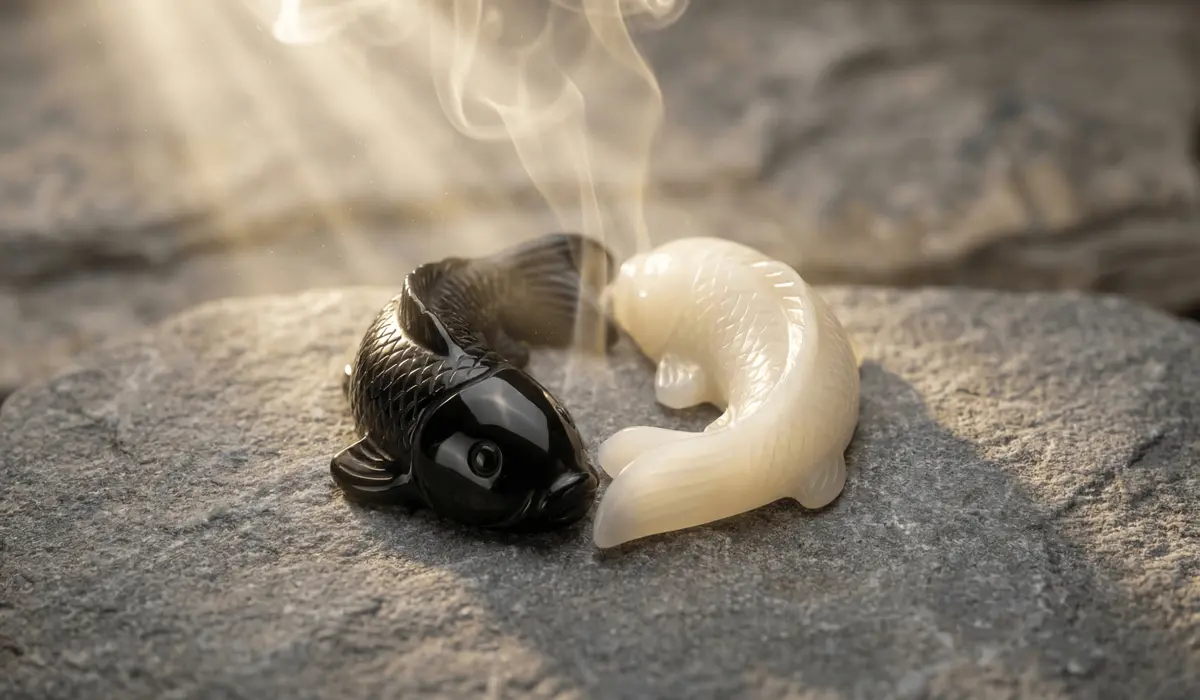
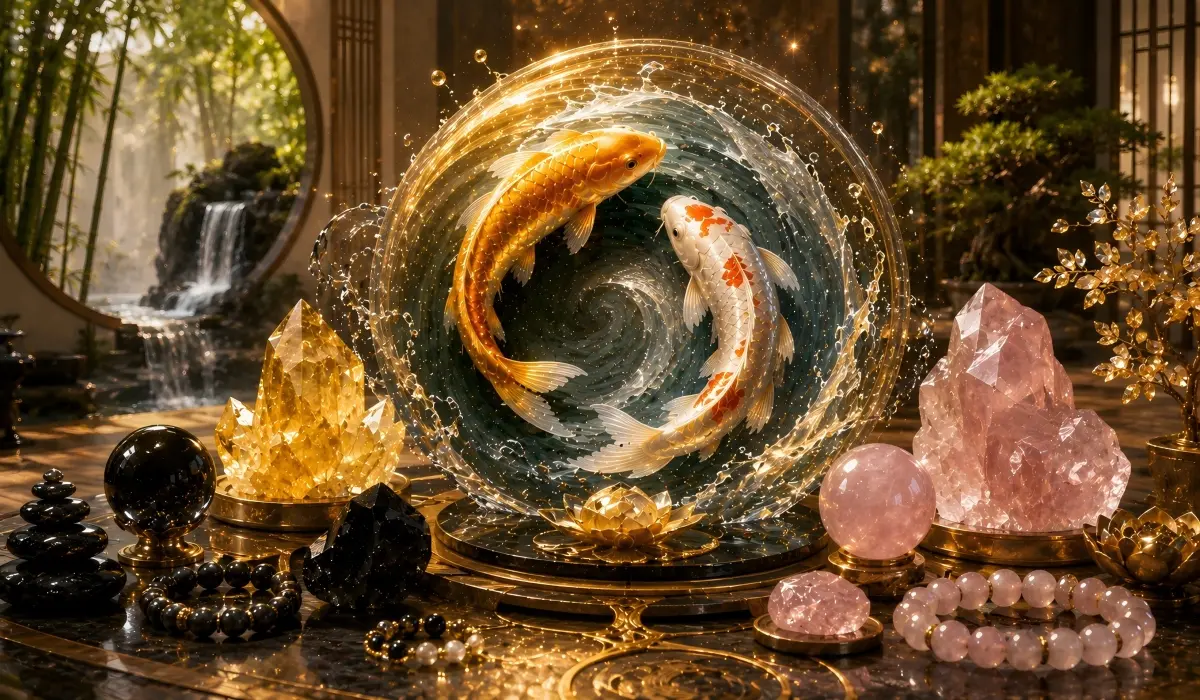
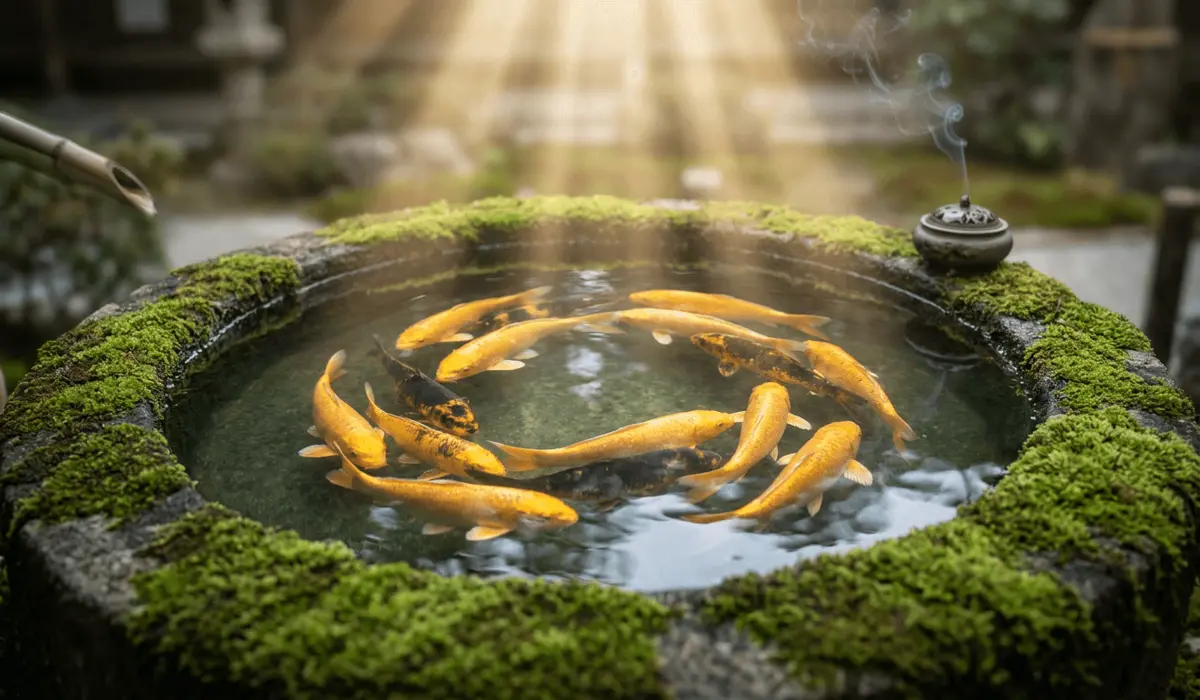
We believe that true success is more than just a number in a bank account. It is a state of being where your outer achievements match your inner peace. In the world of Feng Shui (风水) , few symbols capture this balance as perfectly as the two koi fish swimming in a circle.
Beyond Aesthetics: Why the Two Koi Fish Resonate with the Human Soul?
The image of two koi fish serves as a mirror to our own lives. We all face the eternal dance between struggle and achievement. This symbol bridges the gap between material wealth and spiritual fulfillment by showing that one cannot exist without the other—that true prosperity is not merely a growing bank balance, but a deep-seated sense of "enoughness" that resides within.
When we look at the circular motion of the fish, it acts as a visual anchor for our minds. In neuroscience, this focused attention activates relaxation responses in the prefrontal cortex, helping us enter a flow state (Flow State) —what psychologist Mihaly Csikszentmihalyi called the "optimal experience"—where work feels natural and productive, time dissolves, and creativity flows effortlessly. It reminds us that even in busy times, we can find a rhythm that prevents burnout. The greatest crisis in the modern workplace is not insufficient effort, but excessive effort without direction—the koi's circular movement reminds us that true progress is not a linear sprint, but an upward spiral.
The two koi represent the perpetual motion of life. They teach us that standing still is not an option if we want to grow. In physics, this is known as "dynamic equilibrium"—like a bicycle that can only remain upright while moving forward. By watching their movement, we learn to navigate the currents of our own careers with grace and strength—not becoming arrogant in favorable times, nor collapsing in adversity.
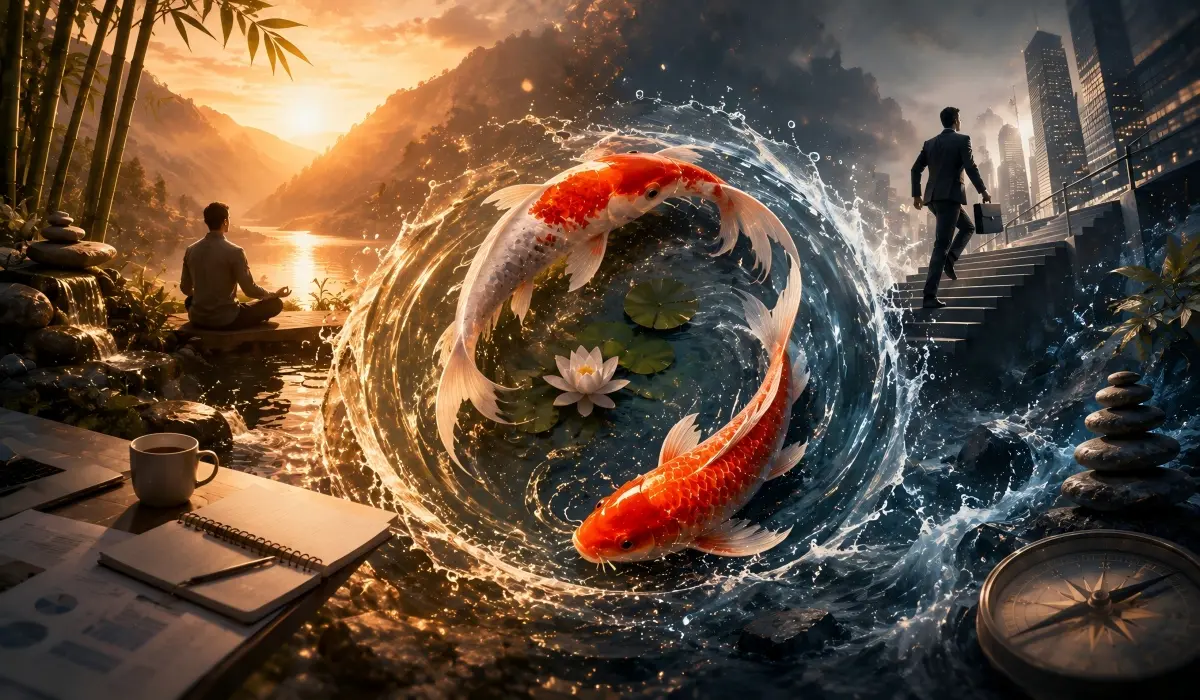
A Modern Psychology Perspective: The Koi as an Antidote to Dichotomous Thinking
In contemporary psychology, people often fall into dichotomous thinking —either success or failure, perfect or worthless. This cognitive distortion is recognized in Cognitive Behavioral Therapy (CBT) as a core trigger for anxiety and depression. The Yin-Yang structure of the two koi is precisely the antidote to this mindset. They show in the most intuitive way that opposing forces can coexist, complement, and even mutually engender one another—that within light resides the seed of shadow, and within shadow glimmers the seed of light.
Research has shown that individuals who tolerate ambiguity and paradox score significantly higher in stress tolerance and creativity than those trapped in black-and-white thinking. A Stanford University study found that managers with "paradoxical thinking" made decisions 30% more effective than their peers in volatile markets. The koi symbol serves as a daily visual reminder: you can struggle and feel at peace at the same time; you can pursue wealth while maintaining your spirituality; you can charge forward at full speed while remaining anchored in inner stillness. This is not compromise—it is wisdom at a higher dimension.
Ancient Origins and the Sacred Legend of the Dragon Gate
The story of the koi begins in ancient Chinese mythology. Legend tells of thousands of koi swimming upstream against the powerful currents of the Yellow River—a treacherous path of whirlpools, waterfalls, and cliffs that caused countless fish to give up halfway. While many surrendered, a persistent pair kept pushing forward, day after day, year after year, for a full hundred years. Their scales were scratched by rocks, their tails torn by rapids, but never once did they cease their rhythmic struggle.
When they reached the top of a massive waterfall known as the Dragon Gate (龙门) , they made a final, heroic leap—a soaring ascent through the clouds. The gods were so impressed by their endurance and courage that they transformed the koi into golden celestial dragons , soaring through the heavens. This journey perfectly represents the convergence of Yin (quiet work) and Yang (total transformation) —a hundred years of ordinary persistence is Yin; that single, brilliant leap of metamorphosis is Yang. Neither can exist without the other: without a century of accumulation, that leap would be mere recklessness; without the final leap of courage, a century of persistence would be a fruitless cycle.
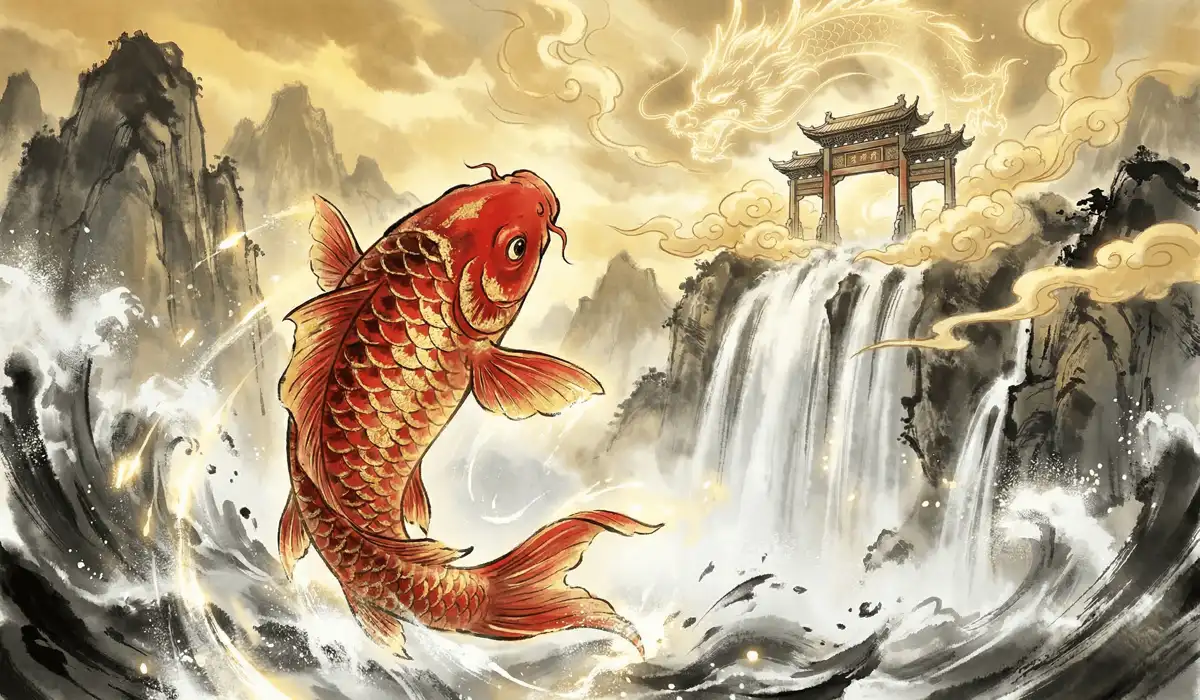
This myth is the most profound metaphor for modern life. It shows that overcoming huge odds requires both unremitting effort and the courage to take a decisive leap at the critical moment. In every person's career, there is a "Dragon Gate"—a defining moment for which all prior preparation has been building. In the imperial courts of old, this symbol was often used to represent scholarly merit and upward mobility , becoming the most sacred emblem for humble scholars—a testament that those who swim against the current shall eventually become dragons.
The Three Key Stages of the Dragon Gate Legend and Their Life Mapping
The Dragon Gate legend is not merely a myth—it is a complete script for every person's career journey. We can break it down into three distinct stages, each with its own mindset, challenges, and coping strategies:
| Stage | Legend Plot | Life Mapping | Koi Virtue | Core Mindset |
|---|---|---|---|---|
| Stage One | Swimming upstream against rapids | Early career: enormous resistance, scarce resources, fierce competition—you're being pushed back daily, three steps forward and two steps back | Perseverance | Don't compare, don't complain—treat every setback as building momentum |
| Stage Two | Continuing for one hundred years | Long-term accumulation: no immediate reward in sight, others around you may have given up or pivoted—you walk alone in the dark | Patience | Trust the power of compounding—improve 1% daily, and in a hundred years you'll have transformed 37-fold |
| Stage Three | Leaping over the Dragon Gate, transforming into a dragon | Breakthrough moment: seizing a rare opportunity, completing a qualitative leap from quantity to quality | Courage | When opportunity arrives, leap without hesitation |
This three-stage model helps readers precisely locate which "waterfall section" they currently occupy. If you feel obstructed at every turn and can barely make progress—congratulations, you are in Stage One, where what you need most is the perseverance to hold on one more time than your competitors. If you have been striving for years without visible results, you are in Stage Two, where the most precious quality is patience—just as bamboo grows only 3 centimeters in its first four years, yet shoots up 30 centimeters daily in its fifth. If you feel "the wind is coming" and opportunity is at hand, you are in Stage Three, where what you need is not hesitation but the courage to take the leap. Understanding your current stage liberates you from anxiety about present struggles—every form of struggle has its meaning, and every stage has its lesson.
The Zen Buddhist and Taoist Influence
In Taoism (Daoism) , the koi is seen as a manifestation of the water element—and water, in the Tao Te Ching, is praised as "closest to the Way"—soft yet powerful, yielding yet able to erode stone. It embodies the wisdom of Wu Wei (无为) : moving with the flow rather than fighting against it. This is not passive resignation, but a profound sense of "timing"—knowing when to exert force and when to wait; cooperating with the current's direction rather than futilely opposing heaven's will. This wisdom leads to a life of less stress and more natural progress, where success falls like ripe fruit rather than being forcibly plucked.
Zen Buddhism also values the koi for its focus. In a Zen garden, the fish represent Zanshin (残心) —a state of total awareness and unwavering concentration. Zen master Shunryu Suzuki once said: "Enlightenment is not some special state of mind, but concentration in everyday life." The koi maintains its direction in rapids, just as the practitioner maintains awareness amidst chaos. They also teach us the lesson of non-attachment (Letting Go) —not clinging to a particular outcome, but clinging to the effort itself; not fixating on when we will arrive, but savoring every moment of the swim. When you stop "desperately wanting" a result, it often comes most easily—this is the Zen paradox of "seeking it, you cannot find it; not seeking it, it comes to you."
By blending these two traditions, the two koi become a powerful tool for deep meditation: they remind us that the highest peaks are supported by the deepest oceans. They help us stay grounded while we aim for the stars, and maintain inner stillness while pursuing excellence.
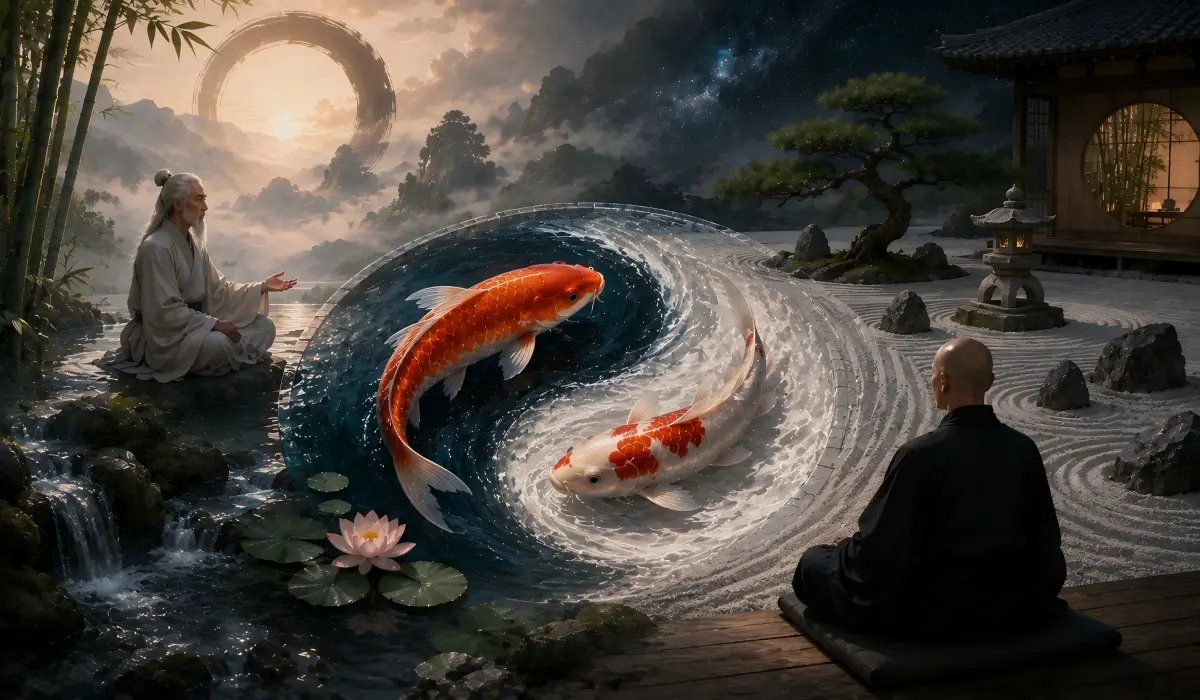
The Tension Between Wu Wei and Persistence: The Unique Balance of Koi Philosophy
Some may ask: "Taoism speaks of Wu Wei, but the koi legend speaks of one hundred years of persistence. Aren't these contradictory?" This is precisely the subtle essence of the dual koi symbol. The Black Koi (Yin Koi) represents Wu Wei—going with the flow, knowing when to rest, trusting the process. The White Koi (Yang Koi) represents persistence—actively swinging the tail, swimming against the current, leaping over the Dragon Gate. True wisdom is not choosing one over the other, but dynamically switching between them—like a skilled long-distance runner who knows when to accelerate, when to conserve, and when to sprint.
In the morning, you may need Yang-driven sprinting—meetings, negotiations, execution. In the afternoon, you need Yin reflection—review, planning, recovery. Across a week, Monday through Wednesday is Yang's offense, Thursday through Friday is Yin's settling. Across a year, spring and summer are Yang's expansion, autumn and winter are Yin's contraction. The koi remind you: do not forget to rest while fighting, and do not completely abandon the fight while resting—true success belongs to those who know how to do the right thing at the right time. This, then, is the most precious gift that koi philosophy offers modern humanity: a sense of rhythm.
Decoding the Symbology of the Dual Koi
The relationship between the black koi and the white/red koi is the very soul of the symbol. The black fish represents Yin—the receptive, intuitive, and nurturing side of our soul. It symbolizes late-night contemplation, dreamlike inspiration, instinctive wisdom, and that quiet certainty of "knowing without doing." The lighter fish represents Yang—the active, protective, and driving force of our ambition. It symbolizes daytime action, goal pursuit, boundary defense, and that fiery conviction that "nothing is impossible."
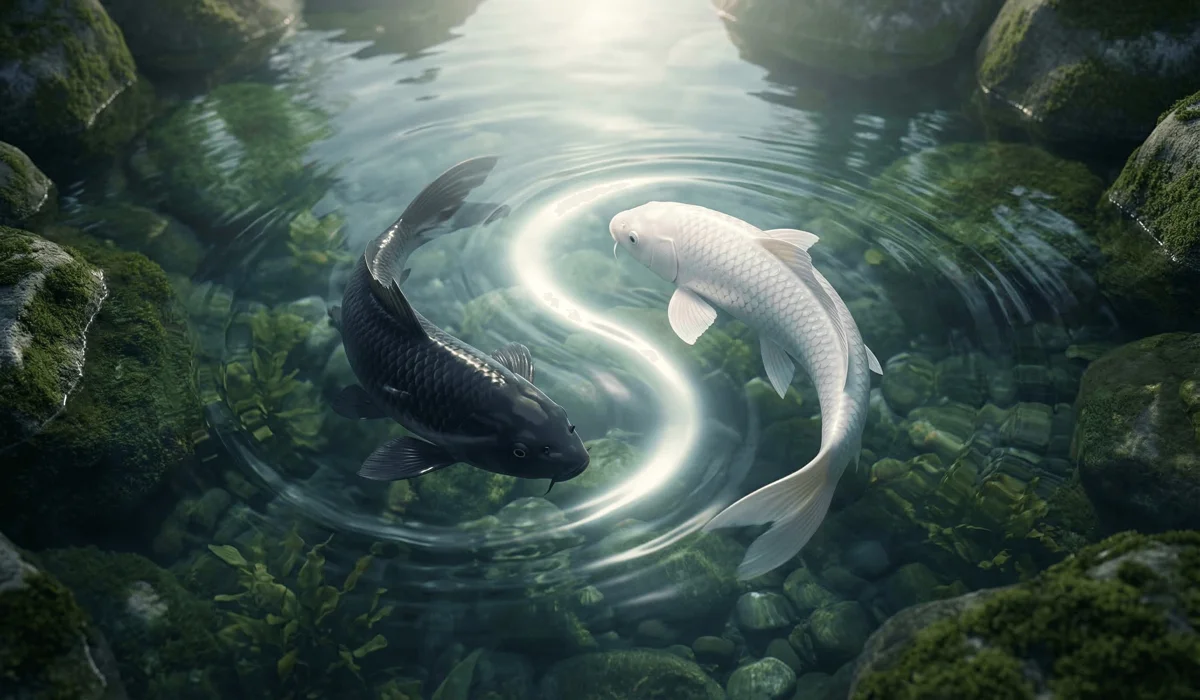
Success is not a static destination but an endless Tai Chi dance. If Yang dominates, you will exhaust yourself before forty—wealthy but too depleted to enjoy it. If Yin dominates, you will remain forever in the comfort zone of daydreams—brilliant but never bringing your gifts into the light. The two koi, in their eternal circular motion, tell us: advance and retreat, expansion and contraction, struggle and rest—each is an indispensable fragment of the complete mosaic of success.
The small eyes within the teardrop shapes—the white dot in the dark fish and the dark dot in the light fish—are the most exquisite touch in the entire composition. They reveal a profound truth: in the deepest darkness, there is always a seed of light; in the brightest light, there also lurks a seed of shadow. This ensures that we are always evolving , and that no state of being is ever permanent or static. If you are at the bottom today, it contains the seed of ascent; if you are at the peak today, it contains the seed of descent. Stay humble, stay vigilant, keep swimming like the fish—this is the very rhythm of life itself.
| Element | Symbolism | Life Application |
|---|---|---|
| Black Koi (Yin) | Intuition, rest, receptivity | Strategic planning, mental recovery, listening to inner voice |
| White/Red Koi (Yang) | Action, growth, drive | Executing tasks, career advancement, courageous decisions |
| Circular Path | Infinite flow, eternal cycle | Maintaining long-term momentum, not thrown off by short-term turbulence |
Cultural Evolution: Eastern and Western Perspectives
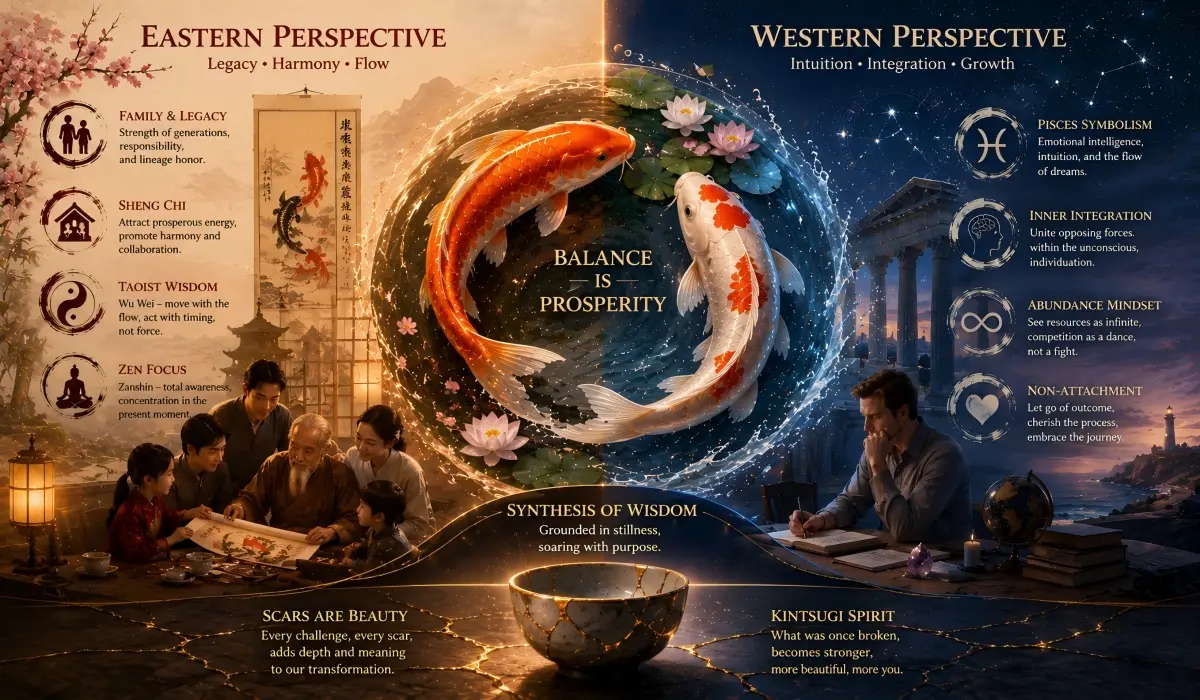
In Eastern cultures , the two koi often stand for family strength and generational responsibility, symbolizing the resilient bond between generations and the continuity of a family lineage. In traditional Chinese households, the paired koi image was often passed down as a family treasure, reminding descendants that your struggle belongs not only to yourself but to the honor of your entire lineage. Using specific pairings can activate Sheng Chi (Prosperous Energy) in a home or office, promoting harmony and collaboration among family members.
Western perspectives have linked the two koi to Pisces symbolism , focusing more on emotional intelligence and the dreamy, intuitive nature of the fish. In Western psychological contexts, the dual koi are seen as symbols of integrating opposing forces within the unconscious —Jungian analysts would view it as the perfect emblem of the individuation process. It encourages an abundance mindset —seeing resources as infinite, viewing competition as a shared dance rather than a fight to the death.
Today, we see a synthesis of Eastern and Western wisdom. We recognize that the "scars" from our upstream struggles add indispensable depth and texture to our lives—much like the Japanese art of Kintsugi (金缮), which uses gold powder to repair broken pottery, making the cracks the most beautiful part of the vessel. Every challenge we face, every scar we bear, makes the final transformation more beautiful and meaningful. Those failures that once brought you pain will one day become the most luminous chapters of your story.
Key Differences Between Koi Philosophy and Mainstream Western Success Doctrines
| Dimension | Mainstream Western Success Doctrine | Dual Koi Philosophy |
| View of Time | Short-term sprints, quarterly goals | One hundred years of persistence, generational transmission |
| View of Failure | Failure is an enemy to be avoided | Struggle is a necessary path, scars are badges of honor |
| Success Criteria | Wealth, status, external metrics | Inner balance, family harmony, spiritual growth |
| Action Mode | Continuous acceleration, multitasking | Yin-Yang rhythm, alternation between work and rest |
This contrast is not meant to reject the immense value of the Western model—indeed, much of modern civilization's prosperity owes to this "sprint-oriented" thinking. But koi philosophy offers an essential supplement that the Western model lacks: it reminds us that success without sustainability is merely a slow bankruptcy, and achievement without inner peace is merely a gilded cage. When the Western pursuit of "faster, higher, stronger" meets the Eastern wisdom of "knowing when to stop and find stability," a more complete and healthier vision of success is born.
Wearing the Amulet: Why Two Koi Fish Jewelry Matters?
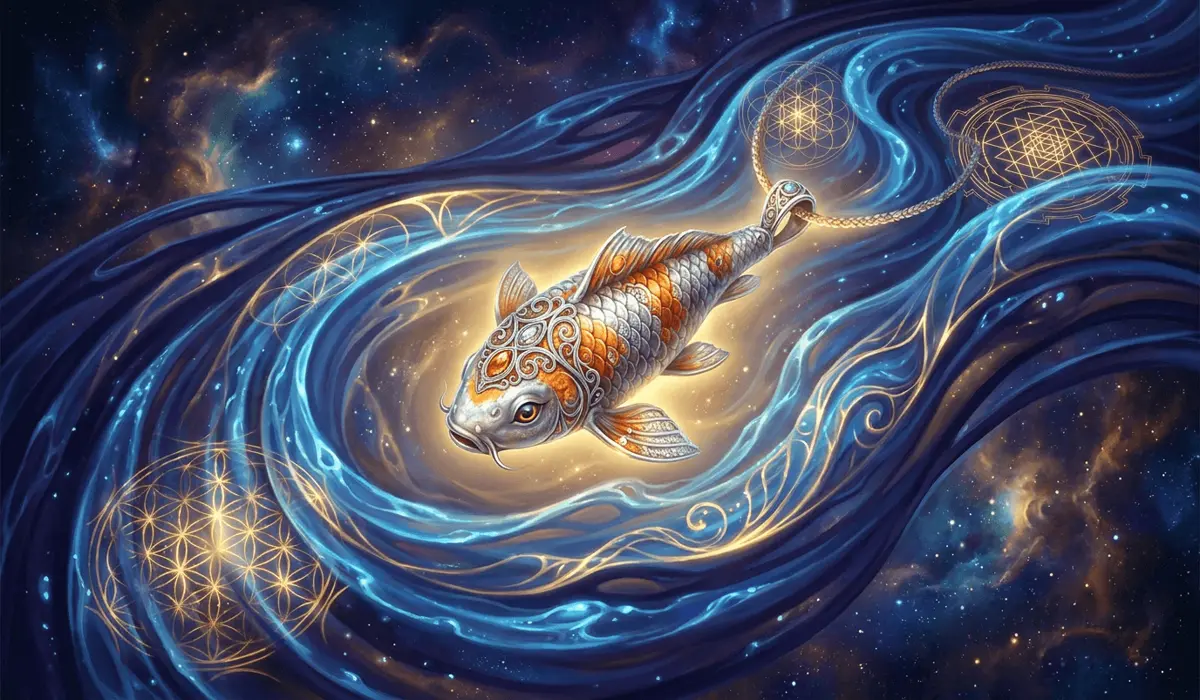
In our digital age, it is easy to feel overwhelmed by 24/7 productivity demands —emails, messages, meetings, deadlines, an endless waterfall pouring down upon us. Wearing a symbol of the two koi serves as a physical reminder to return to your natural rhythm, helping you find your center in this hyper-connected world. It combats digital fatigue by grounding your energy in millennia-old wisdom —when you unconsciously touch that small fish-shaped pendant, your nervous system receives a signal: slow down, breathe, return to the present.
For those in leadership roles, the symbol is particularly potent. Management guru Peter Senge emphasized in The Fifth Discipline that truly great leaders are not "the most dominant," but those who possess both firmness and inclusiveness. The koi teach leaders to balance authoritative Yang—decisive decision-making, firm direction—with collaborative Yin—listening to teams, nurturing talent. An entrepreneur wearing the dual koi is constantly reminded that leadership is not about issuing commands, but about creating an organizational ecosystem where everyone can "swim upstream."
This jewelry also helps manage social anxiety. The water element associated with the koi has a cooling effect on the "fire" of stress. When you feel your heart racing and palms sweating, your fingers touch that smooth, cool jade koi—your parasympathetic nervous system activates, and your heart rate and breathing gradually calm. It provides a sense of emotional flow —emotions are like water, coming and going; you don't need to be swept away, you can swim through them like a fish. This awareness will help you navigate difficult conversations or major life transitions with ease.
How to Choose the Right Koi Jewelry for You: A Guide to Materials and Colors
| Material / Color | Five Element Attribute | Ideal For | Primary Benefit |
| Black Agate + White Koi | Water + Metal | Entrepreneurs, high-stress professionals | Protection, clear decision-making |
| Carnelian + Red Koi | Fire | Sales, performers, public figures | Courage, charisma, passion |
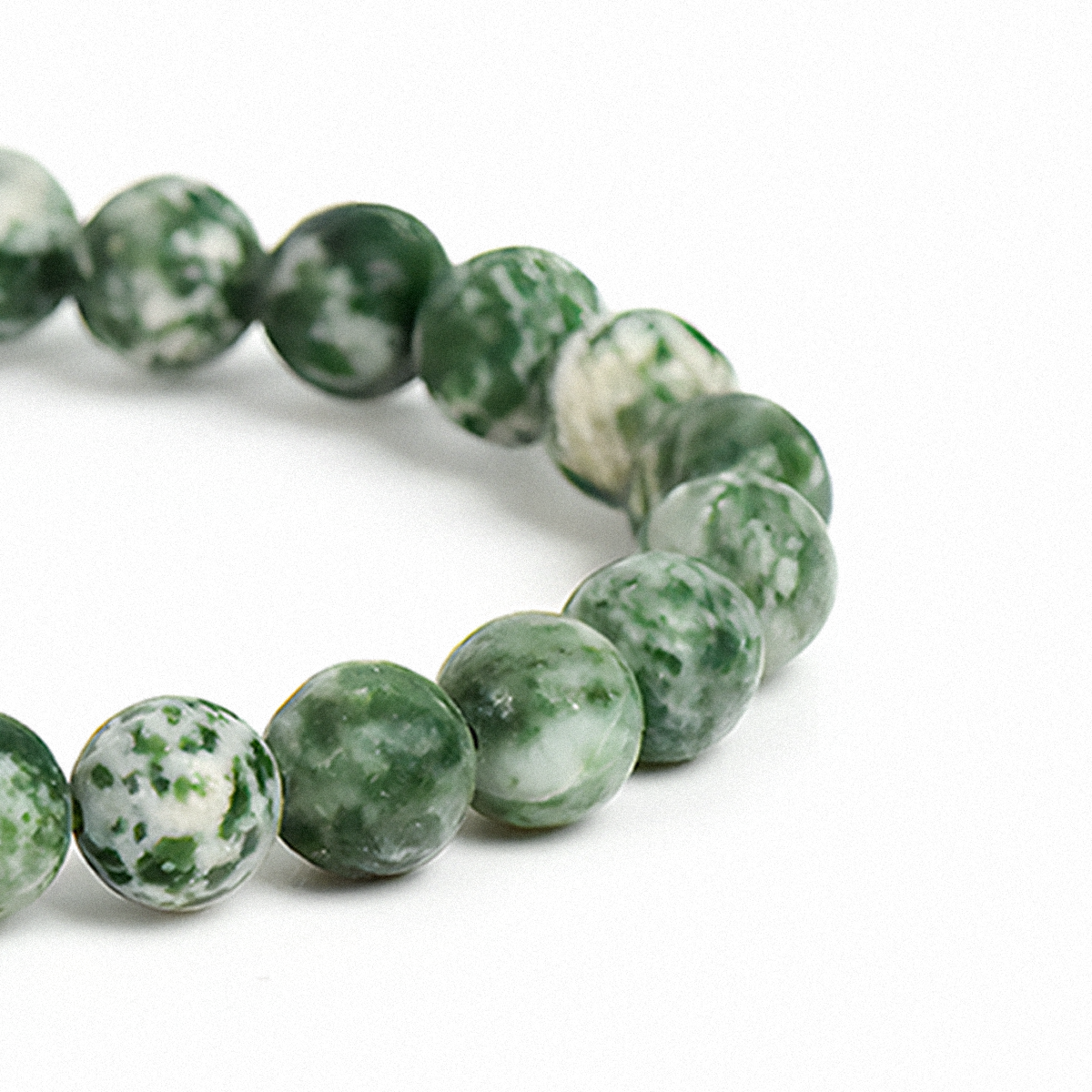
| Jade / Green Jade + Two-Color Koi | Wood | Healers, educators, parents | Growth, harmony, family stability |
| Citrine + Golden Koi | Earth | Finance professionals, managers, wealth-seekers | Wealth, stability, long-term accumulation |
When choosing koi jewelry, consider not only aesthetics but also your current life stage and energetic needs. If you are in the "upstream" period of starting a business, black agate's protective power is your first choice. If you are facing a public speech or important negotiation, carnelian's fire energy will help you shine.
Feng Shui Placement: Maximizing the Flow of Abundance
Where you place the symbol of the two koi matters just as much as why you have it—in Feng Shui, placement determines the nature and direction of energy flow. In traditional Feng Shui, the direction of the fish can change the type of energy they bring into your space. Upward-facing fish symbolize growth, advancement, and ascent —as if charging toward the Dragon Gate. Downward-facing fish represent rooting, grounding, and internalization —meaning you have accumulated enough wisdom and are now settling it into the fabric of your life.
To activate wealth , many experts suggest placing the two koi in the Southeast sector of your home or office—the Wealth Corner on the Feng Shui compass. This direction is associated with the Wood element, and since Water nourishes Wood, water-natured koi here can most effectively stimulate prosperous energy. For career advancement , the North sector is the ideal spot—the North is directly governed by the Water element in Feng Shui, so the koi's energy resonates here with the directional energy, producing a synergy greater than the sum of its parts.
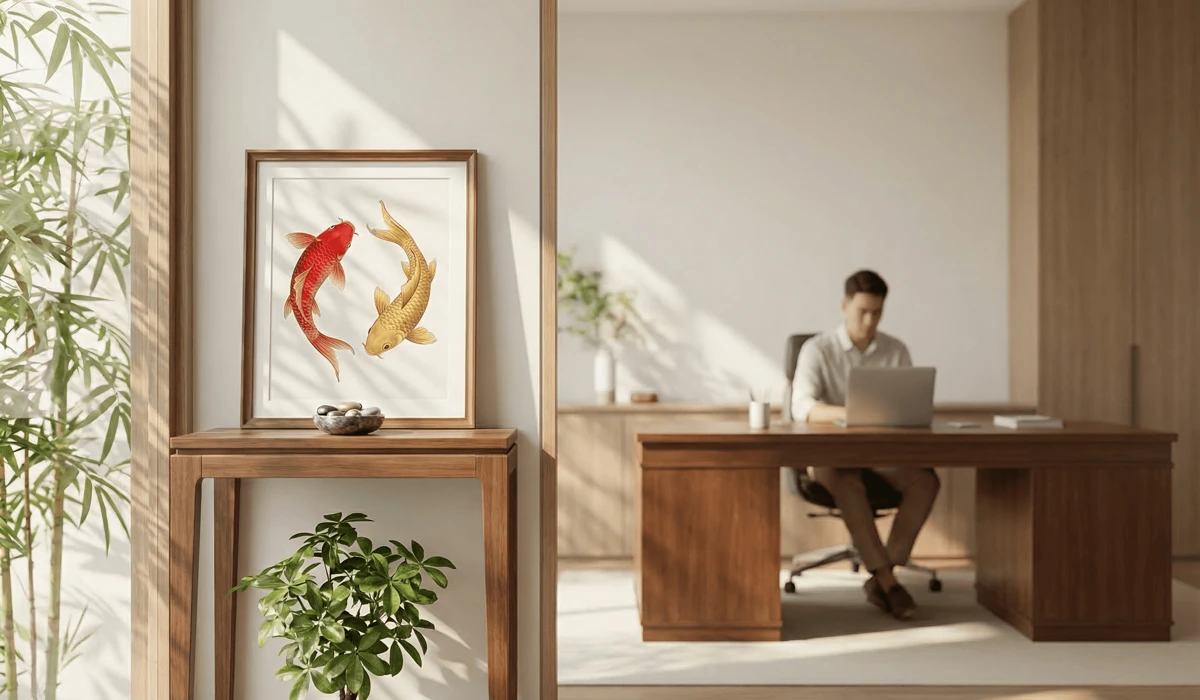
We should always respect the placement taboos of these sacred symbols. Avoid putting them in low-energy areas (like bathrooms or storage rooms) or on the floor —that would mean "trampling" your efforts underfoot. Instead, place them at eye level where they can be seen and honored as part of your daily environment. The best location is where your gaze naturally passes every day—the upper-left corner of your desk, the middle shelf of a living room display cabinet, or your office desktop.
You can find many ways to bring this energy into your home. Some people choose live koi fish tanks —the most powerful Feng Shui arrangement, but requiring professional maintenance knowledge and dedication. Others prefer artistic decor —paintings, embroidery, ceramic ornaments—which carry the complete symbolic energy. Additionally, incorporating martial arts-inspired sculptures or Tai Chi figurines can create a similar sense of dynamic balance and harmony in your workspace, mutually reinforcing the energy of the dual koi.
Koi Placement Quick Reference Table by Space
| Space | Recommended Direction | Recommended Form | Taboo |
| Living Room | Southeast (Wealth) or East (Health) | Wall art, embroidery, ceramic ornament | Do not face the main door directly |
| Office / Study | North (Career) or Northwest (Mentor/Help) | Small statue, desk ornament, mouse pad | Do not place under your seat |
| Bedroom | West (Creativity/Children) or Southwest (Marriage) | Gentle-toned painting, not oversized | Avoid black-dominant koi |
| Shop / Reception Area | Diagonal from entrance (Bright Wealth Corner) | Live koi fish tank (best) or metal ornament | Avoid fish tank directly facing toilet |
Synergy with Gemstones and Art
To amplify the energy field of the two koi, you can pair the symbol with specific stones, creating a "geometric multiplier" effect. Citrine known as the "merchant's stone," excels at attracting and stabilizing wealth—its combination with the golden koi is a premier wealth-attracting partnership. Obsidian provides powerful protection and purification , offering a resilient energy shield during your "upstream" journey. Rose Quartz combined with the dual koi enhances the energy of relationships and emotional harmony. These elements work together to create an influence field many times more powerful than the symbol alone.
Many practitioners also consult resources like the Feng Shui Society to ensure their arrangements follow orthodox tradition rather than folk conjecture. The goal is always to create a space where energy flows freely , much like the water the koi swim in—without obstruction, without stagnation, only ceaseless circulation. When you combine the aesthetic beauty of jade, crystal, and metal with the koi symbol, your space becomes not just a physical place, but a living energy matrix that nourishes everyone within it.
Meditating with the Koi: Rituals for Success
We recommend simple yet effective daily rituals to help you connect with the energy of the two koi through conscious intention. These practices take only a few minutes each day but can significantly shift your internal state, moving you from "passively responding to life" to "actively creating reality." Here are some time-tested methods:
- ☸️ Upstream Breath: Inhale slowly as you visualize the fish pushing against the current, then exhale as you imagine them gliding with ease.
- 🕉️ Wealth Visualization: Close your eyes and see the koi reaching the Dragon Gate, transforming your current goals into golden reality.
- 🧿 Intention Setting: Touch your koi jewelry every morning and state one way you will balance work and rest that day.
- 🌸 Flow Alignment: Place the symbol on your desk to remind you to stay focused on one task at a time, avoiding the "fire" of multi-tasking.
By practicing these regularly, you will gradually align your vibration with the frequency of spiritual prosperity. You will begin to notice "Koi Synchronicity"—a wondrous phenomenon where opportunities appear precisely when you are ready to receive them, the right people walk into your life at the right moment, and inspiration flows naturally when you become still. This is not mysticism—it is the natural resonance that occurs when your inner order aligns with your outer actions.
Taboos and Respectful Usage
Before using the dual koi symbol, it is essential to deeply understand the Dragon Gate legend and its cultural context. It is not merely a decorative item; it is a cultural legacy from the thousand-year heritage of the World of Feng Shui.
We should use it with gratitude and reverence for its Taoist philosophical roots and Zen Buddhist meditative traditions , rather than treating it simply as a "luck-changing tool."
A core taboo is: neglecting the symbol once it is in your home. Just as real fish need feeding and water changes, the "energy" of the symbol needs care and maintenance. Keep the area around it clean and clutter-free —a dusty koi ornament not only fails to attract wealth but symbolizes "stagnant energy." Regularly wipe it gently with a soft cloth, as if tending to a living fish—this act itself becomes a focused meditation.
Finally, remember the most fundamental point: the koi are symbols of perseverance and endurance, not a "get rich quick" charm. They carry the weight of countless days and nights of silent effort, of being pushed back and starting again, of patiently waiting for that final leap. Respect the process—take no shortcuts, blame no one, never give up lightly—and the transformation will come in its own time. As the old saying goes: "The koi leaps over the Dragon Gate—it is no achievement of a single day."
Common Mistakes and Remedies Quick Reference Table
| Mistake | Consequence | Correction Method |
| 1. Placing koi on the floor or very low | Energy is "trampled" and struggles to rise | Move to at least waist height, ideally eye level |
| 2. Koi image is damaged or faded | Symbolizes "exhausted energy" or decline | Replace or repair; if beyond repair, dispose of respectfully (e.g., wrap in red paper before discarding) |
| 3. Keeping live koi in a tank but they frequently die | A Feng Shui warning sign | First improve water quality and lighting; if deaths continue, the location is unsuitable for live fish — switch to a symbol |
| 4. Placing koi next to fierce or aggressive items | Yin-Yang conflict, creates tense energy | Keep away from swords, tiger images, sharp corners |
| 5. Using multiple koi symbols with conflicting directions | Energy is scattered or cancels itself out | Unify direction: all koi images in the home should ideally face the same direction (e.g., inward or east) |
Frequently Asked Questions (FAQ)
Q: What is the deeper meaning of Yin and Yang in professional success?
A: In a professional context, Yang represents the active "hustle"—making calls, closing deals, and taking risks. Yin represents the strategic "rest" and planning—reflecting on results, learning new skills, and recovering from stress. True success requires both; without Yin, you burn out, and without Yang, you never progress.
Q: Why are two koi fish considered the ultimate symbol of relationship harmony?
A: The two koi swim in a synchronized circle, representing two individuals moving through life in perfect rhythm. They show how to be in a partnership without losing your unique identity. This "Sacred Duality" fosters a relationship where both partners support each other's growth and transformation.
Q: How does the direction of koi fish in a ring affect its Feng Shui energy?
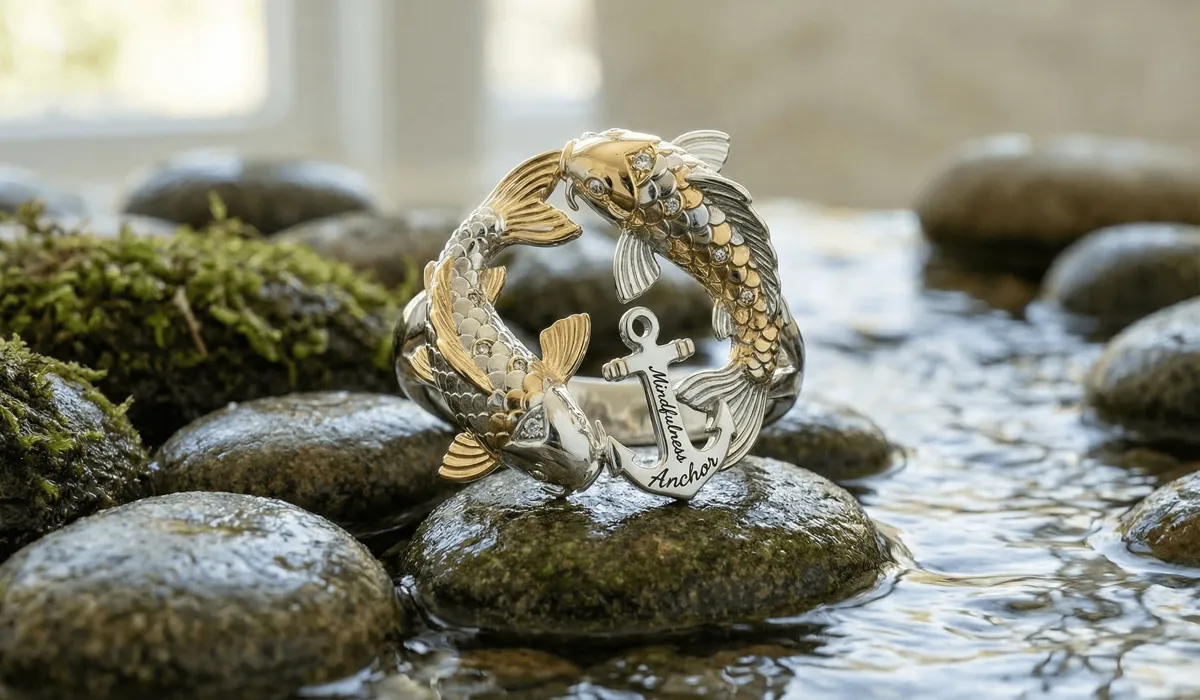
A: When the koi are pointing "up" toward your fingertips, they symbolize advancement, ambition, and the climb toward the Dragon Gate. When pointing "down" toward your wrist, they represent grounding, inner reflection, and the integration of wisdom you have already gained.
Q: Where to place Yin Yang koi symbols to activate wealth in the home?
A: According to the Feng Shui Bagua map, the Southeast sector of your home is the Wealth and Abundance area. Placing the two koi here helps activate prosperous energy. You can also place them in the North sector to specifically boost your career path and professional opportunities.
Q: Why does the black and white koi pairing symbolize total completion?
A: This pairing represents the Taoist belief that the universe is only whole when light and shadow are unified. The black koi holds a seed of light, and the white koi holds a seed of shadow. Together, they represent the absolute whole, reminding us that every part of our journey is necessary for completion.
Conclusion: Integrating the Wisdom of the Two Koi Fish
The journey of the koi is a journey we all share. From the deep, quiet, dark waters of the river to the vast, luminous, expansive heavens above—this is a story of what happens when we refuse to give up and persist to the very end. By embracing both struggle and transformation , we find a truly lasting success —one etched not only in our career achievements but in the very rings of our soul.
We sincerely invite you to find your own balance and anchor these timeless, powerful energies in your daily life. Whether through daily breathing meditations, mindful spatial arrangements, or that piece of sacred jewelry that touches your skin—the two koi are ready to be your most faithful guides on the journey upstream.
If you wish to find a tangible companion for this journey, a physical reminder to carry this energy with you always, we invite you to explore our Rings Collection —each piece carries the spiritual essence of the dual koi, waiting to meet its destined keeper.

Longyi Luck
Longyi Luck is a Feng Shui practitioner and spiritual researcher who blends traditional year-based wisdom with modern lifestyle insights, specializing in Feng Shui, spirituality, meditation, and mindfulness. With years of dedicated study and practice, Longyi explores cultural symbolism and the practical application of ancient wisdom to help individuals cultivate balance, clarity, and harmony in everyday life. Since 2020, Longyi has been committed to translating timeless traditions into accessible guidance for the modern world.
longyi@auraandluck.com
.webp?w=1280&h=1280)
.webp?w=800&h=800)