
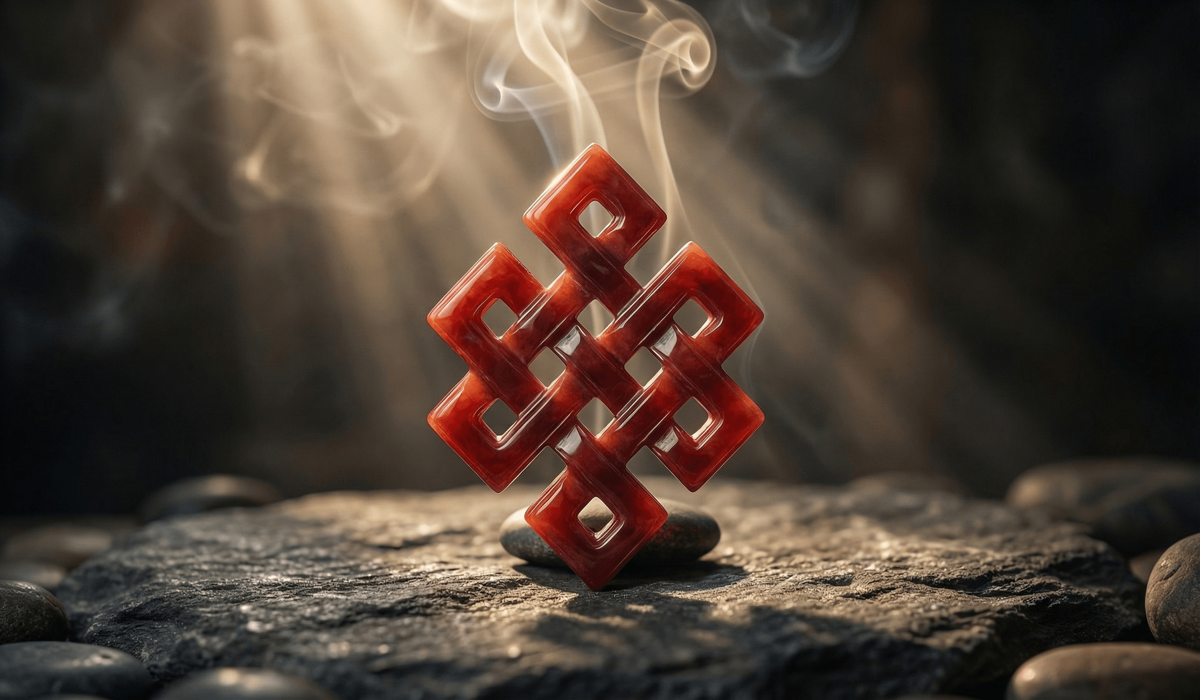
The Feng Shui Mystic Knot is far more than a beautiful design woven from silk threads. It is a sacred map that reveals the infinite nature of our universe. For centuries, this symbol has served as a spiritual mirror, reflecting the truth that our lives and actions are all woven together in a single pattern. This interconnectedness is a core principle in both Feng Shui and Buddhist philosophy, and it serves as the key to understanding the operational laws of the universe.
In our modern world, we often feel disconnected or lonely. The Mystic Knot helps us stay grounded by reminding us of our eternal connection to the whole world. It is a symbol of unity and harmony that brings peace to the soul and harmony to any home. Spiritual teachers often say that when we gaze upon the endless lines of the Mystic Knot, a natural sense of trust in the wholeness of life arises within us—this is a healing power that transcends words.
The Mystic Knot, also called the Endless Knot, is one of the Eight Auspicious Symbols representing the infinite wisdom of the Buddha. In Feng Shui, its overlapping lines stand for unending luck, long life, and prosperity. It acts as a powerful tool to balance energy and ensure constant success. The year 2026 marks the beginning of Period 9 in Feng Shui—an era dominated by the Fire element, emphasizing spirituality, visual aesthetics, and enlightenment. The Mystic Knot, with its red color belonging to Fire and its form resonating with the heart, serves perfectly as the auspicious talisman for this new age.
Ancient Origins and Sacred Legends
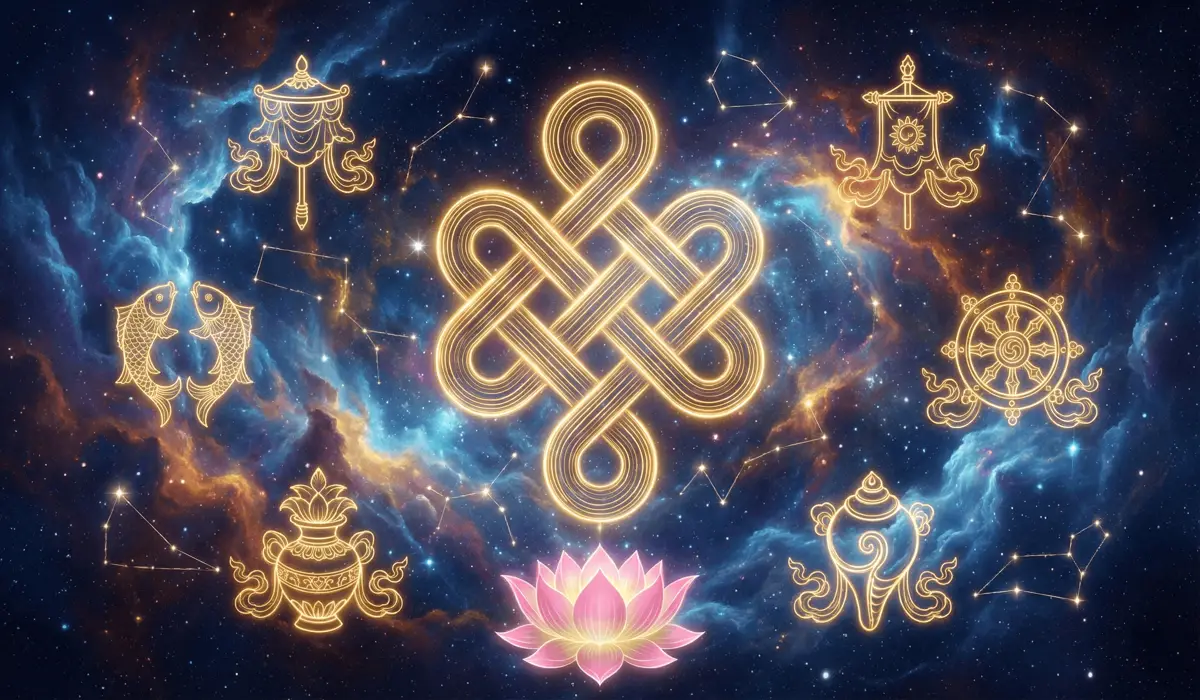
The Buddha and the Eight Auspicious Symbols
The story of the Mystic Knot begins with the Great Buddha. It is known as one of the Eight Auspicious Symbols (Ashtamangala) in ancient traditions. Legend says the gods gave this knot as a gift to the Buddha when he reached enlightenment, symbolizing the universe's recognition of his perfect wisdom and compassion. This act of offering itself carries a profound metaphor—true wisdom is not created but "discovered" and "presented," just as the lines of this endless knot have always existed within the geometry of the cosmos.
Within the sequence of the Eight Auspicious Symbols, the Mystic Knot is typically arranged in the seventh or eighth position, yet its symbolic meaning permeates all other symbols—such as the Precious Umbrella, the Golden Fish, and the Treasure Vase—representing the ceaseless flow of these auspicious qualities. In Buddhist art, we often see the Buddha or Bodhisattvas holding or wearing this knot, signifying that their teachings are never-ending.
Symbol of the Buddha's Heart
This symbol represents the Heart of the Buddha. It shows a mind that has moved past the limits of time and space. It is believed to teach us about perfect compassion and the balance between different parts of our lives—action and rest, giving and receiving, wisdom and method. In Vajrayana tradition, the Mystic Knot is also used to symbolize the union of "skillful means" and "wisdom"—the compassionate action of the masculine and the empty wisdom of the feminine, inseparable like the intertwined lines of the knot.
From a psychological perspective, the Mystic Knot can also be viewed as an archetypal pattern within the human collective unconscious. It appears across numerous ancient civilizations, hinting at humanity's universal yearning for "eternity" and "cyclicality." When you wear or gaze upon the Mystic Knot, you are actually connecting with this millennia-old collective spiritual image.
Interpretations in Tibetan Buddhism and Taoism
In Tibetan Buddhism, the knot is called the Palbheu, representing the union of wisdom and method. These ancient shapes appear across many cultures, showing that the spiritual and physical worlds are never truly separate. In Thangka paintings, the Mystic Knot is often depicted on the Buddha's chest or beneath the lotus throne, symbolizing the eternal transmission of the Dharma and flawless wisdom.
Taoist masters also revere this symbol. They call it the Pan Chang knot and use it to represent the flow of Chi (energy) . It embodies the Tao—a path with no beginning and no end, where everything remains in balance. In Taoist talisman traditions, variations of the Pan Chang knot pattern are frequently used as background motifs for protective amulets, as its continuous lines are believed to lock in true energy and prevent leakage.
Decoding the Symbolism – The Hidden Philosophy
The Srivatsa and the Sacred Mark
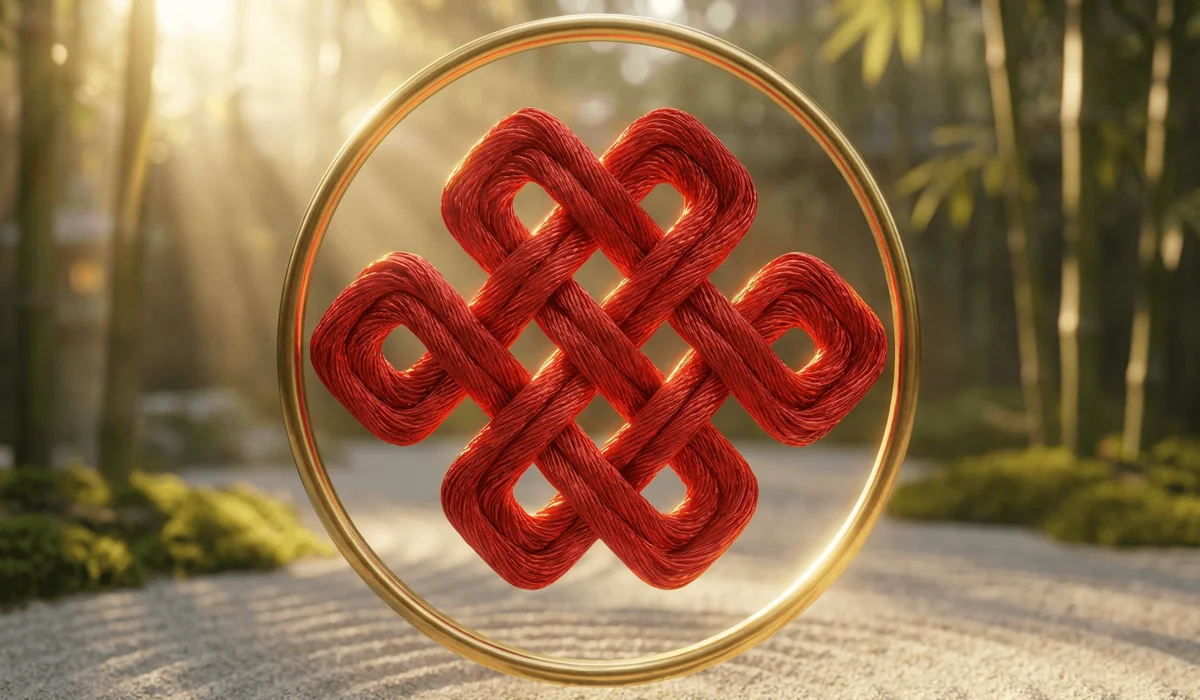
The shape of the Mystic Knot is based on an ancient mark called the Srivatsa. In ancient legends, this mark appeared on the chest of divine beings, meaning being beloved and chosen by the universe for good fortune. This auspicious mark is still revered in many Eastern spiritual traditions. In Vedic culture, the Srivatsa is the auspicious spiral on the chest of Lord Vishnu, representing cosmic prosperity and blessing.
It is worth noting that the Mystic Knot is not a single static pattern but a family of geometric variations. The most common versions include the two-loop knot, the four-loop knot, and the six-loop knot, with the six-loop form (the primary subject of this article) considered the most complete. The two-loop knot symbolizes the harmony of yin-yang duality, the four-loop knot represents the Four Noble Truths or the four great elements, and the six-loop knot corresponds to the Six Paramitas—generosity, discipline, patience, diligence, meditation, and wisdom.
No Beginning, No End: Dependent Origination
The lines have no beginning and no end. This is a lesson about dependent origination (Pratītyasamutpāda) in Buddhism—how everything in life depends on everything else. When we change one part of the knot, the whole structure feels it, just like in our own lives. Nagarjuna wrote in his Mūlamadhyamakakārikā: "Whatever is dependently originated, that is explained to be emptiness." The Mystic Knot is the geometric manifestation of this philosophical proposition—it allows us to "see" emptiness.
In modern systems science, this principle is known as systems theory—the whole is greater than the sum of its parts, and there exist nonlinear relationships among the parts. The Mystic Knot reminds us that a single small thought or act of kindness can create enormous positive ripples thousands of miles away. This is the spiritual expression of the butterfly effect.
The Number 8 and the Six Loops
The knot is usually made of six loops that form the shape of the number eight, creating eight distinct sections. The number eight is very lucky in the current Feng Shui tradition because it brings peak energy to every direction. In Chinese culture, the number eight is strongly associated with wealth and prosperity—the opening ceremony of the Beijing Olympics was held on August 8, 2008, at 8:08 PM, which was no coincidence.
From a geometric aesthetics perspective, the six loops of the Mystic Knot form a perfect topological structure—every line intertwines with others while maintaining overall fluidity and balance. This quality of "complex yet orderly, many yet one" makes it an ideal symbol for harmonizing chaotic energies within a living space.
Visualization of the Law of Karma
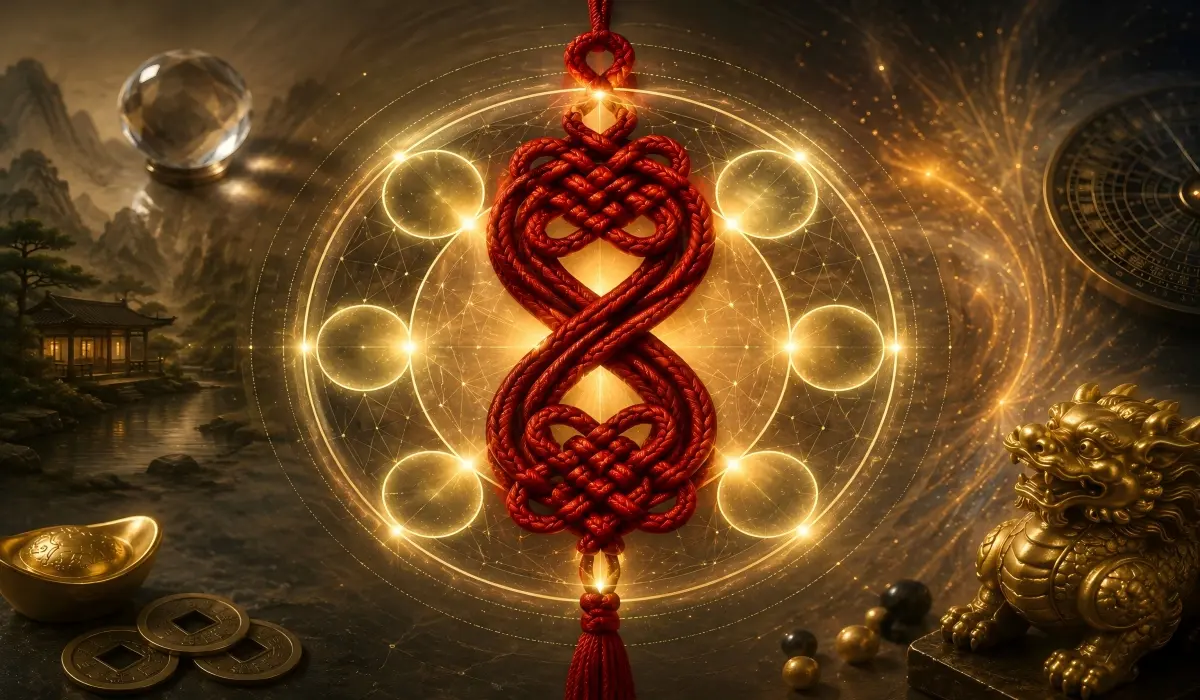
The knot also represents the cycle of Karma. Every action we take is a thread that eventually loops back to us. It reminds us that our past, present, and future are all happening at the same time within this eternal loop. This makes the Mystic Knot a powerful tool for mindful living.
🧘 Mindfulness Exercise: Spend three minutes gently tracing the lines of the Mystic Knot with your fingertip. Feel the rises, turns, and returns. Observe whether your breathing deepens and your thoughts gradually calm. This simple tactile practice is known as "Knot Meditation" (结禅) and is a common introductory meditation method in Tibetan Buddhism.
Cultural Meaning Comparison Table
| Culture | Primary Name | Core Meaning | Symbolic Emphasis |
|---|---|---|---|
| Tibetan Buddhism | Palbheu | Union of Wisdom and Method | Spiritual awakening |
| Taoism | Pan Chang | Infinite Flow of Chi | Energy circulation |
| Modern Feng Shui | Mystic Knot / Endless Knot | Uninterrupted Good Fortune | Practical well-being |
| Hinduism | Srivatsa | Divine Grace and Prosperity | Sacred protection |
| Western Pop Culture | Eternal Love Knot | Eternal Love | Emotional connection |
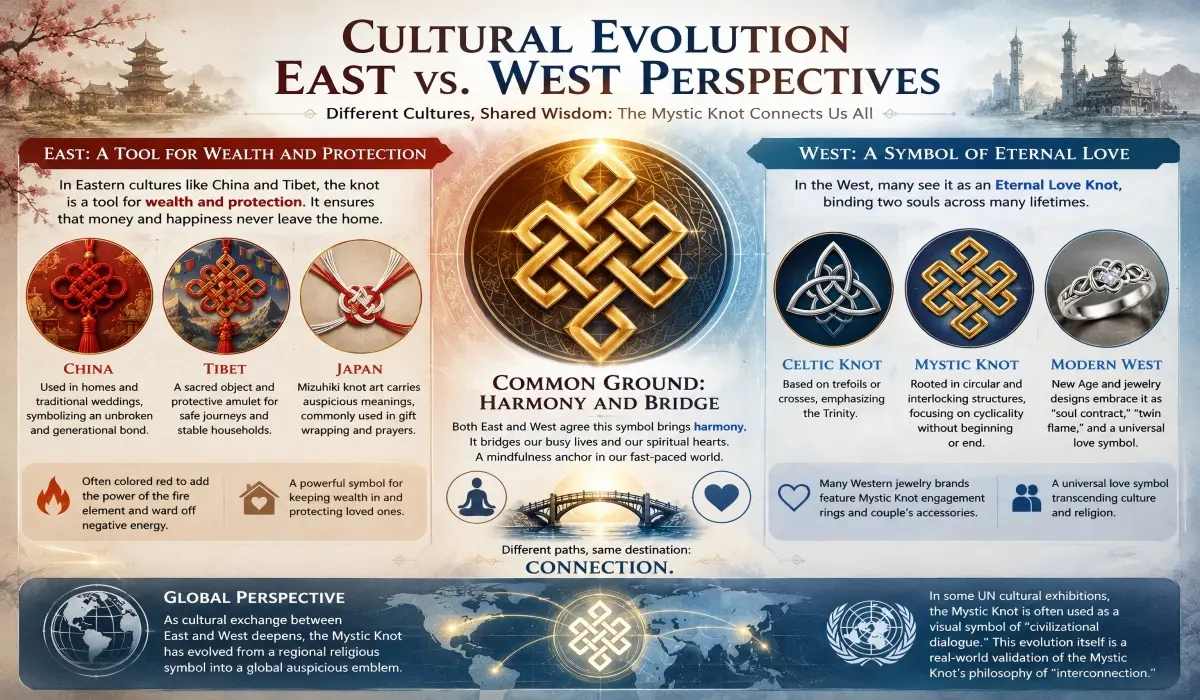
Cultural Evolution: East vs. West Perspectives
East: A Tool for Wealth and Protection
In Eastern cultures like China and Tibet, the knot is a tool for wealth and protection. People use it to ensure that money and happiness never leave their homes. It is often colored red to add the power of the fire element, which also wards off negative energy. In traditional Chinese weddings, the Pan Chang knot is an indispensable element of wedding decorations—it is woven into wedding garments, bridal canopies, and gift boxes, symbolizing an unbroken and generational bond between the newlyweds.
In Tibet, the Mystic Knot is not only a religious sacred object but also a common protective amulet in daily life. Nomads hang small Mystic Knots on saddles or at tent entrances to pray for safe journeys and stable households. In Japan, similar "Mizuhiki" knot art also carries deep auspicious meanings and is commonly used in gift wrapping and shrine prayers.
West: A Symbol of Eternal Love
In the West, many people see it as an Eternal Love Knot. They believe it binds two souls together across many lifetimes. While it looks a bit like a Celtic knot, its geometric rules are very different and specific to energy work. Celtic knots are typically based on trefoils or crosses, emphasizing the Trinity, while the Mystic Knot is rooted in circular and interlocking topological structures, focusing more on cyclicality without beginning or end.
In recent years, the New Age movement has incorporated the Mystic Knot into its symbolic system, endowing it with meanings such as "soul contract" or "twin flame." Many Western jewelry brands have begun designing Mystic Knot-themed engagement rings and couple's accessories, promoting it as a universal love symbol transcending culture and religion.
Common Ground: Harmony and Bridge
Both sides of the world agree that this symbol brings harmony. It helps bridge the gap between our busy daily lives and our quiet spiritual hearts. In our modern, fast-paced world, the Mystic Knot serves as a mindfulness anchor. No matter which hemisphere you live in or which religion you follow, the lines of the Mystic Knot speak the same language—connection.
🌍 Global Perspective: As cultural exchange between East and West deepens, the Mystic Knot has evolved from a regional religious symbol into a global auspicious emblem. In some UN cultural exhibitions, the Mystic Knot is often used as a visual symbol of "civilizational dialogue." This evolution itself is a real-world validation of the Mystic Knot's philosophy of "interconnection."
Wearing the Talisman: Why Jewelry Matters Today
Combating Digital Burnout
Wearing a Mystic Knot can help you deal with digital burnout. In a world of constant phone alerts, the knot acts as a mindfulness anchor, helping you stay centered when everything else feels chaotic. Whenever you feel information overload or attention scatter, glancing down at the Mystic Knot on your chest can instantly bring your awareness back to the present moment—this is a practice of micro-meditation.
Neuroscientific research suggests that visually complex symmetrical patterns can activate the brain's Default Mode Network (DMN), which is closely associated with focus, creativity, and self-reflection. Therefore, wearing the Mystic Knot is not only spiritually meaningful but also beneficial to the brain on a neuroaesthetic level.
Energy Protection and Preventing Leakage
This symbol also offers spiritual protection for your personal energy. It is believed to catch negative energy in its loops so it cannot harm you. This prevents your personal Chi from leaking away when you are tired or stressed. In the view of energy medicine, the human energy field can develop "holes" due to emotional fluctuations and environmental interference, and the closed-loop structure of the Mystic Knot is believed to act like an "energy patch" to repair these gaps.
Beyond wearing it on your body, you can also place the Mystic Knot near electronic devices—such as computers, routers, or phones—to mitigate the energy interference caused by electromagnetic radiation. While this is not physical shielding in a scientific sense, in Feng Shui practice it does provide a psychological sense of stability and reassurance.
Cultivating an Abundance Mindset
Wearing this symbol helps you cultivate an abundance mindset. It shifts your brain away from worrying about not having enough, helping you focus on the infinite possibilities waiting for you every day. In psychology, the Law of Attraction suggests that where your focus goes, energy flows. The endless lines of the Mystic Knot serve as the perfect visual anchor for "infinite possibility."
Moreover, an abundance mindset is not just about money—it also includes time abundance, relationship abundance, and spiritual abundance. The Mystic Knot reminds us that the resources of the universe circulate in cycles—the more you give, the more returns; the more you appreciate, the more you receive.
An Energy Shield in Crowds
Many people find that keeping this symbol close helps them feel safer in large crowds. It builds a soft shield around your body, keeping your own vibes high while blocking out the heavy feelings of others. In crowded subways, large conferences, or social gatherings, the Mystic Knot helps you maintain inner peace.

Material Selection and Effectiveness Comparison
| Material | Five Elements | Core Benefits | Best For | Ideal Wearing Position |
|---|---|---|---|---|
| Red Silk Thread | Fire | Activates energy, wards off negativity | Entrepreneurs, job seekers, students | Wrist, neck |
| Gold/Metal | Metal | Stabilizes wealth, attracts helpful people | Executives, investors, salespeople | Chest, briefcase charm |
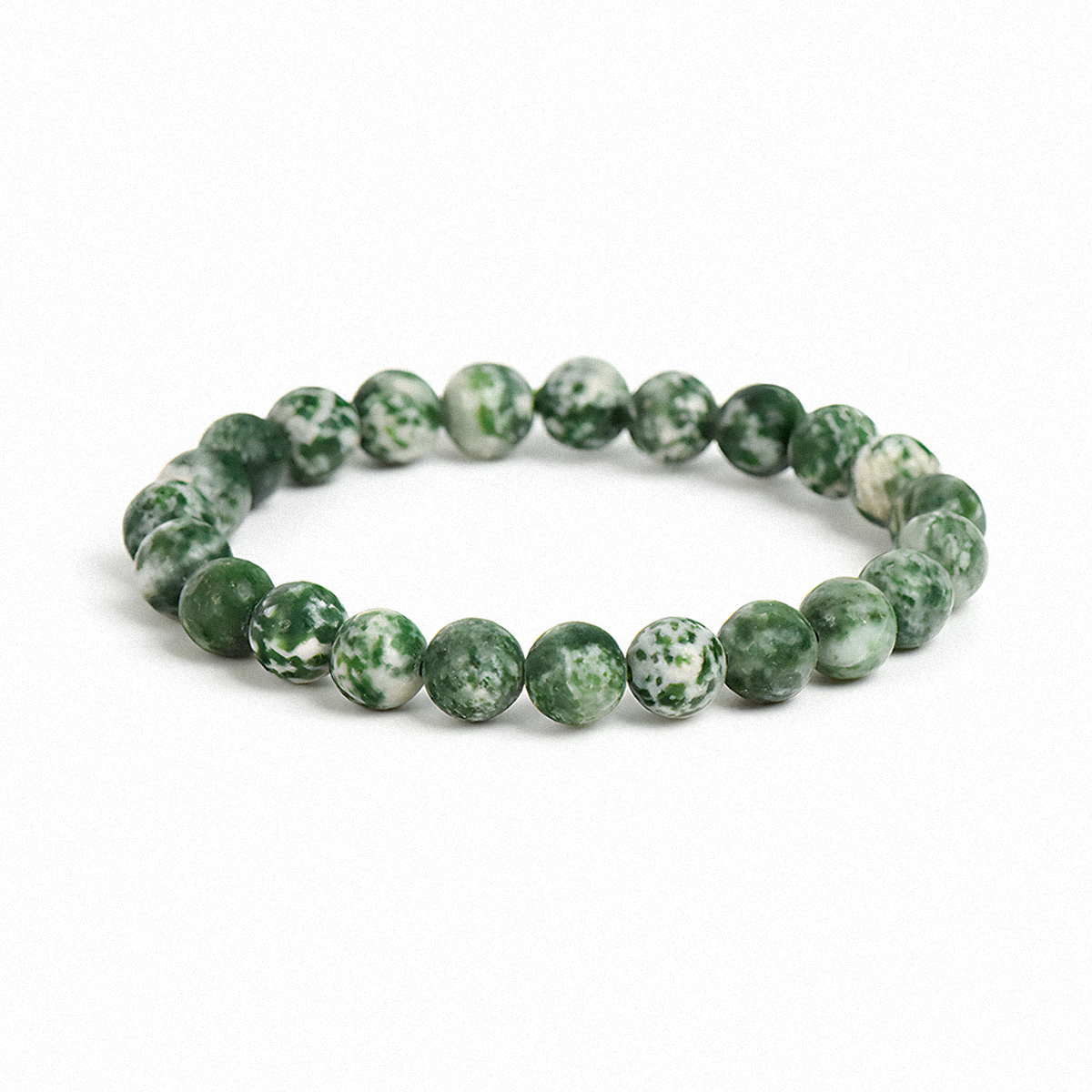
| Natural Jade | Earth | Harmonizes body and mind, protective | Seniors, children, sensitive individuals | Waist, close to skin |
| Crystal/Bejeweled | Water/Fire | Amplifies intention, attracts attention | Artists, public figures | Earrings, rings |
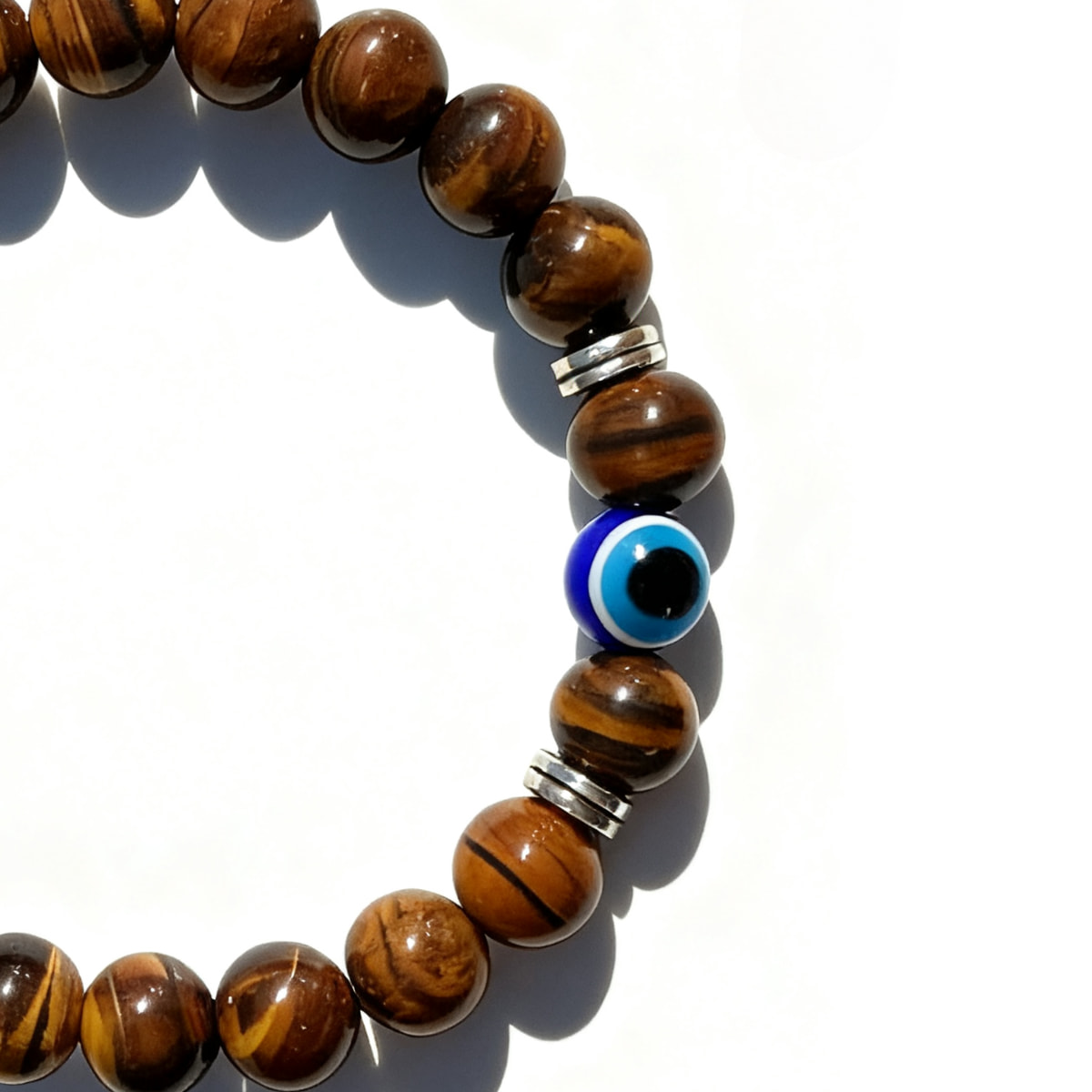
| Wood/Sandalwood | Wood | Soothes emotions, aids meditation | Practitioners, anxious individuals | Hand-held, mala beads |
Feng Shui Placement Guide: Commanding Luck in Every Room
Basic Placement Principles
Where you put your Mystic Knot is very important. It should always be placed in a spot where it receives respect. Never put it on the floor or in a bathroom where energy goes down the drain. It should be placed at or above eye level for best effect. In Feng Shui theory, height represents "dignity" and "importance"—hanging the Mystic Knot high is equivalent to announcing to the universe that your invitation for good fortune is made with sincerity.
Additionally, the Mystic Knot should not be placed directly above the kitchen stove or opposite the bathroom door, as these positions represent "excessive fire" and "energy drainage," weakening its auspicious effectiveness. If the Mystic Knot is hanging, ensure it does not swing violently in the wind, as "stability" is a prerequisite for its efficacy.
North: Activating Career Luck
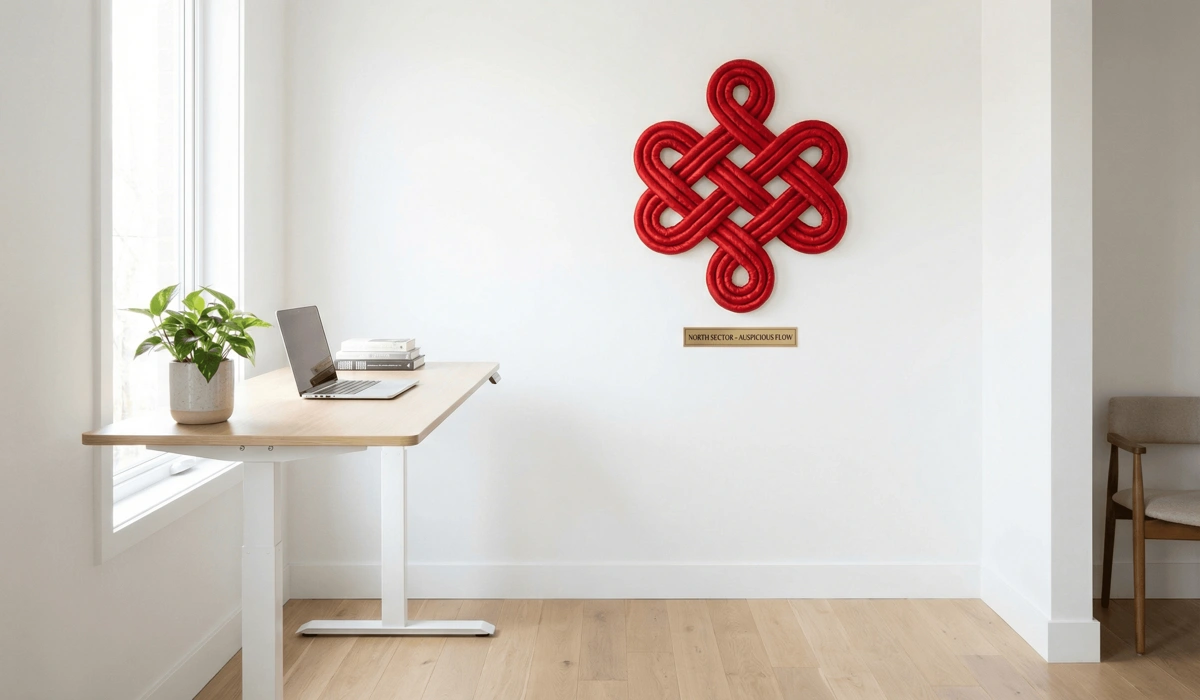
To boost your career, place the knot in the North part of your home or office. This area is linked to your life path. A red knot here helps your work life flow smoothly without stopping or getting stuck. In the Bagua system, the North belongs to the "Kan" trigram, representing Water—Water governs wisdom and flow, perfectly matching the Mystic Knot's quality of "unobstructed circulation."
🧭 Practical Tip: When placing the Mystic Knot in the North sector, you may place a black or dark blue cloth underneath it to strengthen the Water element. In an office environment, you can also hang the Mystic Knot on the side of a filing cabinet at eye level or on the wall behind your chair.
Southwest: Attracting Lasting Love
For those seeking love, the Southwest corner is the best choice. Placing two knots here signals that you desire a relationship that lasts forever. In the Bagua, the Southwest belongs to the "Kun" trigram, representing Earth and the maternal principle—it is the energy field that nurtures relationships and family. A pair of Mystic Knots—one larger and one smaller, or identical in color and style—symbolizes yin-yang balance and a harmonious partnership.
If you already have a partner, you may also place a pair of Mystic Knots in the Southwest of your bedroom to strengthen your existing relationship and enhance mutual understanding and tolerance. It is recommended to place a rose quartz or pink crystal next to the knots to amplify the frequency of love energy.
Southeast: Stabilizing Wealth
For better finances, look at the Southeast wealth corner of your home. A red or gold knot here helps money energy grow and stay inside your house, preventing it from escaping through unexpected bills or bad luck. In the Bagua, the Southeast belongs to the "Xun" trigram, representing Wind—Wind governs circulation, and the Mystic Knot's "retaining" quality perfectly balances the fluidity of Wind, allowing wealth to "come in and stay put."
In commercial settings (such as shops or company reception areas), hanging a gold Mystic Knot in the Southeast can enhance customer trust and repeat business. For online businesses, you can even set a Mystic Knot image as the southeast-corner wallpaper of your computer desktop to create a virtual Feng Shui arrangement.
West: Resolving Disputes and Legal Issues (2026 Special Note)
In 2026, the West sector is affected by the #3 argumentative star, which can cause disputes, gossip, and legal problems. Placing a red diamond-shaped Pan Chang Knot (six-row rhombus type) in the West can effectively resolve conflicts and protect your reputation. The #3 star is the "argumentative star" in Feng Shui, while the #5 yellow star brings disaster—both need to be "drained" through the Fire attribute of the color red.
In addition to the Mystic Knot, it is also recommended to keep this area bright and tidy, avoiding clutter or discarded documents. If conditions permit, place a small red lamp in this sector, lit around the clock, to continuously activate the resolving power of the Mystic Knot.
Northeast: Weakening the Retreating #4 Star (2026 Special Note)
In Period 9, the once-auspicious #4 star has fallen into the Northeast and become inauspicious, potentially bringing romantic entanglements or mental confusion. Placing a Mystic Knot here helps stabilize the mind and avoid unnecessary emotional disturbances. The #4 star governs scholarship and romance; when in retreat, it can easily lead to poor judgment in emotional matters—the Mystic Knot's "rational" quality serves as a balancing counterforce.
⚠️ Special Note: In 2026, the Northeast should not have too many Water-element items (such as fish tanks or water fountains), as this would amplify the negative effects of the retreating star. The Mystic Knot alone is sufficient to provide "stabilizing" effects without the need for additional Water enhancement.
The Power of Red and Gold
Color changes how the knot works in your space. Red is the most common color because it activates energy and wakes up a room that feels dull or bored. Gold knots are better for keeping wealth that you already have. They are perfect for the West and Northwest areas of your house, which are linked to helpful people and your own creativity. When choosing a color, refer to the Five Elements generation and control principle: if a sector of your home is "lacking Fire" (e.g., insufficient sunlight), use a red knot to supplement; if it is "lacking Metal" (e.g., unstable finances), use gold to solidify.
Additionally, white and silver Mystic Knots are less commonly used in Feng Shui, but in specific situations—such as when the Northwest sector is suppressed by heavy metal objects—a white knot can be used to "neutralize" excessive Metal energy. Green Mystic Knots are associated with the East and are suitable for family harmony and health luck.
Cultural Etiquette and Taboos
We must treat the Mystic Knot with care to keep its power. A broken or frayed knot should never be kept in your house. A break in the lines means a break in your good luck flow. In Feng Shui tradition, any damaged auspicious item is considered to have "completed its mission" or "taken a hit on behalf of the owner"—therefore, it should not be treated carelessly.
How to Dispose of a Broken Knot
If a knot breaks, it means it has finished its job of protecting you. Do not just throw it in the trash like common waste. It is better to burn it or bury it in the ground while saying thank you for its help. This act of gratitude closes the energy loop respectfully. When burning, choose an open outdoor space and use natural materials (like dry leaves) to aid combustion; when burying, choose a spot under a healthy tree, allowing its energy to return to nature.
🕯️ Gratitude Ritual: When disposing of a broken Mystic Knot, you may light a white candle, press your palms together, and softly say: "Thank you for your protection all this time. Your mission is complete. May you return to the earth/flames and become part of the endless cycle once more." Then sit in silence for one minute to complete the ritual.
Keeping Symbols Clean and Whole
Keeping your symbols clean and whole shows that you respect the universe. Wipe them regularly with a soft, clean cloth to prevent dust accumulation. If needed, you can consult Professional Feng Shui experts for advice on refreshing the energy in your home. If a Mystic Knot is exposed to direct sunlight for extended periods, its red silk threads may fade—this does not mean the energy has failed, but it is recommended to move it to a shaded spot to maintain its visual vibrancy.
Taboos Summary
| Taboo Action | Reason | Correct Practice |
|---|---|---|
| Placing on floor or in bathroom | Energy drains away | Place at or above eye level |
| Continuing to use after breakage | Break symbolizes interrupted luck | Dispose with gratitude by burning or burying |
| Allowing others to touch carelessly | Energy field interference | Inform others not to touch, or purify regularly |
| Contact with water or stains | Silk damage, energy clouded | Avoid liquids; dry-clean regularly |
Rituals and Practice: Using the Knot for Meditation
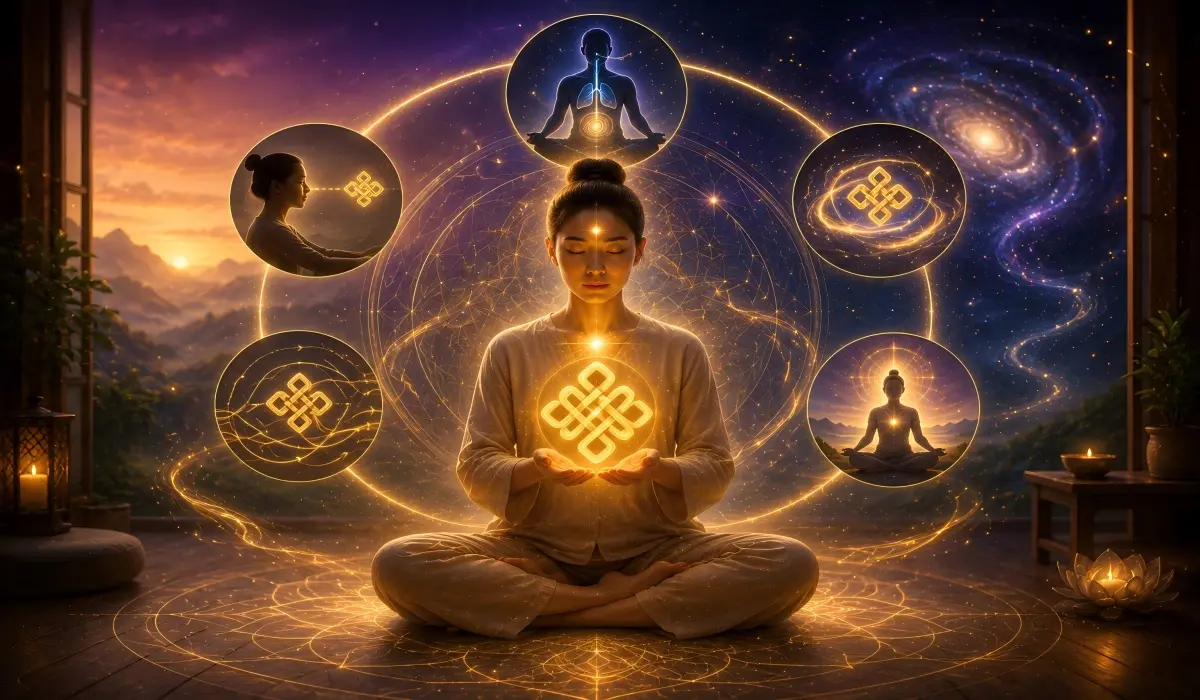
You can use the Mystic Knot as a focus for your daily meditation. Sitting quietly with the symbol helps calm a busy mind. It is a simple way to practice being present in the moment – also known as mindfulness. In Tibetan Buddhism, visualizing the Mystic Knot is believed to open the "eye of wisdom," helping practitioners see through the illusory nature of phenomena.
Advanced Meditation – The Five-Step Visualization Practice
In addition to the four-step activation ritual mentioned earlier, you can also engage in a deeper five-step visualization meditation:
-
Preparation and Breath Regulation: Find a quiet corner, sit cross-legged or upright in a chair, and take seven deep breaths to settle your body and mind.
-
Gaze Focus: Place the Mystic Knot at arm's length directly in front of your line of sight. Gently gaze at its center point without straining to look at any specific line.
-
Following the Lines: Allow your gaze to slowly follow a single line—track its turns, crossings, and returns. Don't rush; let your eyes wander as if strolling through a labyrinth.
-
Merging with Emptiness: When you follow the line back to its "starting point," you will realize that the "start" does not actually exist. At this moment, experience the feeling of "no beginning, no end"—thoughts may disappear, leaving only pure awareness.
-
Dedication of Merit: At the end of the meditation, "dedicate" your calmness and insights to all beings—silently recite: "May this peace extend to all."
Daily Mini-Ritual
If you do not have time for a full meditation session, you can perform a 30-second mini-ritual each morning before putting on your Mystic Knot:
-
Gently pinch the knot between your thumb and index finger, close your eyes, and take one deep breath.
-
Silently recite your intention for the day—"Today, I choose calm," "Today, I open myself to receive," or "Today, I am connected to all things."
-
Then put it on.
The Mystic Knot and Period 9 Feng Shui in 2026
Basic Characteristics of Period 9
The year 2026 marks the full unfolding of the Period 9 (Nine Purple Fire Period) . Period 9 is dominated by the Fire element, with the South as its primary direction, and its symbolic meanings include brightness, civilization, technology, visual arts, and spiritual awakening. In this era, people's pursuit of "meaning" will become unprecedentedly strong, and the Mystic Knot perfectly meets this need—it is both an aesthetic visual delight and a profound spiritual comfort.
Why the Mystic Knot Is the "Premier Symbol" of Period 9
The Mystic Knot's red color belongs to Fire, highly compatible with Period 9's Fire element; its heart-shaped structure resonates with the Li trigram (representing "heart" and "vision"); and its endless lines symbolize the infinite flow of information and energy in Period 9. Therefore, wearing or placing the Mystic Knot during Period 9 is essentially "calibrating" your personal energy field in the temporal dimension to resonate with the larger energy field of the era.
Personalized Placement Suggestions for Period 9
-
If you are an entrepreneur or creator: Place one gold Mystic Knot in the Southeast and another in the South of your office to enhance innovation and public influence.
-
If you are an office worker: Hang a red Mystic Knot in the North of your desk and place a small Mystic Knot sticker on the back of your computer screen to stabilize career luck.
-
If you are a homemaker or caregiver: Hang a wooden Mystic Knot in the central area (Taiji point) of your home to harmonize the energy field of the entire family.
-
If you are a student or researcher: Place a green Mystic Knot in the Northeast of your desk to boost academic luck and mental clarity.
🔮 Forward-looking Perspective: From 2026 to 2044, the entire Period 9, the popularity of the Mystic Knot is expected to rise continuously. It is not merely a revival of a traditional symbol but also a spiritual anchor for modern people seeking "connection" and "stability."
Conclusion: Integrating the Wisdom of the Mystic Knot
May the lines of your life be as smooth and unending as the Mystic Knot itself. May you weave a life filled with compassion, strength, and plenty for many years to come. By bringing this symbol into your world, you are choosing a path of harmony and balance.
Take a moment today to look at your surroundings and see where energy might be stuck. A simple knot can be the key to opening new doors of opportunity. Always remember that your intention is the most important part of Feng Shui. The Mystic Knot is a tool that helps your mind focus its power. When you use it with a kind heart, the results will be much stronger for everyone involved.
FAQ: Unraveling the Mysteries of the Endless Knot
Q: What is the deeper spiritual meaning of the Mystic Knot in 2026?
A: In the coming years, the knot represents the balance between our digital lives and our souls. It reminds us to stay human and connected to nature even when we use a lot of technology. It is a symbol of stability during times of big change.
Q: Why is the Mystic Knot the most powerful symbol for Period 9 Feng Shui?
A: Period 9 is a time of fire and high energy. The red color and heart connection of the Mystic Knot fit perfectly with this era. It helps manage the fast pace of life so we do not feel overwhelmed by too much heat or light.
Q: Where should I place a Mystic Knot to stabilize career volatility?
A: The best place is the North sector of your home or office. Hanging it at eye level near your desk ensures that your professional life stays on a steady and growing path. It prevents sudden drops in your success or income.
Q: Can the Mystic Knot be used to attract a soulmate?
A: Yes, by placing a pair of knots in the Southwest corner of your bedroom. This tells the universe you are ready for a partner who is deeply connected to you. It sets the intention for a relationship that is based on mutual respect and eternal love.

Longyi Luck
Longyi Luck is a Feng Shui practitioner and spiritual researcher who blends traditional year-based wisdom with modern lifestyle insights, specializing in Feng Shui, spirituality, meditation, and mindfulness. With years of dedicated study and practice, Longyi explores cultural symbolism and the practical application of ancient wisdom to help individuals cultivate balance, clarity, and harmony in everyday life. Since 2020, Longyi has been committed to translating timeless traditions into accessible guidance for the modern world.
longyi@auraandluck.com
.webp?w=800&h=800)
.webp?w=800&h=800)