
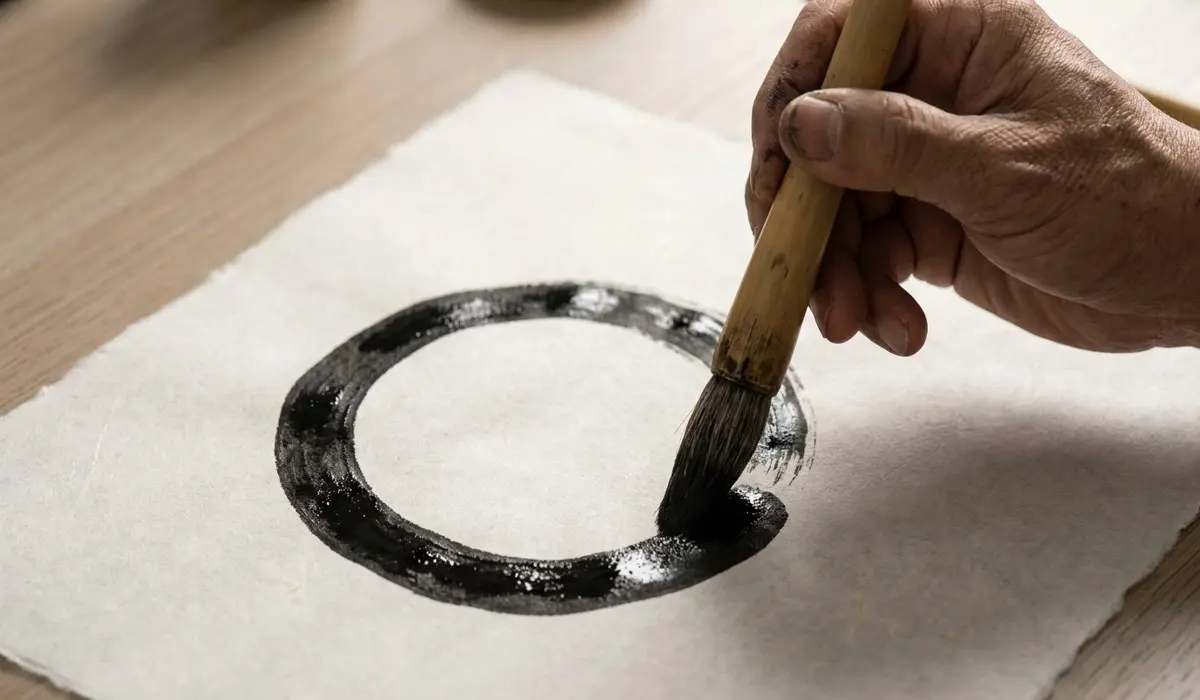
Drawing an Ensō (円相) is a sacred Zen ritual where you create a circle in one single, fluid breath-stroke to show your state of "no-mind" and the beauty of imperfection. To draw it correctly, you must use washi paper and a brush to capture your energy in that exact moment without trying to make it look perfect.
Preparation Essentials:
-
Sacred Space: Clear all clutter and find a quiet, well-lit spot.
-
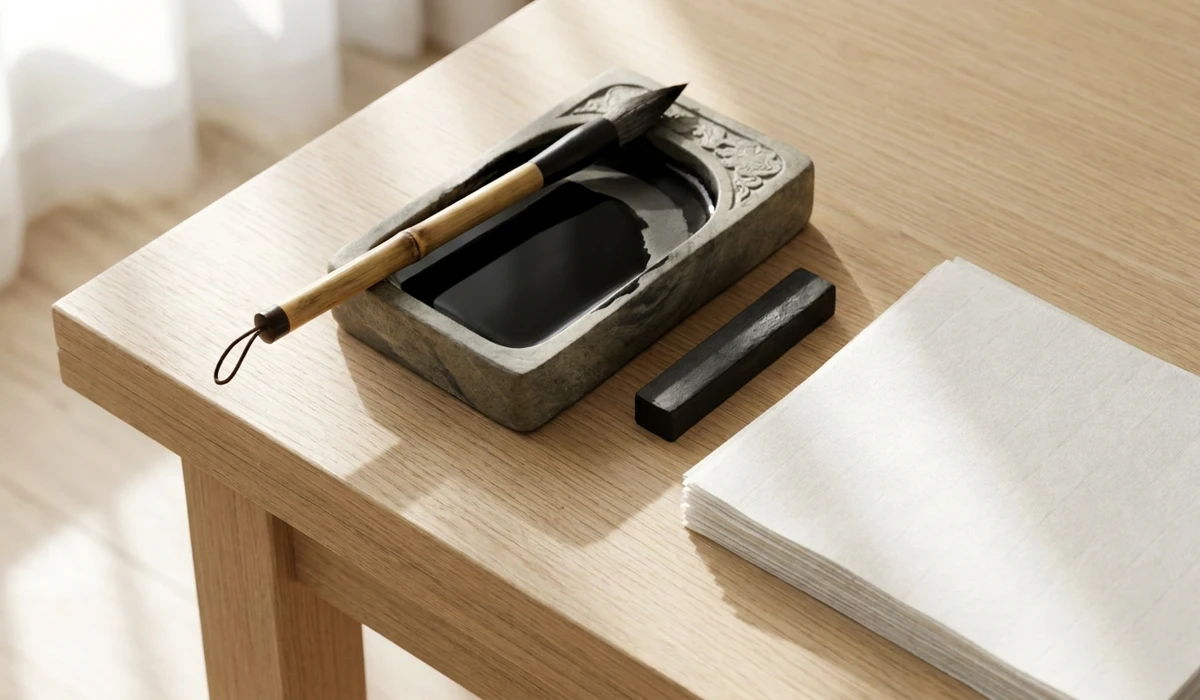
Traditional Tools: Use a Fude brush, Sumi ink, and textured paper.
-
Mindset: Release all goals of creating "art" and focus on your breath.
-
Timeframe: Allow at least 20 minutes for the full grounding and drawing ritual.
Introduction
In our studio at Aura & Luck, we believe that the Ensō is much more than just a simple shape on paper. This ancient symbol serves as a direct mirror to your soul and captures your mental state at the exact moment of creation. When you draw the circle, you are aligning your personal energy with the great Void (Śūnyatā 空).
The Ensō carries profound symbolic meaning in Buddhist philosophy. "Void" does not signify "nothingness" — rather, it refers to the interdependent nature of all things, the absence of independent self-existence. When you draw an Ensō, you are in fact expressing this awakened understanding of interconnectedness through a single stroke of ink. Each Ensō is unique, just as every moment of lived experience can never be replicated.
The ritual requires you to let go of your ego and your desire for a perfect result. Our many years of guiding rituals have shown that a "perfect" circle often lacks the true Zen spirit. By focusing on the process instead of the outcome, you can experience a deep sense of peace and clarity.
Modern psychological research also supports this "process-oriented" approach to practice. Flow State theory indicates that when a person is fully immersed in an activity, they experience a high degree of focus and satisfaction. Ensō drawing is an ideal path to entering the flow state — it requires you to be fully present with your breath, your brush movement, and the flow of ink, rather than fixating on the final image.
Did You Know?
The Ensō (Japanese: 円相) was introduced to Japan around the 13th century and became a quintessential representation of Japanese Zen aesthetics. Its origins can be traced back to the Tang Dynasty master Nanyang Huizhong (active 711–762 CE) in China, and was further developed by the Guiyang school, which used ninety-seven types of Ensō diagrams to guide students toward enlightenment.
Video source:YouTube
Author:Study Buddhism
Original video link:https://www.youtube.com/watch?v=Cc4nRkQ5p94
Preparation and Essential Tools for Zen Calligraphy
Before you begin the physical act of drawing, you must gather the right materials to support your spiritual journey. Using authentic tools helps you connect with the history of this practice and respects the tradition of Shodo (書道). We suggest finding items that feel good in your hands and have a natural texture.
Essential Tools for Your Practice
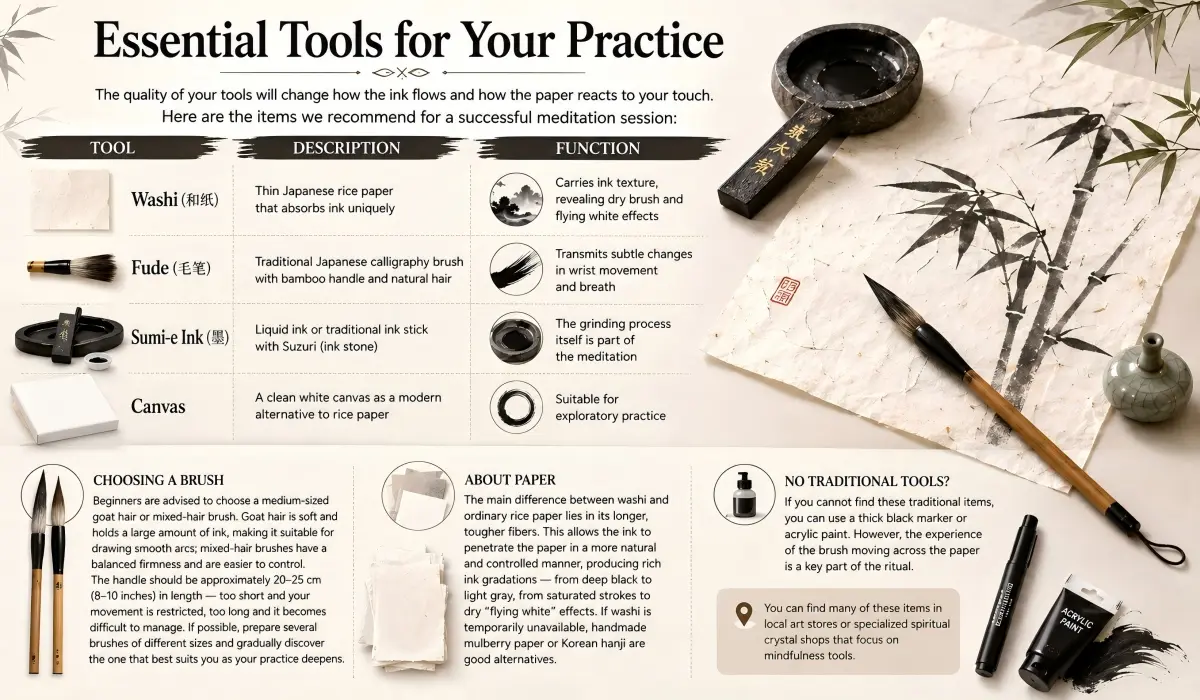
The quality of your tools will change how the ink flows and how the paper reacts to your touch. Here are the items we recommend for a successful meditation session:
| Tool | Description | Function |
|---|---|---|
| Washi (和纸) | Thin Japanese rice paper that absorbs ink uniquely | Carries ink texture, revealing dry brush and flying white effects |
| Fude (毛笔) | Traditional Japanese calligraphy brush with bamboo handle and natural hair | Transmits subtle changes in wrist movement and breath |
| Sumi-e Ink (墨) | Liquid ink or traditional ink stick with Suzuri (ink stone) | The grinding process itself is part of the meditation |
| Canvas | A clean white canvas as a modern alternative to rice paper | Suitable for exploratory practice |
When selecting a brush, beginners are advised to choose a medium-sized goat hair or mixed-hair brush. Goat hair is soft and holds a large amount of ink, making it suitable for drawing smooth arcs; mixed-hair brushes have a balanced firmness and are easier to control. The brush handle should be approximately 20–25 cm (8–10 inches) in length — too short and your movement is restricted, too long and it becomes difficult to manage. If possible, prepare several brushes of different sizes and gradually discover the one that best suits you as your practice deepens.
Regarding paper, the main difference between washi and ordinary rice paper lies in its longer, tougher fibers. This allows the ink to penetrate the paper in a more natural and controlled manner, producing rich ink gradations — from deep black to light gray, from saturated strokes to dry "flying white" effects. If washi is temporarily unavailable, handmade mulberry paper or Korean hanji are good alternatives.
If you cannot find these traditional items, you can use a thick black marker or acrylic paint. However, the experience of the brush moving across the paper is a key part of the ritual. You can find many of these items in local art stores or specialized spiritual crystal shops that focus on mindfulness tools.
Ritual Space Cleansing
In our experience, your physical environment affects your internal energy during the ritual. Start by clearing all physical clutter from your desk or table to create a sense of openness. A clean space allows your Chi (气) to flow without being blocked by messy surroundings.
In addition to physical space clearing, you can also perform energetic cleansing. Light a natural incense stick (such as sandalwood or white sage) and let the smoke circulate through the space, helping to disperse stagnant energy fields. You may also place a crystal (such as clear quartz or amethyst) at the corner of your desk — these are believed to stabilize environmental energy. Research has shown that clean, organized environments significantly reduce cortisol (stress hormone) levels, creating favorable conditions for deep meditation.
Settle into a quiet room where you will not be interrupted by phones or other people. Soft, natural light is best for keeping your mind focused and calm during the drawing process. Make sure your seat allows you to sit with an upright and alert posture for better breathing.
If conditions permit, consider playing soft ambient music or singing bowl audio during your practice. Frequencies at 432Hz or 528Hz are believed by some to promote physical and mental relaxation. Of course, complete silence can be equally effective — the key is to find the background atmosphere that best supports your personal practice style.
Step-by-Step Guide to Drawing Your First Enso Circle
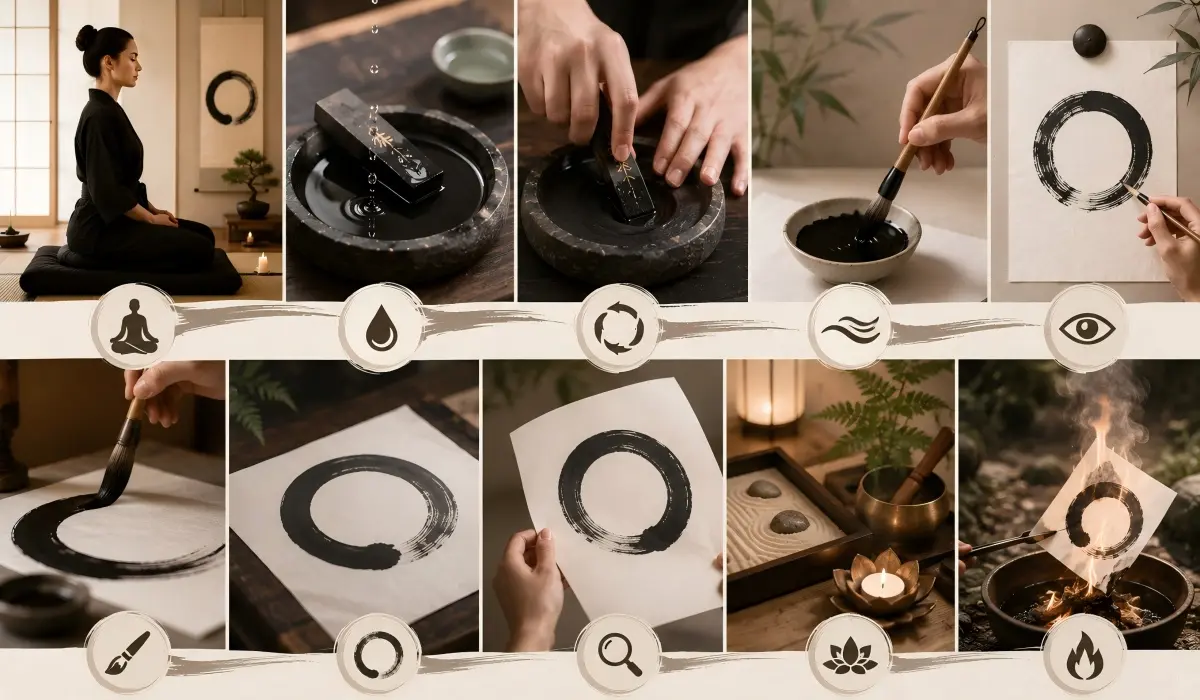
Drawing the Enso is a multi-step ritual that begins long before the brush touches the paper. Each part of the process is a form of meditation that prepares your spirit for the final stroke. Following these steps will help you reach a state of calm and focus.
Preparing Your Sacred Space and Grounding Energy
Begin by looking at your paper as a sacred "Void" that is ready to receive your energy. Sit in a posture inspired by Zazen (坐禅) to keep your core stable and your mind steady. This physical grounding is the foundation for a fluid and powerful brush movement.
Specific posture guidelines: sit on the front third of your chair, with both feet flat on the floor, shoulder-width apart; your spine should be naturally straight, neither rigid nor slack; tuck your chin in slightly, and lightly press the tip of your tongue against the roof of your mouth; your hands can rest in your lap, one over the other, or lightly on your thighs. This posture helps sink the qi to the dantian, allowing for deeper, fuller breaths.
Establish a rhythmic and natural breathing pattern that fills your lower belly. We often suggest taking three deep breaths to release any tension in your shoulders or neck. Once you feel settled, you are ready to begin the ritual of the ink.
One effective breathing technique is the 4-7-8 breathing method: inhale for 4 seconds, hold for 7 seconds, exhale for 8 seconds. Repeat three to five times. This quickly activates the parasympathetic nervous system, reducing heart rate and bringing you into a relaxed yet alert state — the ideal physiological preparation for Ensō drawing.
The Ritual of Grinding the Ink and Controlled Breathing
If you are using a traditional ink stick, engage in the slow and rhythmic process of grinding it on the stone. View this grinding as the actual start of your meditation rather than just a chore. The sound and smell of the ink can help pull you deeper into the present moment.
Inhale deeply as you move the stick across the stone and exhale as you apply gentle pressure. This repetitive motion helps synchronize your body and mind before you pick up the brush. Through years of guiding rituals, we have found that this stage is where most people find their inner quiet.
When grinding ink, pay attention to the water-adding rhythm: first place 3–5 drops of clean water in the ink stone, then grind the ink stick in a circular motion. As the ink gradually darkens, add water drop by drop until you reach the ideal concentration — the ink should cling to the brush hairs without dripping off quickly. The entire process takes approximately 5–10 minutes, and this time itself constitutes a profound dynamic meditation.
If using prepared liquid ink, pour it into a small porcelain dish and stir it briefly with the ink stick. Though simple, this action still helps facilitate the psychological transition from "everyday state" to "ritual state." Regardless of which method you choose, the key is to perform every action with awareness.
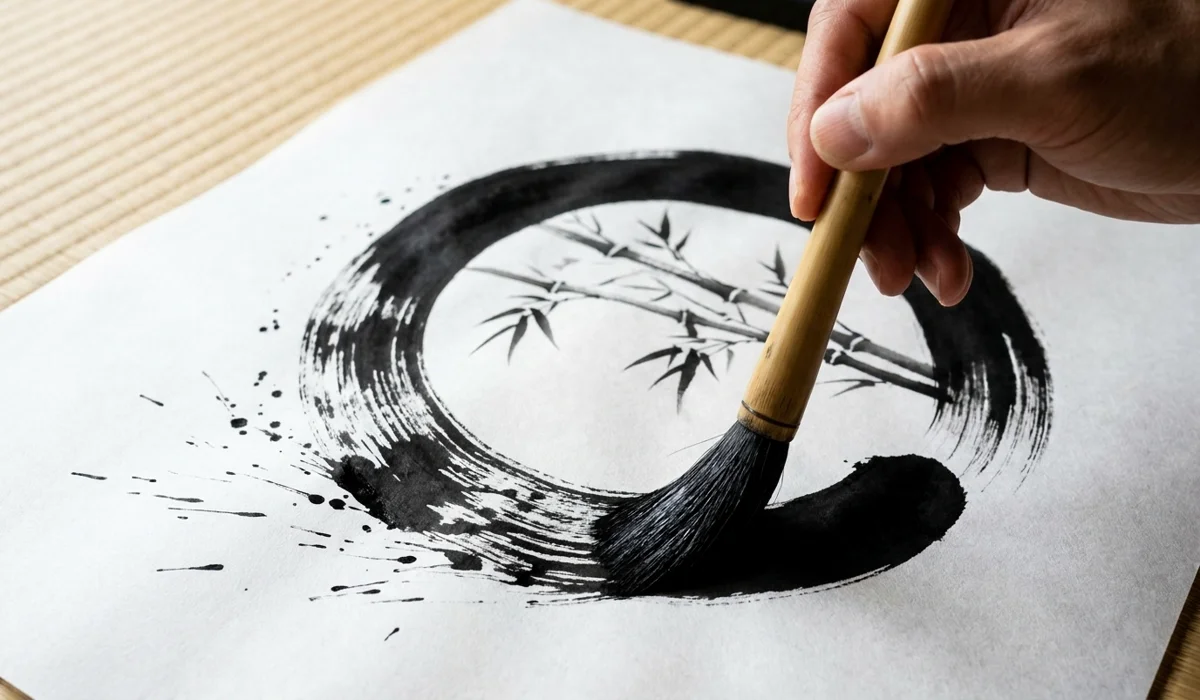
Visualizing the Void: Mental Preparation for the Stroke
Gaze at the empty paper without focusing your eyes on any specific point. Try to clear your mind of any expectations or the pressure to make something beautiful. In Zen, this is the first step toward achieving a state of "no-mind" or Mushin (无心).
Visualize the path your brush will take before it actually touches the white surface. See the circle in your mind's eye but do not try to control it too tightly. Just let the image exist in the space in front of you while you maintain your steady breath.
💡 Visualization Tip
Close your eyes and use three to five breaths to mentally "rehearse" the path of the brush. Feel the connection between your shoulder, elbow, and wrist moving in unison. Then open your eyes and make your stroke.
If distracting thoughts arise, do not resist them — simply notice their presence, then gently guide your attention back to your breath and the paper. This cycle of "noticing — letting go — returning" is the core practice of Mindfulness Meditation. Even before the brush touches the paper, your practice is already unfolding in this present moment.
Executing the Enso in a Single Uninterrupted Breath
Saturate your brush fully with ink so that it can complete the circle without running dry. Place the brush on the paper at a spot that feels natural, such as the 12 o'clock or 6 o'clock position. In one continuous and fluid exhalation, move your whole arm from the shoulder to draw the circle.
Do not stop moving until the circle is complete and the brush is lifted from the page. The movement should be fast enough to be fluid but slow enough to be mindful.
Pay attention to three key points during the stroke:
-
Shoulder-driven movement: The Ensō is not drawn with the fingers or wrist alone. It is driven by the shoulder joint as the axis, moving the entire arm. This produces more natural, expansive arcs.
-
Brush angle: The brush handle should maintain a tilt of approximately 70–80 degrees from the paper surface. The brush tip can rotate moderately during the stroke to maintain even line quality.
-
Speed variation: Typically, you may move slightly slower at the top and bottom of the arc, and slightly faster along the sides, creating a natural rhythm.
A common mistake beginners make is applying too much pressure. Remember that the relationship between the brush tip and the paper should be a "kiss" rather than a "bite" — gentle contact often produces lines with more vitality and life. You may do a few trial strokes on scrap paper beforehand to feel how different pressure levels affect the ink marks.
Observing the Result: Embracing Imperfection and Wabi-Sabi
Once the stroke is done, lift the brush decisively and set it down. Resist every urge to look at your work with a critical or judging eye. Instead, look at the circle as a finished expression of your energy in that single breath.
Observe the "hollow" parts where the ink might be thin or the "dry" edges of the stroke. These are signs of Wabi-Sabi (侘寂), which is the beauty of things that are imperfect and temporary. Your Enso is a perfect record of your true self in that specific moment in time.
Look closely at your Ensō — you will find it contains a wealth of "information": Is the starting point firm and decisive? Is the arc smooth and flowing? Does the ending come to a clean finish or does it hesitate? Every detail is telling you about your physical and mental state at that moment. Do not judge them — simply read them, like reading a page from your own diary.
In the Japanese tea ceremony, there is the concept of "Ichi-go ichi-e" (一期一会), meaning that each encounter is unique and can never be repeated. Ensō drawing is the embodiment of "ichi-go ichi-e" in art — the circle you draw in this moment will never appear again, and its very uniqueness is what makes it precious.
Sealing the Practice and Meditating on the Finished Circle
Sit in silence with your finished Enso while the ink begins to dry on the paper. Reflect on how your internal feelings were translated into the shape on the page. You may notice that a busy mind creates a shaky line, while a calm mind creates a smooth one.
At this point, try viewing the circle upside down: flip the paper or rotate it 180 degrees to look at your Ensō from a new angle. This perspective shift often reveals new discoveries — you may notice details overlooked when viewed right-side-up, or gain a different sense of the overall composition. This "perspective-shifting observation" helps break attachment to the idea of a "correct" orientation.
Acknowledge that this specific moment is now over and cannot be repeated or fixed. This helps you practice the art of letting go and staying present for the next experience. To keep your meditation area peaceful, you might consider placing a small Zen garden, singing bowl, or calming natural décor on your desk to support a grounded and mindful atmosphere.
After completion, you may choose to preserve your Ensō or burn it. Preserving allows you to look back and track your progress over time; burning is a deeper practice of letting go — returning the circle to the void, symbolizing non-attachment to any outcome. Both approaches have their beauty, and you may choose according to your heart's inclination.
Video source:YouTube
Author:Esteban Martinez
Original video link:https://www.youtube.com/watch?v=QLFft9xmnm8
The Logic of the Open vs. Closed Enso
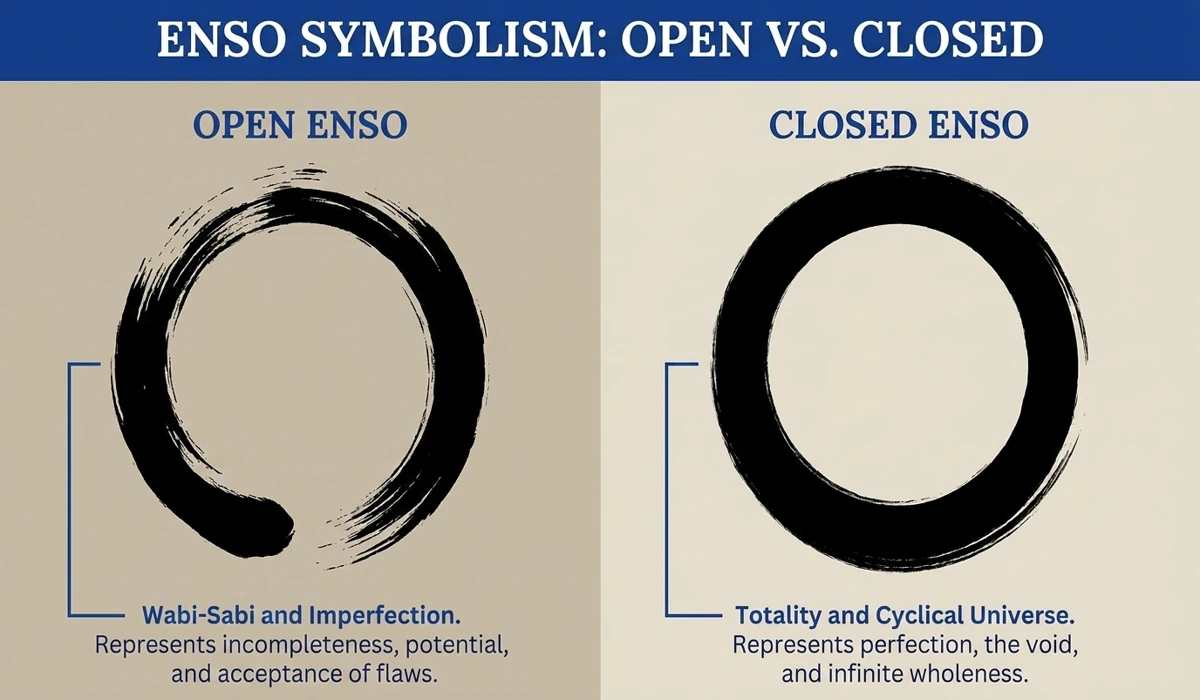
When you draw an Ensō, you have the choice to leave the circle open or to close the loop entirely. Both styles have deep spiritual meanings that can help you focus your meditation. Understanding these differences allows you to choose the style that best fits your current spiritual needs.
.webp?w=1200&h=700)
The Meaning of the Gap (Open Enso)
An open Ensō has a visible gap between where the brush starts and where it ends. This gap represents the idea that the soul is not a closed vessel but stays open to the universe. It suggests that there is always room for movement, growth, and the flow of energy.
The open circle also highlights the concept of imperfection as a source of beauty. In our studio, we often suggest the open circle for those who are working on letting go of control. It reminds us that life is a process that never truly stops moving or changing.
From a philosophical standpoint, the open Ensō resonates with the Daoist concept of "emptiness" (虚) — "empty yet inexhaustible, moving and ever producing." It is precisely that one gap that prevents the circle from becoming closed and rigid, preserving a quality of breathing vitality. Many Zen monks, when drawing an open Ensō, intentionally leave a clean, sharp "cut" at the ending point, like the lingering resonance of a snapped string.
The Logic of Totality (Closed Enso)
A closed Ensō forms a complete loop where the beginning and end meet or overlap. This style represents totality, perfection, and the cyclical nature of the entire universe. It is often used to manifest a sense of wholeness and the successful completion of a cycle.
Many people find comfort in the closed circle when they need to feel centered and protected. It symbolizes that everything you need is already within you and that the universe is a complete system. Selecting this style can help you feel more grounded during times of great change.
The closed Ensō is frequently used in meditation practice for marking the completion of a cycle — such as the end of the year, the conclusion of a project, or the closing of a chapter in life. It helps you draw a definitive line under past experiences and greet new beginnings from a state of wholeness.
Drawing from the Hara
Whether open or closed, the movement must always originate from your "Hara" (原/丹田) — the physical and spiritual center of your body located just below the navel. By drawing from your center, the stroke becomes a pure expression of your life force, connecting your physical body to your higher consciousness.
How to connect with your Hara? Place one hand lightly on the area three finger-widths below your navel. Take several deep breaths, feeling the slight warmth as your breath reaches this point. When you can clearly perceive the presence of your Hara, pick up the brush — you will notice a significant improvement in the stability of your stroke.
Critical Taboos and Common Mistakes to Avoid
To keep the Ensō ritual pure and effective, there are certain things you should never do. These "taboos" are meant to protect the meditative state and ensure your practice remains honest. Breaking these rules can turn a spiritual exercise into a simple art project.
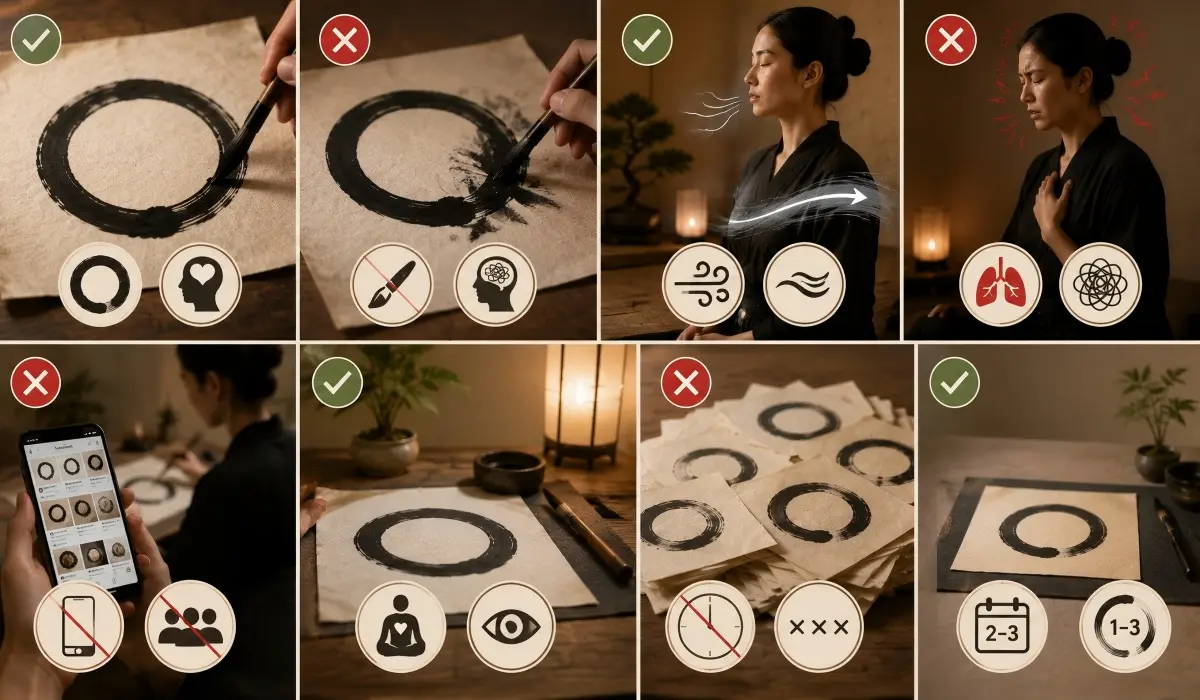
Do's and ❌ Don'ts Quick Reference
| ✅ DO | ❌ DON'T |
|---|---|
| Complete in one stroke, never modify | "Touch Up": Never go back to fix a line or fill a gap |
| Exhale during the stroke | Hold Your Breath: The stroke must flow with a steady exhalation |
| Accept the circle's natural form | Obsess over symmetry: A mathematically perfect circle lacks living Zen spirit |
| Grind ink thoroughly and clear space | Rush the prep: Skipping preparation ruins your grounding |
| Observe without judgment | Judge the result: Calling the circle "good" or "bad" brings your ego back |
When you try to "fix" a line, you are essentially lying about the moment that has already passed. The first stroke is the absolute truth of your mind at that specific second. If the ink is thin or the shape is wobbly, simply accept it as a true reflection of your current state.
Holding your breath causes your body to become tight and stops the flow of your internal energy. The stroke must be a physical extension of your breath leaving your body. If you feel like you are rushing, take a moment to reset your posture and try to Spiritual Mantras Meditations to calm your heart before the next attempt.
Another common pitfall is comparing yourself to others. In the age of social media, people are accustomed to sharing their work and seeking validation. But the core of Ensō practice is about "looking inward" — no matter how beautiful someone else's circle may be, it has no bearing on your own internal state. It is advisable not to post your works on social media during the early stages of practice. Wait until you have developed a sufficiently stable understanding of the Ensō before considering sharing.
Finally, a word of caution about over-practice. Drawing dozens of Ensōs in a single day can render the practice mechanical rather than meditative. The wisdom of Zen is "less is more" — one intentional, mindful drawing is worth ten rushed, thoughtless ones. We recommend practicing 2–3 times per week, drawing only 1–3 circles per session, allowing ample time for each experience to settle and be internalized.
Maintenance: When to Repeat the Enso Ritual
Drawing an Enso is not a one-time event but a practice that can be repeated throughout your life. Because your energy changes every day, each circle you draw will look different from the one before. Regular practice helps you stay connected to your inner self and track your spiritual growth.
We recommend performing the ritual whenever you feel mentally cluttered or disconnected from your center. The act of grinding the ink and making the stroke can help clear away mental fog. It is a very effective way to reset your energy after a stressful day or a difficult conversation.
In the Zen tradition, many monks draw an Enso every single day as a spiritual "check-in." Over time, you can look back at your old circles to see how your mind has evolved. You might also use this ritual during special Tai Sui Amulets transitions to clear out stagnant energy and start fresh.
Maintaining a simple practice journal can be very helpful. After each session, record the date, your state of mind, whether you drew an open or closed Ensō, and any observations you wish to note. Months later, revisiting this journal will reveal subtle correspondences between the circles on paper and your written reflections — when you were feeling low, the lines were often hesitant; when your spirit was expansive, the strokes flowed freely.
On Reddit, users often share how mindfulness drawings help them manage their mental states. In the r/RainbowEverything community, user Neurographics_fan shared their experience:
"Black marker + colored pencils."
*sources:[Rainbow Everything neuromandala](https://reddit.com/r/RainbowEverything/comments/1ti03cb/rainbow_everything_neuromandala_my_mindful_line/)*
This case shows how different forms of mindful drawing, like this neuromandala, can be used for relaxation.
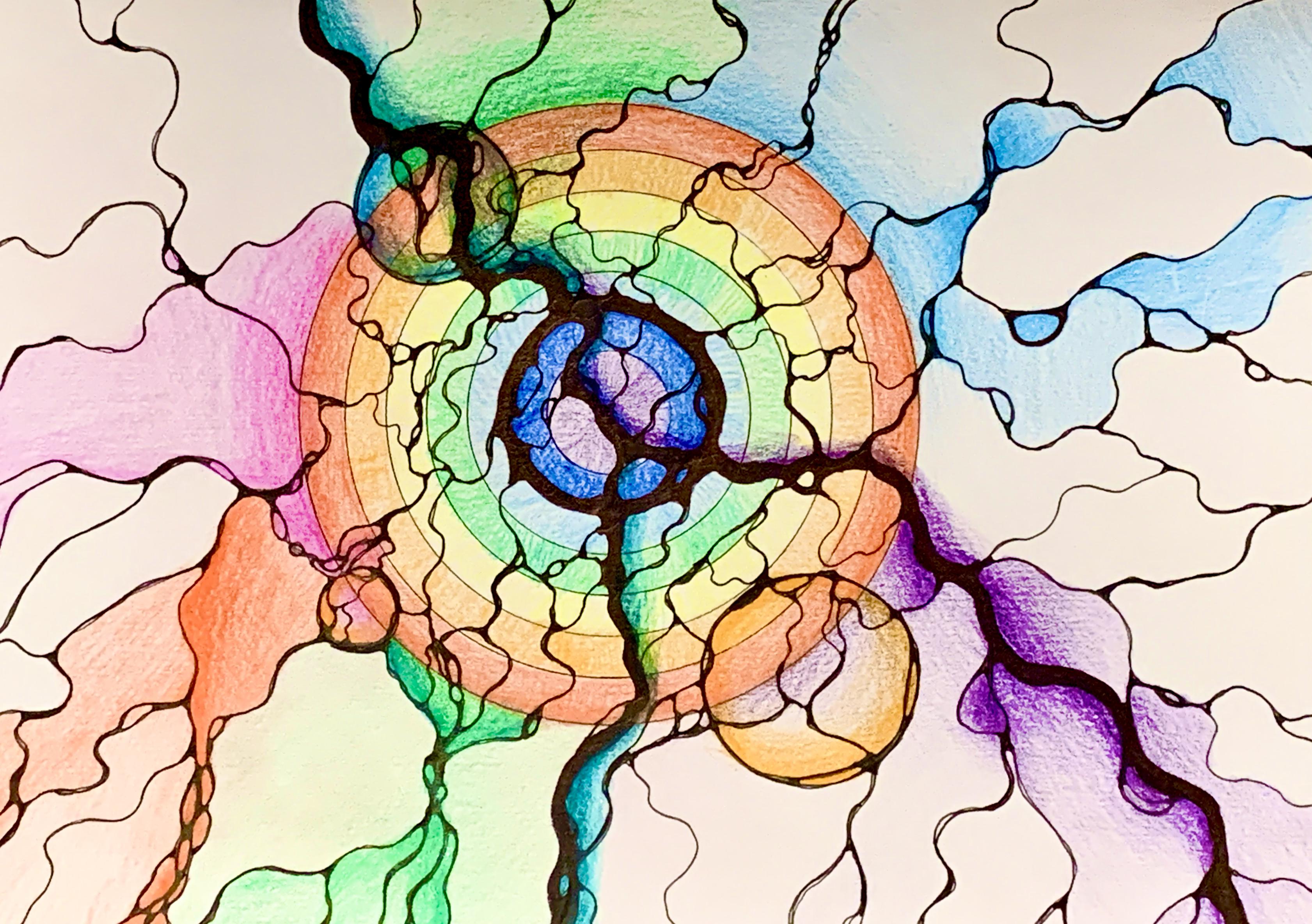 *sources:[Reddit - Neurographics_fan - Rainbow Everything neuromandala](https://reddit.com/r/RainbowEverything/comments/1ti03cb/rainbow_everything_neuromandala_my_mindful_line/)*
This illustrates that while traditional tools are best, the goal is always mindful focus.
For a visual guide on the technique, we recommend watching this demonstration by a professional. It shows the speed and breath control needed to make a successful circle.
Frequently Asked Questions
Q: Why is the Enso often asymmetrical?
A: Asymmetry reflects the natural state of the universe and the uniqueness of your own current vibration at the moment of drawing.
Q: Can I draw an Enso with a marker?
A: Yes, beginners can use markers, but the traditional brush and paper better capture the fluid flow of your energy.
Q: Should I draw the circle clockwise or counter-clockwise?
A: There is no fixed rule for the direction; you should follow whatever intuitive movement feels most natural to you in the moment.
Q: What should I do with my finished Enso circles?
A: You can keep them to track your spiritual journey or release them as a practice of letting go of your attachment to physical things.
Q: How long should it take to draw the circle?
A: The actual stroke takes only a few seconds, but the preparation and grounding steps should take at least fifteen minutes.
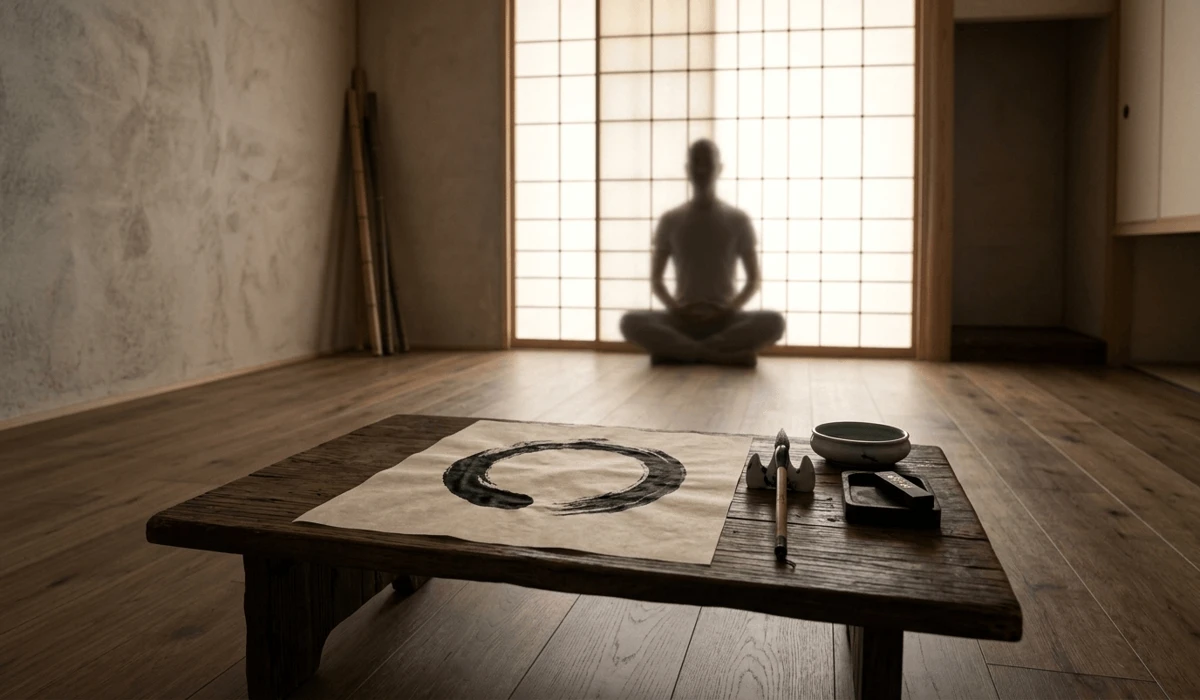
Conclusion and Mindful Intention
The Ensō is not just a drawing of a circle; it is a drawing of the present "moment" in its truest form. By practicing this ritual, you learn to embrace the beauty of things that are imperfect and temporary. Trust the process of the single, fluid stroke to help you find genuine peace and clarity in your daily life.
We encourage you to explore further resources about how physical space and energy interact. Your journey into Zen calligraphy is a path toward understanding your own mind and soul. Be patient with yourself as you learn to move your brush with the rhythm of your own breath.
Finally, we leave you with a Zen verse to serve as a guide for your practice:
"In the stroke, no mind; in the mind, no brush.
The circle is not a circle — it is your true face."
Each time the brush meets the paper is an encounter — an encounter with your unadorned, authentic self that seeks nothing outside itself. May every Ensō you draw become a clear mirror, reflecting the wholeness and freedom that already resides within you.

Longyi Luck
Longyi Luck is a Feng Shui practitioner and spiritual researcher who blends traditional year-based wisdom with modern lifestyle insights, specializing in Feng Shui, spirituality, meditation, and mindfulness. With years of dedicated study and practice, Longyi explores cultural symbolism and the practical application of ancient wisdom to help individuals cultivate balance, clarity, and harmony in everyday life. Since 2020, Longyi has been committed to translating timeless traditions into accessible guidance for the modern world.
longyi@auraandluck.com

.webp?w=800&h=800)
.webp?w=800&h=800)