
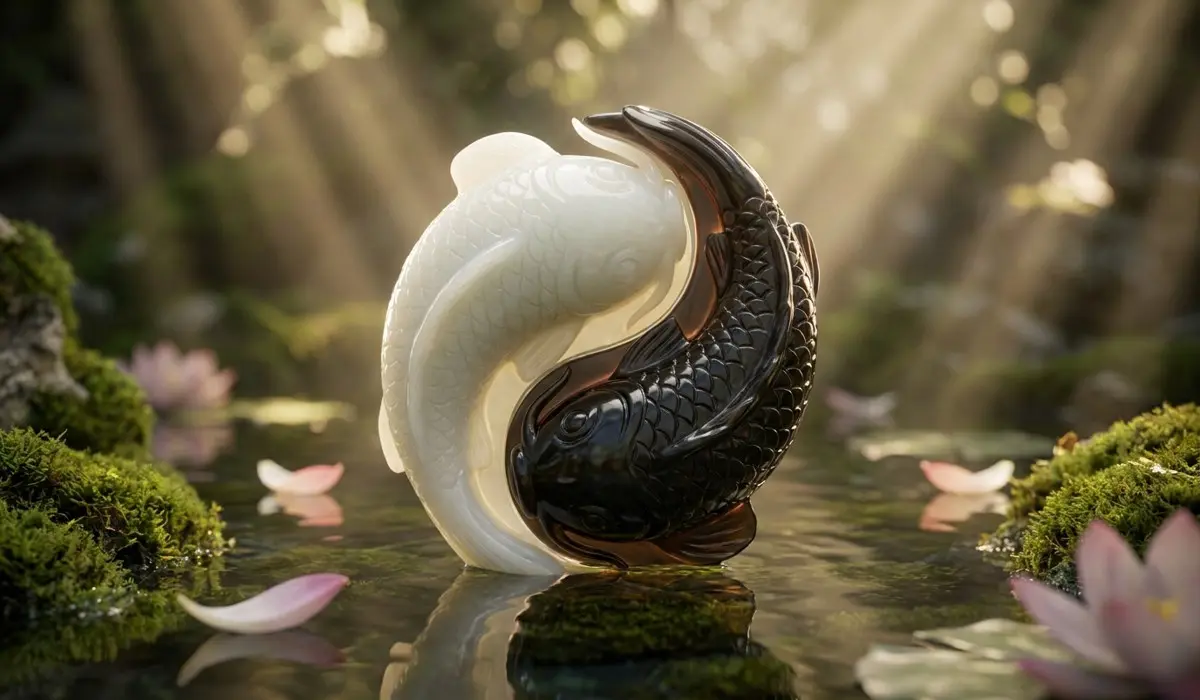
Introduction: Finding Your Center in the Flow
We see the world as a place of constant motion where finding peace feels like a challenge. The Yin Yang Koi Fish serves as more than just a beautiful image in a garden. It represents a living map of the human soul and its journey toward greatness. By blending fluid movement with sacred geometry, this symbol helps us navigate the highs and lows of modern life. We believe that understanding this ancient icon can help you find dualistic harmony in your own daily life rhythm.
In modern society, people commonly face digital burnout, anxiety disorders, and attention fragmentation. The Yin Yang Koi acts as a visual anchor that helps the brain shift from beta waves (stress) to alpha waves (relaxation). This is why, in 2026, this ancient symbol has returned to the public eye as a popular totem in mindfulness meditation and energy healing.
Ancient Origins and Sacred Legends: The Birth of a Symbol
The Legend of the Dragon Gate: From Koi to Celestial Dragon
The story of the koi begins with a test of spiritual resilience. According to the Legend of the Dragon Gate, a golden koi swam against the powerful current of the Yellow River for 100 years. While other fish gave up, this single koi reached the top of a massive waterfall. The gods were so impressed by its grit and perseverance that they turned the fish into a Celestial Dragon. This myth teaches us that perseverance in adversity is the key to evolving into our highest selves.
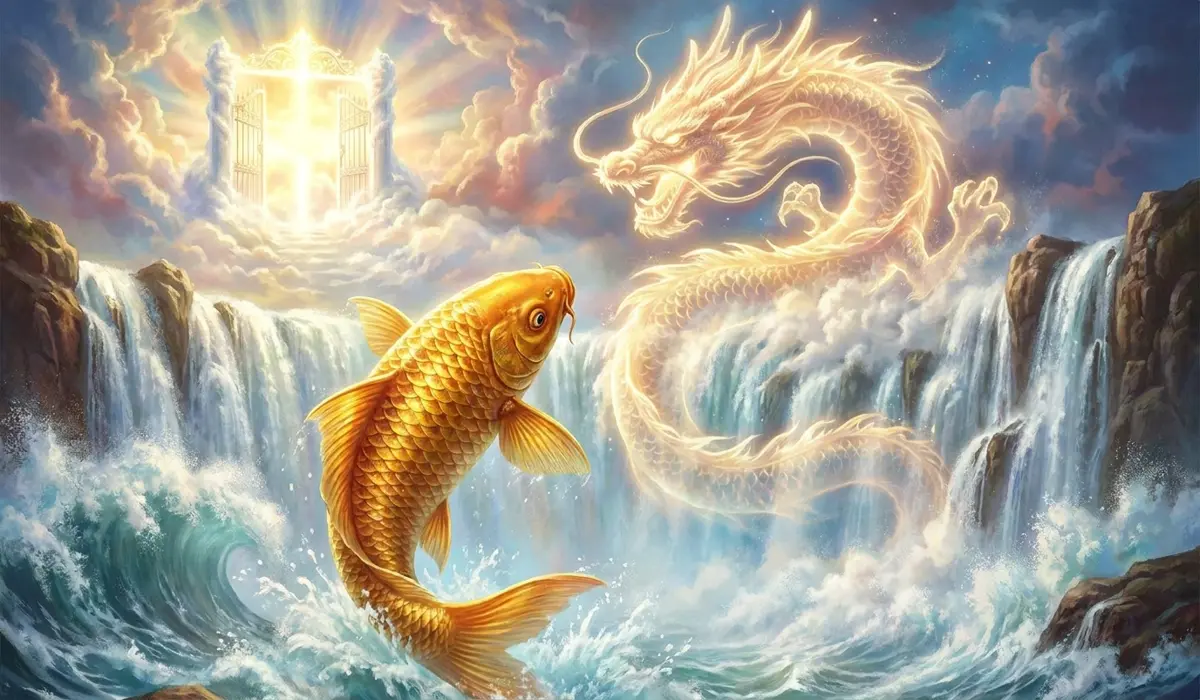
In traditional Chinese culture, the legend of the koi leaping over the Dragon Gate has inspired countless scholars and officials pursuing academic and career success. The koi has thus become a symbol of academic achievement and career advancement. Feng Shui practitioners believe that displaying koi imagery in the home or office can stimulate the occupant's ambition and fighting spirit. This legend aligns closely with Taoist philosophy — true growth often occurs when we push against resistance, not when we drift comfortably downstream.
Taoist Taiji: The Universal Law of Opposites in Unity
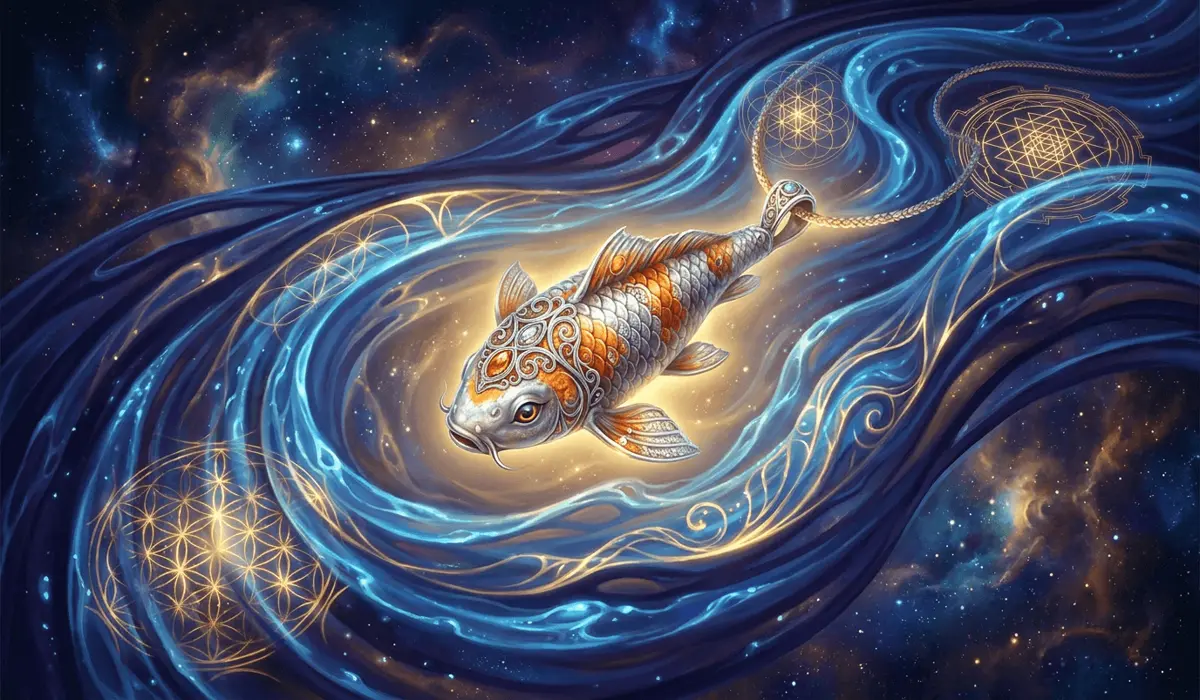
This symbol also draws deep energy from Taoism and the concept of Taiji (太极). Taiji shows that life is a perpetual motion of opposing forces that are actually interdependent. The circular chase of two koi fish creates a sacred geometry of circles that mirrors the natural world. It reminds us that there is always a seed of light in the dark and a seed of rest in the active — this is the essence of mutual generation of Yin and Yang.
From a cosmological perspective, the Yin-Yang fish image in the Taiji diagram is considered one of the earliest visual models of energy flow. Yin represents receptivity, stillness, intuition, and the inner world; Yang represents action, creation, logic, and the outer world. When these two energies take the form of koi fish, they are no longer abstract concepts but living, breathing symbols of life force. Feng Shui masters frequently use this imagery to teach that living spaces require Yin-Yang balance — too much Yin leads to stagnation and depression, while too much Yang creates restlessness and agitation.
Japanese Shintoism and Zen Buddhism: Living Art and Water Meditation
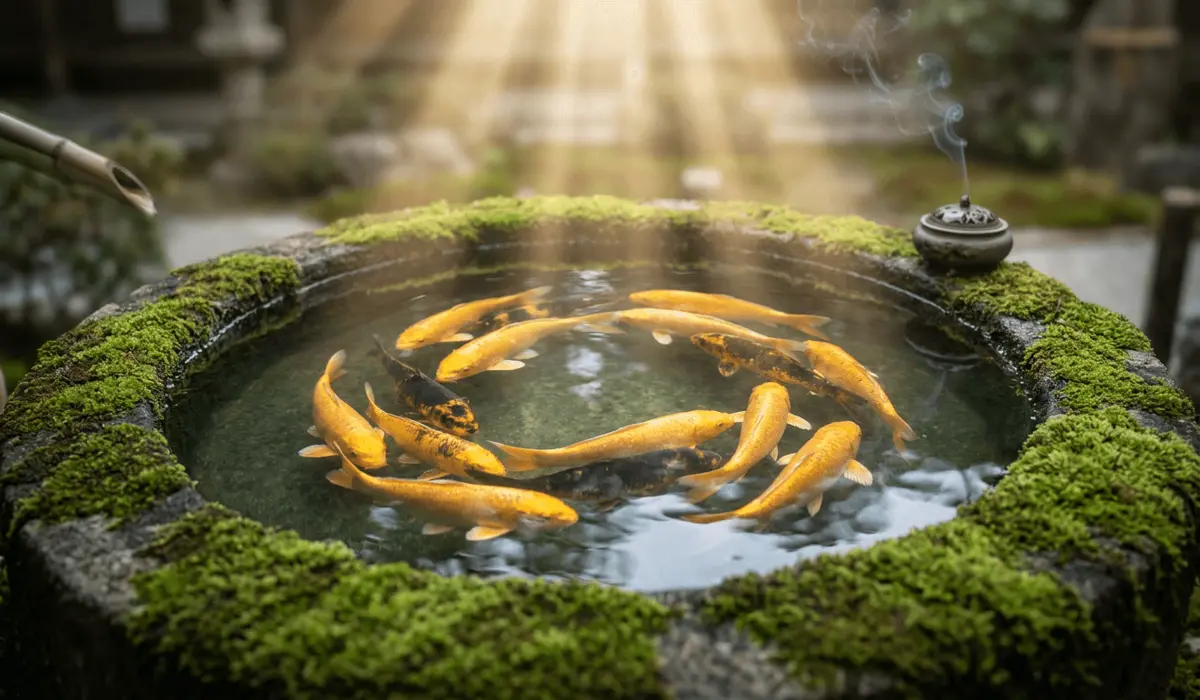
In Japanese Shintoism and Zen Buddhism, the koi is seen as "living art" or Nishikigoi. Zen practitioners often use the movement of fish in water as a form of Zen water meditation. They observe the fish to learn how to stay present and remain mindful. This interconnectedness between the fish and the water reflects how we should interact with our own environment to maintain emotional equilibrium.
🧘 A Classic Zen Koan:
Question: "Is the fish happy?"
Answer: "You are not the fish, how do you know the fish is not happy?"
— This aligns perfectly with the practice of observing the Yin Yang Koi: we are not trying to "understand" the fish, but to become the flow itself.
In Japanese culture, the koi is also deeply connected to the spirit of Bushido. Samurai warriors regarded the koi as a symbol of courage and perseverance because it faces the blade (kitchen knife) without flinching. This composure in adversity is a vital quality for spiritual growth. Zen temples often feature ponds with koi fish, and monks practice mindfulness and concentration by feeding and observing them. Modern psychology has confirmed that this practice helps reduce cortisol levels, alleviating stress and anxiety.
The Hidden Philosophy: Decoding the Yin Yang Koi Symbolism
Karmic Cycles and The Middle Way
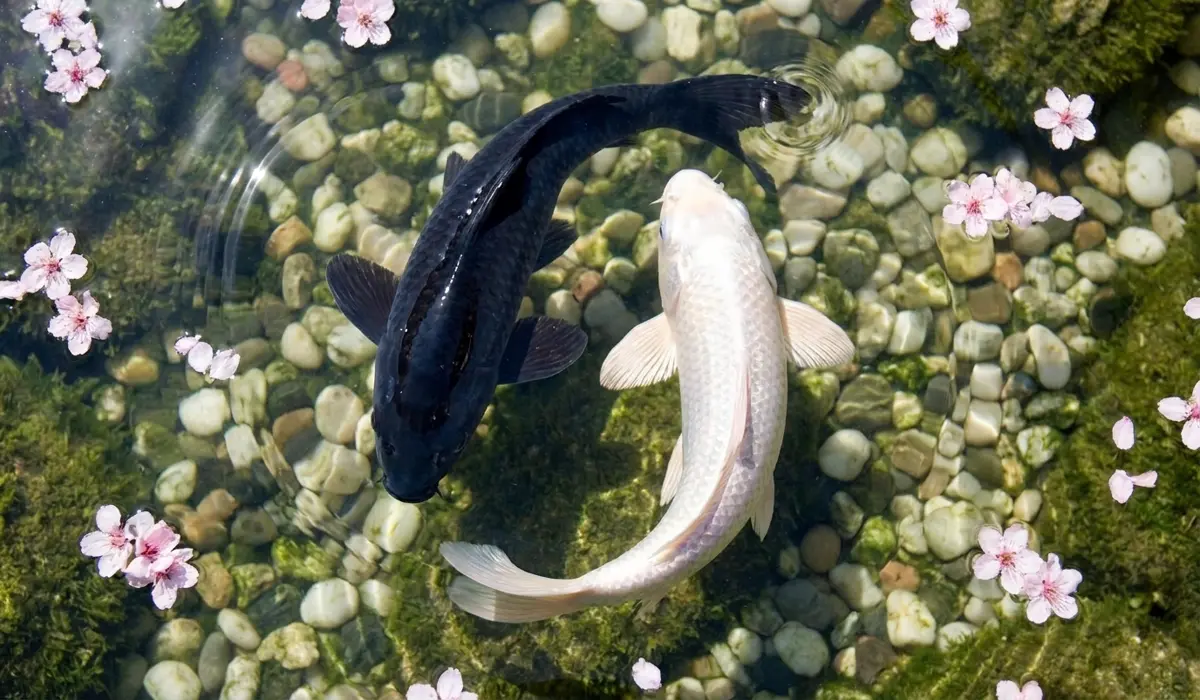
The Yin Yang Koi is a visual lesson in karmic cycles and the flow of the universe. Each fish has an "eye" that matches the color of its partner, representing Yin-Yang balance — Yang within Yin, Yin within Yang. This detail tells us that no force is ever purely one thing. For example, even in our most Yang (active) moments, we must hold a small bit of Yin (rest) to stay healthy. This balance is what we call The Middle Way — avoiding extremes and embracing harmonious coexistence.
From a Buddhist perspective, the circular swimming of the Yin Yang Koi symbolizes samsara (the cycle of birth, death, and rebirth) — where suffering and joy alternate endlessly. However, the koi is not trapped in this cycle; through persistent effort, it eventually leaps over the Dragon Gate and achieves liberation. This offers a profound spiritual insight: karma is not an unchangeable destiny. Through mindfulness, wholesome actions, and diligence, we can transform the direction of our karma.
Karma and Koi Correspondence Table:
| Type of Karma | Koi State | Transformation Method |
|---|---|---|
| Wholesome Karma (Positive) | Swimming downstream with ease | Gratitude and continuation of good deeds |
| Unwholesome Karma (Negative) | Struggling against the current | Mindful awareness, transforming through goodness |
| Neutral Karma | Still waters, no clear direction | Awareness, infusing meaning into the present |
The Flow of Qi and Spiritual Frequency
The fluid motion of the fish also mimics the flow of Qi (Life Force Energy) throughout a space. When we look at the Yin Yang Koi, we are seeing the spiritual frequency of life itself. The fish move in a circle to show that time and energy are not linear. Instead, they are part of a continuous loop of growth and renewal. This helps us understand that struggles are just one part of a larger, beautiful cycle.
In Feng Shui, the flow of water represents the movement of wealth and opportunities. The koi, as an active life form in water, is regarded as an "accelerator" and "purifier" of Qi energy. The energetic vortices created by a healthy koi swimming are believed to activate the energy field of the surrounding space. This is why many corporate lobbies and high-end residences feature koi ponds — not merely as decoration, but as a core element of energy Feng Shui. The quality of Qi flow directly affects the occupants' health, emotions, and decision-making abilities.
The Power of Spiritual Resilience
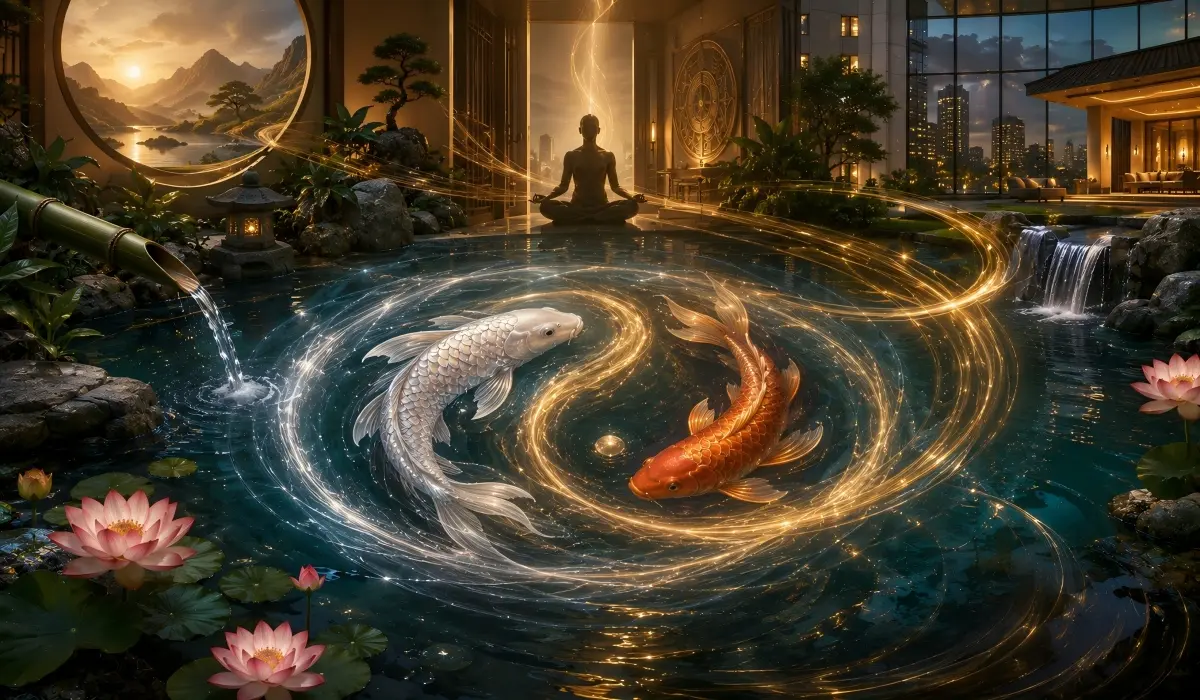
True strength comes from the ability to adapt to changing currents. The koi does not fight the water; it learns to move within it to reach its goal. This spiritual resilience is why many people feel a deep connection to this symbol during hard times. It promises that if we keep moving forward, we will eventually find our own Dragon Gate.
🧠 Modern Psychology Perspective:
This concept aligns closely with what psychologist Angela Duckworth calls "Grit" — passion and perseverance for long-term goals. The Yin Yang Koi is the totemic expression of grit.
The Five Dimensions of Spiritual Resilience:
-
Emotional Resilience: Maintaining stability amid emotional turbulence, like a koi maintaining balance in water
-
Volitional Resilience: Not giving up on goals when facing difficulties, like a koi swimming against the current
-
Social Resilience: Knowing how to seek support and connection, like koi swimming in schools
-
Meaning Resilience: Finding opportunities for growth in suffering, like the koi leaping the Dragon Gate
-
Energy Resilience: Skillfully utilizing environmental forces rather than brute force resistance, like a koi using the water's flow
The Yin Yang Koi and the Seven Chakra System
In modern energy healing practice, the Yin Yang Koi symbol has been extended to the chakra system for balancing. The seven chakras are the body's energy centers, and the koi's swimming path resembles the spiral ascent of Kundalini energy along the spine.
| Chakra | Location | Koi Symbolism | Imbalance Signs | Balancing Method |
|---|---|---|---|---|
| Root Chakra | Base of spine | Black koi's grounding power | Fear, insecurity, survival anxiety | Visualize black koi sinking to the bottom |
| Sacral Chakra | Lower abdomen | Red koi's passion and vitality | Stagnant creativity, emotional numbness | Visualize red koi swimming freely |
| Solar Plexus | Stomach area | Gold koi's power and confidence | Low self-esteem, controlling behavior | Visualize gold koi leaping from water |
| Heart Chakra | Chest | Pink/green koi's love and compassion | Loneliness, resentment, inability to trust | Visualize twin koi swimming heart-to-heart |
| Throat Chakra | Throat | Blue koi's expression and truth | Communication issues, self-suppression | Visualize blue koi blowing bubbles |
| Third Eye | Forehead | Purple koi's intuition and insight | Confusion, lack of vision | Visualize the light in the purple koi's eye |
| Crown Chakra | Top of head | White koi's spiritual connection | Disconnection, spiritual emptiness | Visualize white koi transforming into a Celestial Dragon |

Cultural Evolution: Eastern vs. Western Interpretations
| Culture | Primary Focus | Key Symbolism | Typical Applications |
| Eastern (Taoist/Zen) | Collective Harmony, Family Success | Wealth Manifestation, Family Prosperity, Samurai Valor | Home altars, company lobbies, ancestral homes |
| Western (Modern) | Personal Growth, Emotional Healing | Identity, Pisces Zodiac Connection, Inner Balance | Therapy offices, yoga studios, personal jewelry |
Despite these different views, the core message remains the same. Both sides of the world recognize the koi as a sign of synchronicity. It tells us that we are exactly where we need to be. Whether you seek money or peace of mind, the koi points the way toward a balanced life.
In Western astrology, the symbol of Pisces is precisely two fish swimming in opposite directions, bearing a striking resemblance to the Yin Yang Koi. Pisces is considered the most spiritual and intuitive sign of the zodiac. Its ruling planet Neptune governs dreams, illusions, and spiritual transcendence. If you are a Pisces, wearing a Yin Yang Koi piece may be particularly effective in unlocking your spiritual gifts.
🌐 Further Reading:
Refer to Koi Fish Meaning for more historical data on global fish symbols.
.webp?w=1200&h=700)
Wearing the Talisman: Why Yin Yang Koi Jewelry Remains Essential Today
A Mindful Anchor in the Digital Age
In our digital age, we are often overwhelmed by notifications and social anxiety. Wearing a Yin Yang Koi talisman acts as a mindful anchor. It provides a physical point of focus that reminds us to breathe and find our center. This type of jewelry serves as protective amulets against the chaotic energy of the outside world.
Why Koi Jewelry Is Especially Effective in 2026:
-
High-frequency vibration: The koi, as a species full of vitality, carries a high spiritual frequency that helps elevate the wearer's energy field
-
Visual reminder: Glimpsing the koi jewelry during a busy day instantly triggers a mindful state
-
Tactile anchoring: Touching a koi pendant or bracelet quickly returns you to the present moment through tactile connection
-
Community identification: Wearing the Yin Yang Koi symbol attracts like-minded people and builds spiritual community connections
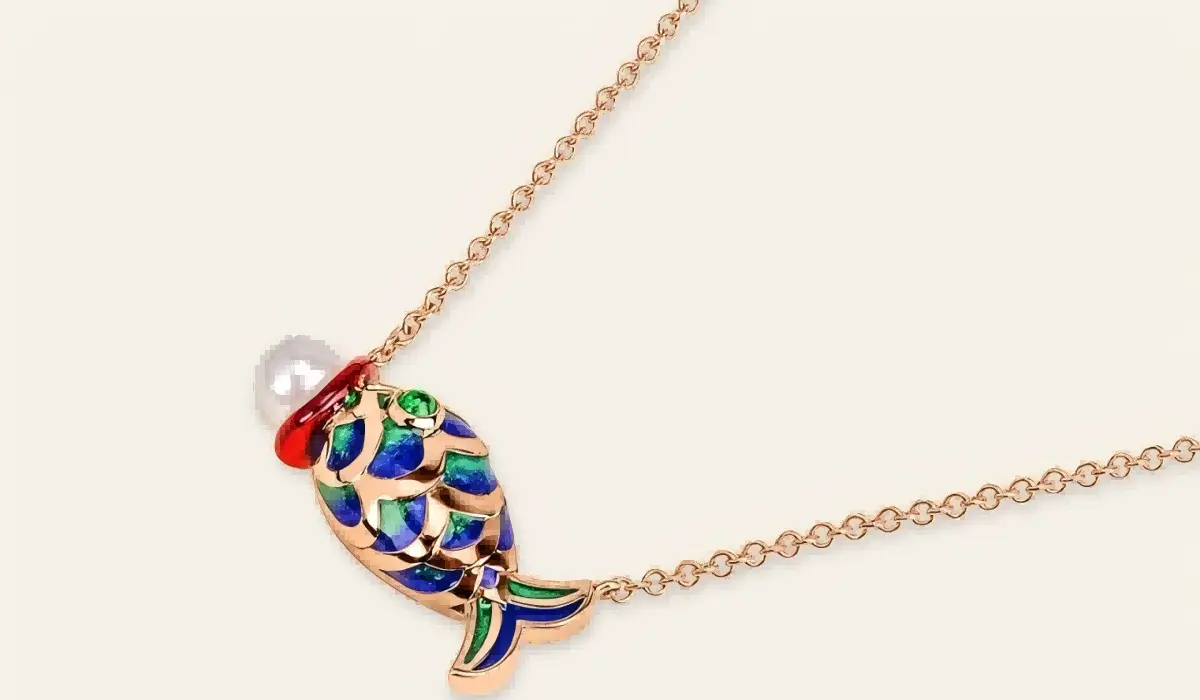
Life Force Vitality and Soul Attraction
The Yin Yang Koi is not just decoration; it is a tool for life force vitality. By keeping this symbol close to your skin, you invite the fluid energy of the koi to balance your own personal Qi. It is especially powerful for those seeking a romantic soulmate, as it attracts your "other half" through the frequency of dualistic harmony.
The Three Principles of Soul Attraction:
-
Frequency Resonance: The Yin-Yang balanced frequency of the koi attracts partners who also seek balance
-
Energy Imprinting: Long-term wearing of the koi talisman imprints a harmonious energy imprint on your aura
-
Synchronicity Triggering: The koi symbolizes synchronicity, helping you recognize "fated" encounters in your life
Pairing with Crystals
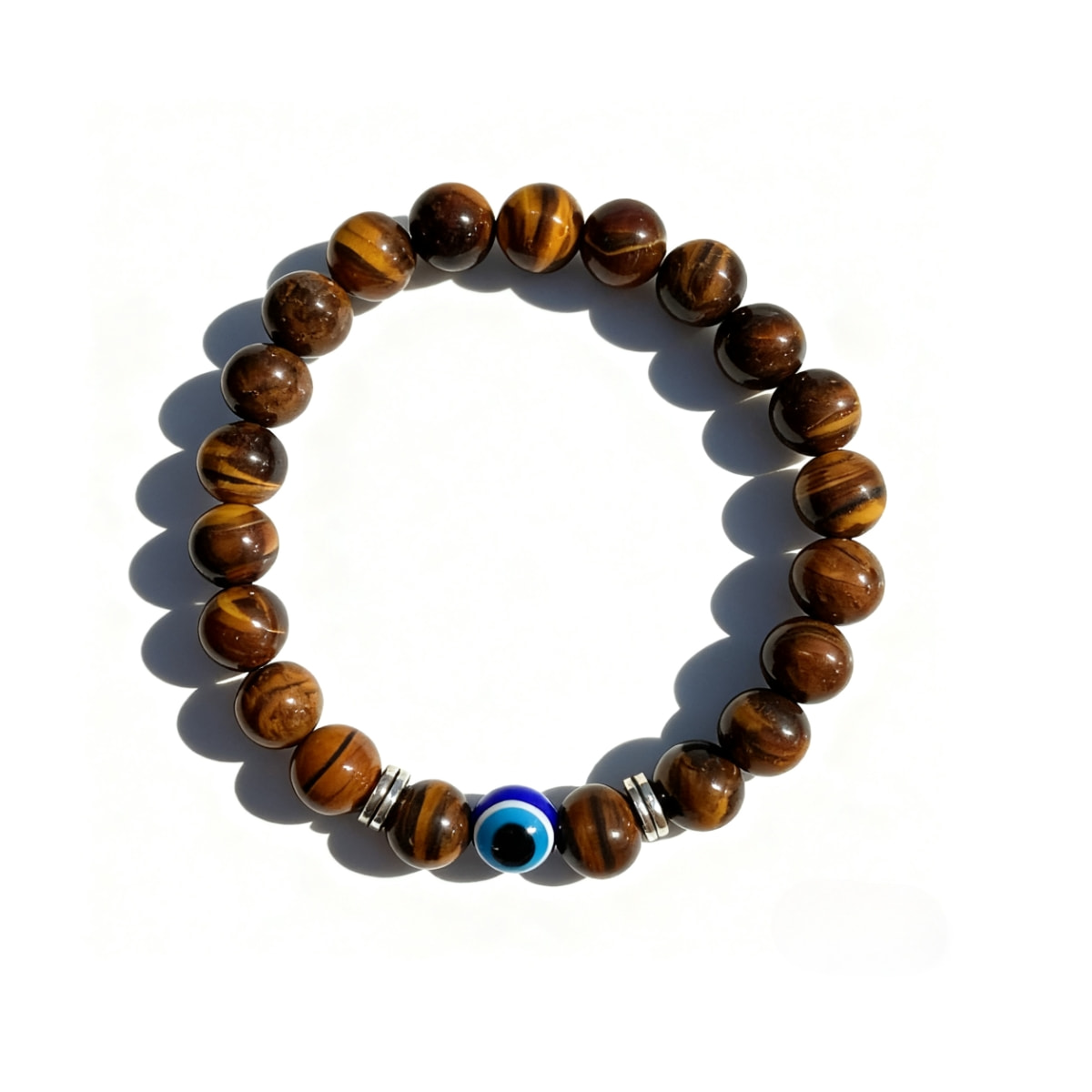
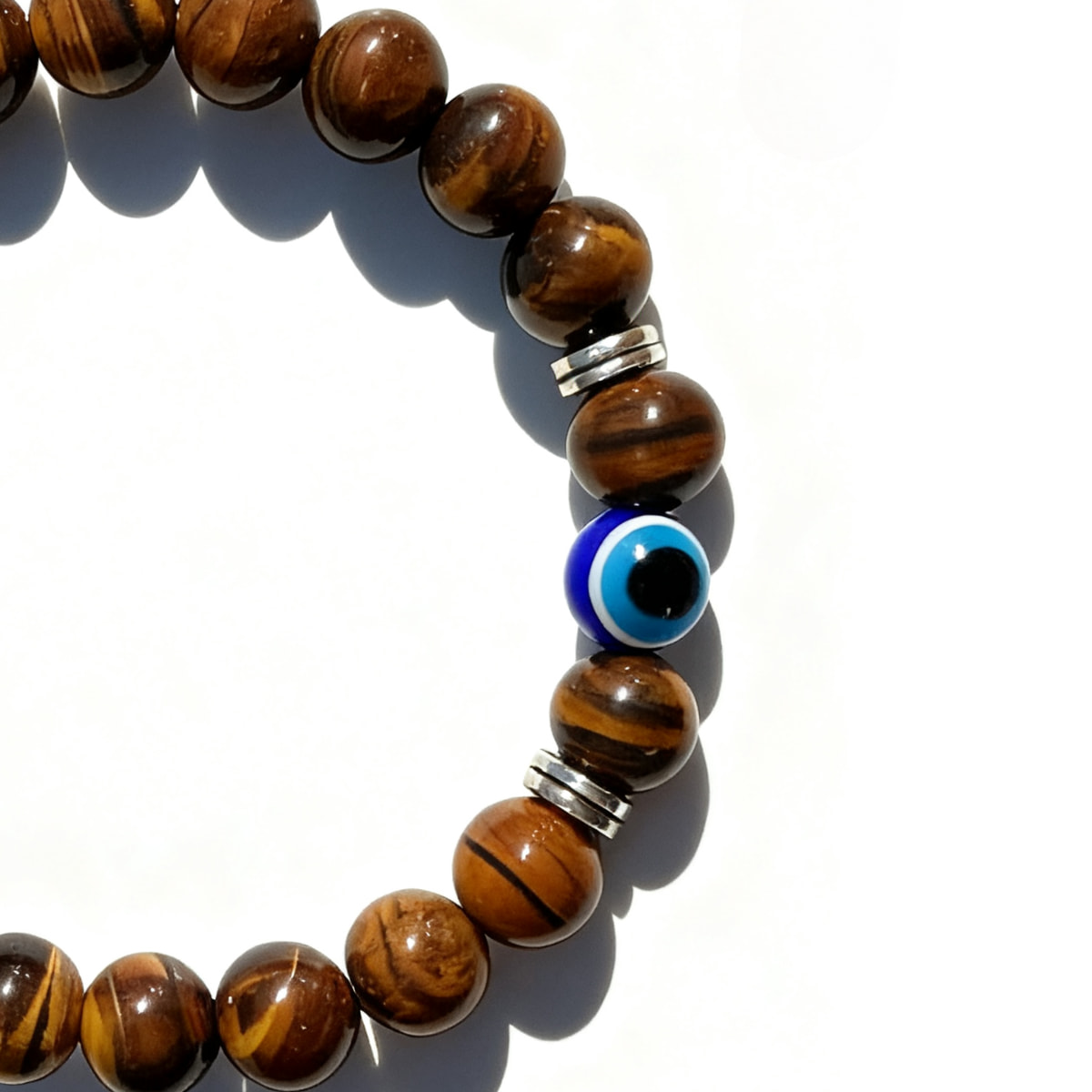
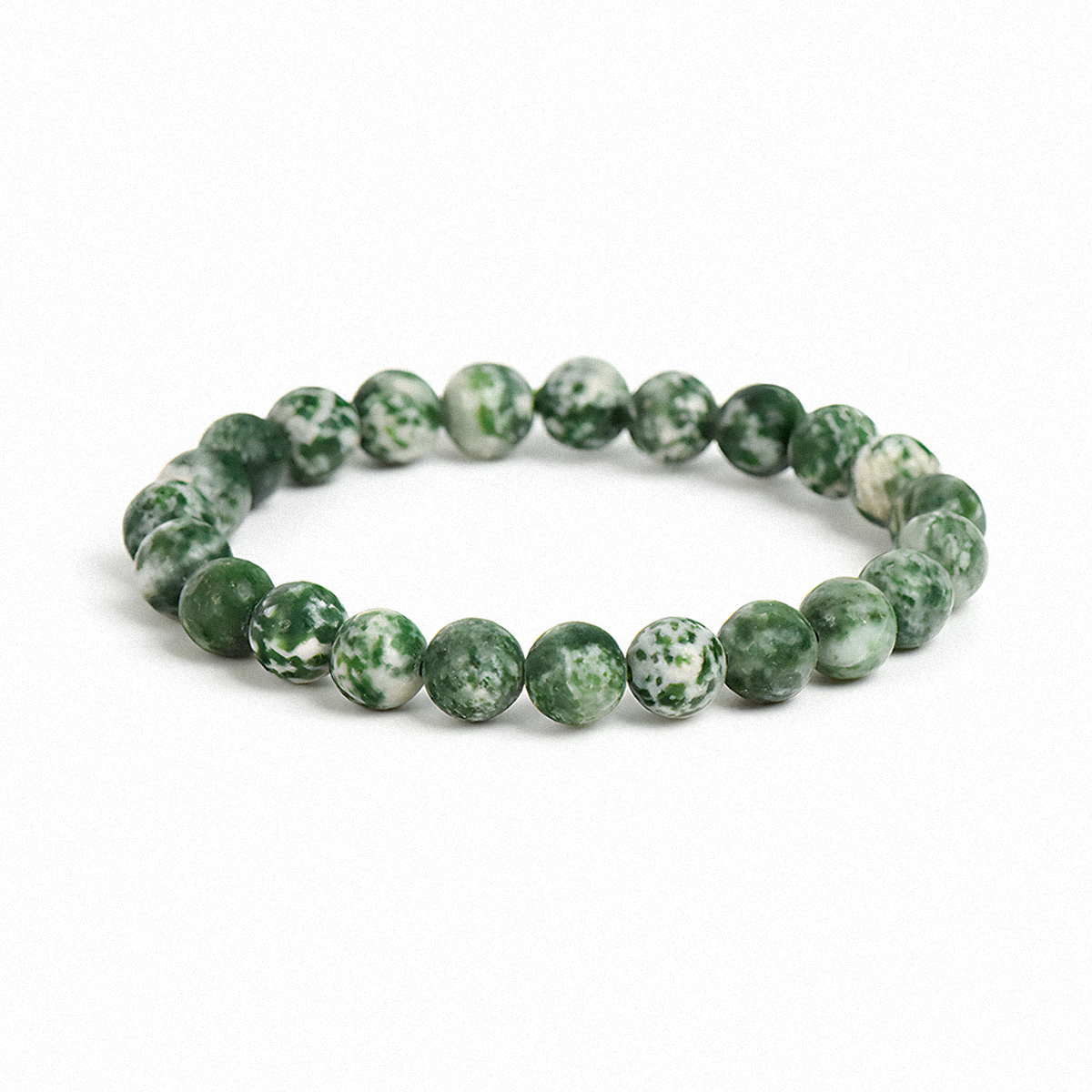
We often recommend pairing these symbols with specific crystals to amplify their power. Jade is excellent for auspicious abundance, while Black Obsidian offers grounding and protection. This combination turns a piece of jewelry into a functional tool for spiritual resilience.
Recommended Pairing Table:
| Crystal | Main Effect | Synergy with Koi | Recommended Wearing Position |
|---|---|---|---|
| Jade | Wealth, Longevity | Amplifies "abundance" frequency, accelerates wealth manifestation | Left wrist (receiving energy) |
| Black Obsidian | Protection, Negativity absorption | Shields positive flow, absorbs negative energy | Right wrist (projecting protection) |
| Amethyst | Spirituality, Calmness | Enhances meditation effects, boosts intuition | Neck area (near Third Eye) |
| Moonstone | Emotional balance | Resonates with Koi's "Yin-Yang" nature, stabilizes mood swings | Chest area (near Heart Chakra) |
| Citrine | Confidence, Creativity | Amplifies the koi's "leaping over the Dragon Gate" striving energy | Abdomen area (near Solar Plexus) |
| Rose Quartz | Love, Relationship Harmony | Strengthens the koi's "partner" energy, attracts love | Chest area (near Heart Chakra) |

Feng Shui Mastery: Placing Yin Yang Koi Art for Maximum Wealth Flow
Mindful Placement in Your Home Sanctuary
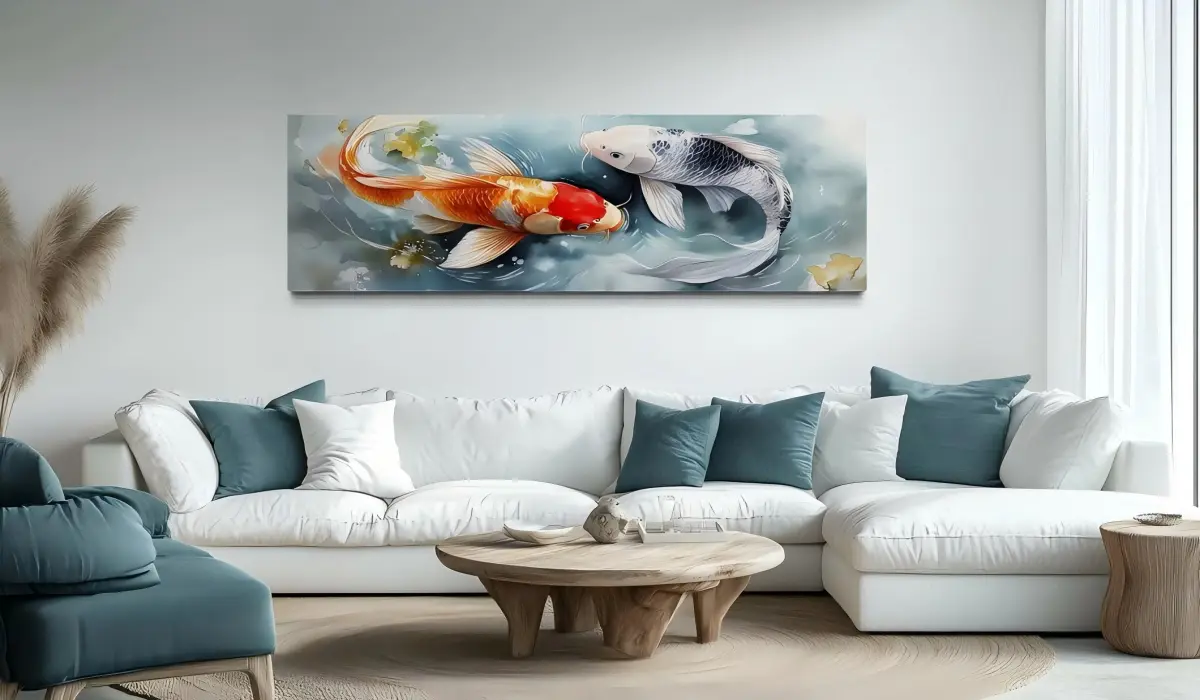
Proper mindful placement can change the entire feel of your home sanctuary. In Feng Shui, water symbols are traditionally used to boost the flow of money and opportunities. However, you must be careful about where you place these active images. For example, a Yin Yang Koi painting in the bedroom might cause restless sleep because the energy is too Yang (active) .
| Room | Suitability | Recommendations |
|---|---|---|
| Living Room | ★★★★★ | Best position, gathers positive energy of family and guests |
| Study/Office | ★★★★★ | Enhances career fortune and creativity |
| Dining Room | ★★★★ | Strengthens family harmony and sense of abundance |
| Entrance/Foyer | ★★★★ | Welcomes Qi energy into the home |
| Bedroom | ★★ | Use with caution, avoid overly "Yang" energy affecting sleep |
| Bathroom | ★ | Taboo — low energy and disrespectful |
| Kitchen | ★★ | Fire-Water conflict, needs balance consideration |
Directional Secrets: Southeast and North
TTo attract wealth manifestation, place your koi art in the Southeast sector of your home or near the front door. This encourages Qi energy flow to enter your life and stay there. For career growth, the North sector is the best choice.
2026 Flying Star Special Notes:
| Direction | 2026 Flying Star | Koi Placement Effect |
|---|---|---|
| Southeast | #8 White Left Assistant Star (Positive Wealth) | Excellent — wealth manifestation doubled |
| True North | #1 White Greedy Wolf Star (Windfall/Peach Blossom) | Excellent — opportunities and relationships both flourish |
| Southwest | #5 Yellow Unrelenting Star (Inauspicious) | Not recommended — may trigger health issues |
| True East | #2 Black Sick Star (Illness) | Not recommended — may affect health luck |
The Magic of the Number Nine
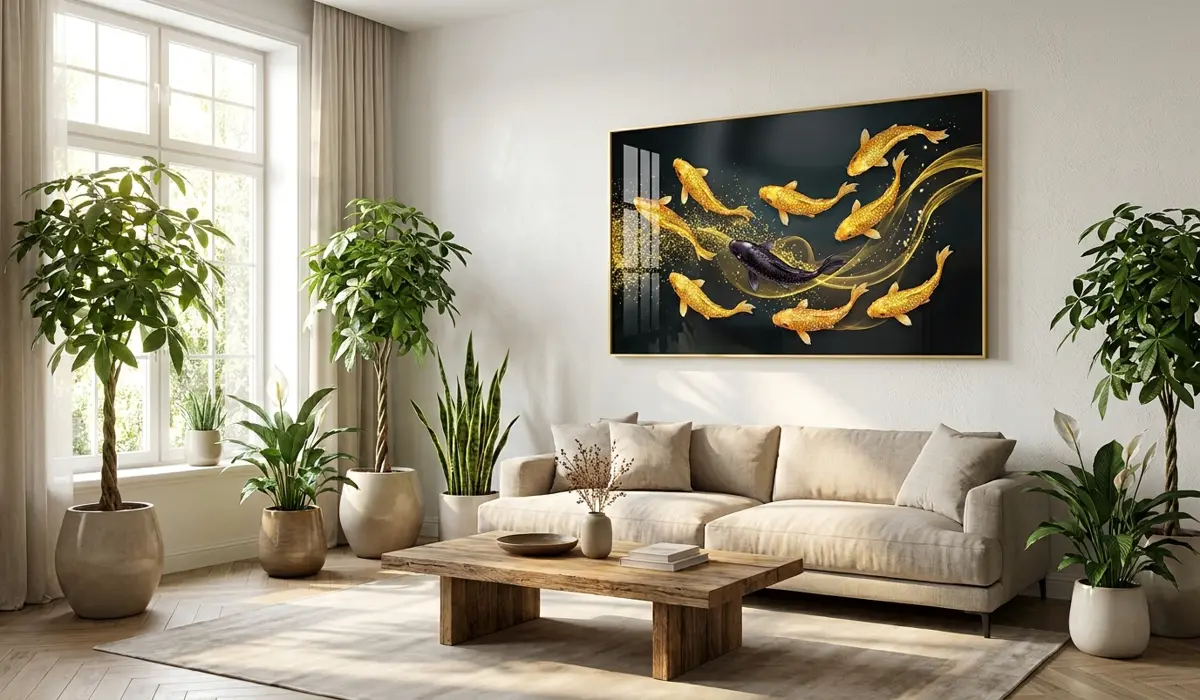
In many traditions, the number of fish you display is very important. A common Feng Shui setup uses nine koi fish, usually eight gold or red koi plus one black koi:
-
🐟 Eight gold or red koi: Attract prosperity and joy to the inhabitants
-
🐟 One black koi: Acts as a protector by absorbing negative energy or bad luck
-
🐟 Combination of nine fish: Creates a complete protection and growth cycle
⚠️ Common Taboos:
| Taboo | Reason | Solution |
|---|---|---|
| Placing koi art on the floor or in the bathroom | Low energy, disrespectful | Move to eye level or higher |
| Fish swimming toward windows or doors (not into the house) | Wealth flowing out | Rotate the frame direction |
| Clutter around koi artwork | Clutter blocks Qi flow | Keep the space tidy |
| Using damaged or faded koi images | Symbolizes decline, not prosperity | Replace with clear, intact artwork |
| Placing koi alongside inauspicious animals (snakes, eagles) | Energy conflict | Display separately or with auspicious companions |
By following these rules, you turn your living space into a magnet for positive vibes. It is a simple way to use sacred geometry to improve your daily life.
🔗 Advanced Learning: For more advanced placement tips, consult the Feng Shui Society experts or refer to Feng Shui Charts for annual advice.
Rituals and Practices: How to Meditate with the Yin Yang Koi
Zen Water Meditation
You can use the Yin Yang Koi symbol as a focus for your daily Zen water meditation. Start by sitting in a quiet place and visualizing two koi fish swimming in a slow, perfect circle. As you breathe in, imagine the light fish rising. As you breathe out, imagine the dark fish descending. This rhythmic pulsing helps to reset your emotional equilibrium.
Koi Journaling
Another great practice is journaling with the koi as a mirror for self-reflection:
-
"Upstream" Phase: Involves struggle and perseverance in adversity (like the koi swimming toward the waterfall).
📝 Journal prompt: "In which area of my life do I feel the most resistance right now? What is this 'upstream' trying to teach me?" -
"Downstream" Phase: About surrender and enjoying the Qi energy flow.
📝 Journal prompt: "Which area requires me to relax and trust? Can I go with the flow like the koi?"
In the Reddit r/CTsandbox community, user u/Melodic-Reporter5687 explores the creative power of these fish:
"Does anyone have any idea for the abilitys of 2 shikigami for my oc the shikigami are named yin and yang and are both giant koi fish"
*sources:[Shikigami ideas?](https://reddit.com/r/CTsandbox/comments/1skqvy0/shikigami_ideas/)*
This shows how the dual koi concept inspires modern storytelling and character building by using the balance of opposing powers.
Connecting with the Pisces Zodiac
For those born under the sign of Pisces, this meditation can be even more powerful. The Pisces zodiac connection naturally aligns with the energy of the dual fish. It helps those with sensitive spirits find spiritual resilience. If you are interested in how the stars influence your luck, visit World of Feng Shui for additional insights.
Pisces Customized Koi Meditation:
-
Neptune Connection: During meditation, imagine the koi swimming in silver moonlight, connecting to Neptune's spiritual energy
-
Pisces Symbol Alignment: Visualize the two koi swimming in the direction of the Pisces symbol — one upward, one downward, representing the balance between spirituality and materiality
-
Water Sign Enhancement: Use Pisces' natural empathy and intuition to deepen your emotional connection with the koi
Cultural Etiquette and Taboos: Respecting the Sacred Carp
Avoid Spiritual Bypassing
When using the Yin Yang Koi, it is important to respect its Taoist symbolism. This is not just a trend; it is a sacred part of history. Avoid "spiritual bypassing," which means using the symbol only for looks without understanding its depth. Treating the image with respect ensures that you stay aligned with its positive spiritual frequency.
Placement Taboos
One common taboo is placing Yin Yang Koi art on the floor or in a bathroom. These areas are seen as having "low" energy, which can disrespect the Celestial Dragon transformation. Always keep your koi symbols at eye level or higher. This honors the Legend of the Dragon Gate and the hard work the fish put in to achieve divinity.
Direction and Cleanliness
-
Always ensure that the fish in your art appear to be swimming "into" the house rather than "out" of it. If they are swimming toward a window or door, it symbolizes your wealth manifestation leaving your life. Correcting the direction helps keep the auspicious abundance inside.
-
We also suggest keeping the area around your koi art clean and clutter-free. Clutter blocks the Qi energy flow and makes the symbol less effective. A clean space allows the dualistic harmony of the fish to radiate throughout the entire room.
📋 Quick Checklist
Is the koi symbol at eye level or higher?
Are the fish swimming toward the interior of the room?
Is the surrounding area clean and clutter-free?
Have you cleansed it regularly with incense or salt water?
Video source:YouTube
author:Next Luxury
Original video link:https://www.youtube.com/watch?v=gqELOhXfAcM
Practical Steps to Integrate the Yin Yang Koi Wisdom
-
Set a daily intention: Touch your koi jewelry and visualize your Dragon Gate goal.
Example: "Today, like the koi, I move gently but firmly against the current." -
Workplace placement: Place a Yin Yang Koi image in your workspace to stay calm during digital burnout.
-
Breathing exercise: Practice a 5-minute breathing exercise while focusing on the circular path of the two fish.
-
Regular cleansing: Cleanse your koi charms with salt water or incense to keep their Qi fresh and active.
-
Monthly energy audit: Every new moon, reassess the placement and cleanliness of koi art in your home to ensure unobstructed energy flow.
-
Share with others: Share the story and meaning of Yin Yang Koi with a friend — teaching deepens your own understanding.
Frequently Asked Questions
Q: What is the deeper spiritual meaning of the Yin Yang Koi Fish beyond balance?
A: Beyond simple balance, it represents the soul's path to total transformation. It reminds us that through steady work and spirit, we can change from a humble fish into a powerful dragon. It is a symbol of the infinite growth we are all capable of achieving.
Q: Why does the Yin Yang Koi symbol promote emotional healing in 2026?
A: In a world full of high-speed tech and constant stress, the koi offers a return to natural rhythms. Its fluid movement helps soothe the mind and reduce the symptoms of digital burnout. It encourages us to find a center point where external chaos cannot touch our inner peace.
Q: What is the difference between red and black koi symbolism in Feng Shui?
A: Red or gold koi are usually associated with high energy, passion, and financial success. Black koi are symbols of protection and the ability to overcome obstacles. Together, they ensure that you are both gaining new things and keeping what you have safe.
Q: Does the number of fish in a Yin Yang design change its spiritual frequency?
A: Yes, the frequency shifts based on the numbers used. Two fish focus on the balance of partnerships and internal duality. Nine fish expand that energy into a "total completion" frequency, which is best for creating overall wealth and protection for a large group or family.
Q: Which direction should a Yin Yang Koi painting face to attract wealth?
A: For the best results, the painting should be placed on a Southeast wall. This area is known as the "Wealth Corner" in traditional practices. Ensure the fish are swimming toward the center of your room to pull the energy inward.
Conclusion: Integrating the Wisdom of the Yin Yang Koi
The Yin Yang Koi Fish is a timeless reminder that life is a beautiful, never-ending dance. By embracing both the light and the dark, we find the strength to swim against any current. We invite you to use this spiritual art to ground your energy and reach for your own version of the Dragon Gate. May your journey be filled with dualistic harmony and the courage of the Celestial Dragon.
In this age of uncertainty, the wisdom of the Yin Yang Koi is more precious than ever. It teaches us that true peace is not the absence of storms, but the ability to maintain balance amid the waves. Whether you are currently in an upstream or downstream phase, the koi reminds you — every stroke strengthens you, every journey brings you closer to your Dragon Gate.

Longyi Luck
Longyi Luck is a Feng Shui practitioner and spiritual researcher who blends traditional year-based wisdom with modern lifestyle insights, specializing in Feng Shui, spirituality, meditation, and mindfulness. With years of dedicated study and practice, Longyi explores cultural symbolism and the practical application of ancient wisdom to help individuals cultivate balance, clarity, and harmony in everyday life. Since 2020, Longyi has been committed to translating timeless traditions into accessible guidance for the modern world.
longyi@auraandluck.com
.webp?w=800&h=800)
.webp?w=800&h=800)